Which shows \(\frac{7}{8}\) decomposed correctly?
- \(\frac{4}{8}+\frac{3}{8}\)
- \(\frac{5}{8}+\frac{3}{8}\)
- \(\frac{6}{8}+\frac{2}{8}\)
- \(\frac{3}{8}+\frac{3}{8}\)


Students will decompose fractions in more than one way and justify each decomposition with models and equations.
Which shows \(\frac{7}{8}\) decomposed correctly?
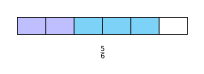
The fraction bar shows \(\frac{5}{6}\) divided into parts. Which equation shows this decomposition?
Which decomposition of \(\frac{9}{10}\) is correct?
\(\frac{5}{8}\) can be written as \(\frac{2}{8}+\frac{2}{8}+\frac{1}{8}\). Which other decomposition is correct?
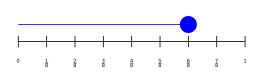
Here is a number line showing \(\frac{6}{8}\): Which shows one correct way to decompose this into two equal jumps?
\(\frac{4}{5}\) can be written as the sum of four unit fractions:
\(\frac{5}{4}\) is the same as \(1\frac{1}{4}\). Which shows this decomposition?
Mia has a string of length \(\frac{11}{12}\) yard. She cuts it into two pieces where one piece is \(\frac{6}{12}\) yard. Which shows this decomposition?
\(\frac{7}{8}\) can split apart. Let's check A: \(\frac{4}{8}+\frac{3}{8}\)—add the numerators: \(4+3=7\), so we get \(\frac{7}{8}\) \checkmark. Perfect!
Look at the bar—the light blue section is \(\frac{2}{6}\) and the dark blue is \(\frac{3}{6}\). Add them: \(2+3=5\), so \(\frac{2}{6}+\frac{3}{6}=\frac{5}{6}\) \checkmark.
When the denominators match, add the numerators! \(4+5=9\), so we get \(\frac{4}{10}+\frac{5}{10}=\frac{9}{10}\) \checkmark.
Let's verify A: \(1+1+3=5\), so \(\frac{1}{8}+\frac{1}{8}+\frac{3}{8}=\frac{5}{8}\) \checkmark. This breaks \(\frac{5}{8}\) into three parts!
Two equal jumps of \(\frac{3}{8}\) each: \(3+3=6\), so \(\frac{3}{8}+\frac{3}{8}=\frac{6}{8}\) \checkmark. Both parts are the same!
A unit fraction always has a numerator of 1. Four copies of \(\frac{1}{5}\): \(1+1+1+1=4\), giving us \(\frac{4}{5}\) \checkmark.
\(\frac{4}{4}\) is one whole, and \(\frac{1}{4}\) more makes \(1\frac{1}{4}\). Add: \(4+1=5\), so \(\frac{4}{4}+\frac{1}{4}=\frac{5}{4}\) \checkmark.
Mia's string is \(\frac{11}{12}\) long. One piece is \(\frac{6}{12}\), so the other must be \(\frac{11}{12}-\frac{6}{12}=\frac{5}{12}\). Check: \(6+5=11\) \checkmark.
