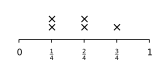
Look at the line plot of seed lengths (in inches). How many X marks are above \(\frac{2}{4}\) inch?
- \(1\)
- \(2\)
- \(3\)
- \(5\)


Students will create and interpret line plots containing fractional measurement data.
Look at the line plot of seed lengths (in inches). How many X marks are above \(\frac{2}{4}\) inch?
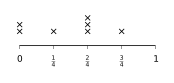
Look at the line plot showing pencil lengths (in inches): How many pencils measured \(\frac{2}{4}\) inch?
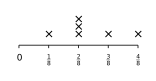
Look at the line plot of plant growth measurements (in inches). How many X marks are above \(\frac{2}{8}\) inch?
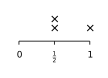
Look at the line plot of measurements in halves of an inch. How many X marks are above \(\frac{1}{2}\) inch?
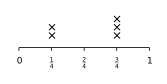
Look at the line plot of ribbon lengths in fourths of an inch. Which length has the most X marks?
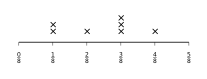
Here is a line plot showing sticker lengths (in inches): What is the difference in inches between the longest and shortest stickers?
Students recorded the thickness of books using fourths of an inch. The data are: \(\frac{2}{4}\), \(\frac{3}{4}\), \(\frac{2}{4}\), \(\frac{2}{4}\). If you plot this data, how many X marks will be above \(\frac{2}{4}\)?
A baker measured flour scoops in eighths of a cup. The measurements are: \(\frac{2}{8}\), \(\frac{3}{8}\), \(\frac{2}{8}\), \(\frac{4}{8}\), \(\frac{3}{8}\), \(\frac{3}{8}\). Which measurement appears most often?
On the line plot, count the X marks stacked above \(\frac{2}{4}\) inch. There are exactly \(\mathbf{2}\) X marks at that position.
Look at the line plot where \(\frac{2}{4}\) inch is marked. Count the X marks stacked above that tick: we see \(\mathbf{3}\) marks.
On the line plot, count the X marks stacked above \(\frac{2}{8}\) inch. There are \(\mathbf{3}\) X marks.
On the line plot, count the X marks stacked above \(\frac{1}{2}\) inch. There are exactly \(\mathbf{2}\) X marks.
On the line plot, \(\frac{1}{4}\) inch has \(2\) X marks, while \(\frac{3}{4}\) inch has \(3\) X marks. So \(\mathbf{\frac{3}{4}}\) inch has the most.
The shortest sticker is at \(\frac{1}{8}\) inch and the longest is at \(\frac{4}{8}\) inch. The difference is \(\frac{4}{8} - \frac{1}{8} = \mathbf{\frac{3}{8}}\) inch.
We count the measurement \(\frac{2}{4}\) inch in the data: it appears \(3\) times. So there are \(\mathbf{3}\) X marks above it.
Let us count: \(\frac{2}{8}\) cup appears \(2\) times, \(\frac{3}{8}\) cup appears \(3\) times, and \(\frac{4}{8}\) cup appears \(1\) time. So \(\mathbf{\frac{3}{8}}\) cup is the most common.
