CH07-04 lesson

Line Plots with Fractions Learning Activity

A focused Grade 4 learning session for Line Plots with Fractions using visual models, worked examples, strategy guidance, and a short mastery check.

15
minutes
6
lesson parts
11
practice items
Learning goal

Students will create and interpret line plots containing fractional measurement data.

Student goal: I can use a line plot to represent and solve problems with fractional data.

Helpful first: Comparing Fractions
concept

Learn the Idea

Line Plots with Fractions means using equal parts, number lines, and clear fraction language to describe parts of a whole.

  • Identify the whole before naming a fraction.
  • Make sure each part is equal in size.
  • Use a number line or model to show where the fraction belongs.
  • Explain whether two fractions have the same size or different sizes.
visual model

See the Math

Visual Model 1

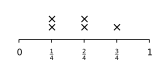
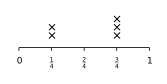
Question: Look at the line plot of seed lengths (in inches). How many X marks are above \(\frac{2}{4}\) inch?

Visual Model 1

  • A. \(1\)
  • B. \(2\)
  • C. \(3\)
  • D. \(5\)

Why it works: On the line plot, count the X marks stacked above \(\frac{2}{4}\) inch. There are exactly \(\mathbf{2}\) X marks at that position.

Answer: \(2\)

worked example

Follow a Worked Example

Example 1

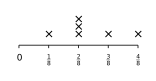
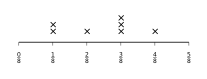
Question: Look at the line plot of plant growth measurements (in inches). How many X marks are above \(\frac{2}{8}\) inch?

Example 1

  • A. \(1\)
  • B. \(2\)
  • C. \(3\)
  • D. \(4\)
  1. On the line plot, count the X marks stacked above \(\frac{2}{8}\) inch.
  2. There are \(\mathbf{3}\) X marks.

Answer: \(3\)

Example 2

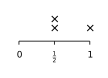
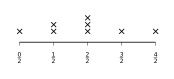
Question: Look at the line plot of measurements in halves of an inch. How many X marks are above \(\frac{1}{2}\) inch?

Example 2

  • A. \(1\)
  • B. \(2\)
  • C. \(3\)
  • D. \(4\)
  1. On the line plot, count the X marks stacked above \(\frac{1}{2}\) inch.
  2. There are exactly \(\mathbf{2}\) X marks.

Answer: \(2\)

real world

Connect It to a Real Situation

Problem 1

Question: Here is a line plot showing sticker lengths (in inches): What is the difference in inches between the longest and shortest stickers?

Problem 1

  • A. \(\frac{1}{8}\) inch
  • B. \(\frac{2}{8}\) inch
  • C. \(\frac{3}{8}\) inch
  • D. \(\frac{4}{8}\) inch

Why it works: The shortest sticker is at \(\frac{1}{8}\) inch and the longest is at \(\frac{4}{8}\) inch. The difference is \(\frac{4}{8} - \frac{1}{8} = \mathbf{\frac{3}{8}}\) inch.

Answer: \(\frac{3}{8}\) inch

strategy

Avoid Mistakes and Choose a Strategy

  • Counting unequal parts as if they were equal.
  • Forgetting that the denominator tells how many equal parts make the whole.
  • Comparing fractions without first checking the size of the whole.
  • Placing a fraction on a number line without counting equal intervals.
  • Draw the whole first, then divide it into equal parts.
  • Use number lines when the question asks about order or location.
  • Say the fraction out loud to connect numerator and denominator meanings.
  • Check whether the answer should be closer to 0, 1/2, or 1.
summary

Remember the Key Idea

Line Plots with Fractions becomes easier when students connect the question to a model, use clear steps, and explain why the answer fits.

GOLDEN RULE

Equal parts first, fraction name second.

Guided to independent practice

Solve before opening the answer

Use scratch paper. The explanation matters more than simply seeing whether the choice is correct.

warmup

2 questions
G4-C07-T04-Q001 About 1 min

Look at the line plot of seed lengths (in inches). How many X marks are above \(\frac{2}{4}\) inch?

Line Plots with Fractions visual for G4-C07-T04-Q001
  1. A \(1\)
  2. B \(2\)
  3. C \(3\)
  4. D \(5\)
Check answer and explanation

Answer B: \(2\)

On the line plot, count the X marks stacked above \(\frac{2}{4}\) inch. There are exactly \(\mathbf{2}\) X marks at that position.

G4-C07-T04-Q002 About 1 min

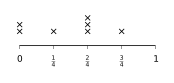
Look at the line plot showing pencil lengths (in inches): How many pencils measured \(\frac{2}{4}\) inch?

Line Plots with Fractions visual for G4-C07-T04-Q002
  1. A \(1\)
  2. B \(2\)
  3. C \(3\)
  4. D \(4\)
Check answer and explanation

Answer C: \(3\)

Look at the line plot where \(\frac{2}{4}\) inch is marked. Count the X marks stacked above that tick: we see \(\mathbf{3}\) marks.

guided

1 question
G4-C07-T04-Q003 About 1 min

Look at the line plot of plant growth measurements (in inches). How many X marks are above \(\frac{2}{8}\) inch?

Line Plots with Fractions visual for G4-C07-T04-Q003
  1. A \(1\)
  2. B \(2\)
  3. C \(3\)
  4. D \(4\)
Check answer and explanation

Answer C: \(3\)

On the line plot, count the X marks stacked above \(\frac{2}{8}\) inch. There are \(\mathbf{3}\) X marks.

practice

5 questions
G4-C07-T04-Q004 About 1 min

Look at the line plot of measurements in halves of an inch. How many X marks are above \(\frac{1}{2}\) inch?

Line Plots with Fractions visual for G4-C07-T04-Q004
  1. A \(1\)
  2. B \(2\)
  3. C \(3\)
  4. D \(4\)
Check answer and explanation

Answer B: \(2\)

On the line plot, count the X marks stacked above \(\frac{1}{2}\) inch. There are exactly \(\mathbf{2}\) X marks.

G4-C07-T04-Q005 About 1 min

Look at the line plot of ribbon lengths in fourths of an inch. Which length has the most X marks?

Line Plots with Fractions visual for G4-C07-T04-Q005
  1. A \(\frac{1}{4}\) inch
  2. B \(\frac{1}{2}\) inch
  3. C \(\frac{3}{4}\) inch
  4. D \(1\) inch
Check answer and explanation

Answer C: \(\frac{3}{4}\) inch

On the line plot, \(\frac{1}{4}\) inch has \(2\) X marks, while \(\frac{3}{4}\) inch has \(3\) X marks. So \(\mathbf{\frac{3}{4}}\) inch has the most.

G4-C07-T04-Q006 About 1 min

Here is a line plot showing sticker lengths (in inches): What is the difference in inches between the longest and shortest stickers?

Line Plots with Fractions visual for G4-C07-T04-Q006
  1. A \(\frac{1}{8}\) inch
  2. B \(\frac{2}{8}\) inch
  3. C \(\frac{3}{8}\) inch
  4. D \(\frac{4}{8}\) inch
Check answer and explanation

Answer C: \(\frac{3}{8}\) inch

The shortest sticker is at \(\frac{1}{8}\) inch and the longest is at \(\frac{4}{8}\) inch. The difference is \(\frac{4}{8} - \frac{1}{8} = \mathbf{\frac{3}{8}}\) inch.

G4-C07-T04-Q007 About 1 min

Students recorded the thickness of books using fourths of an inch. The data are: \(\frac{2}{4}\), \(\frac{3}{4}\), \(\frac{2}{4}\), \(\frac{2}{4}\). If you plot this data, how many X marks will be above \(\frac{2}{4}\)?

  1. A \(1\)
  2. B \(2\)
  3. C \(3\)
  4. D \(4\)
Check answer and explanation

Answer C: \(3\)

We count the measurement \(\frac{2}{4}\) inch in the data: it appears \(3\) times. So there are \(\mathbf{3}\) X marks above it.

G4-C07-T04-Q008 About 1 min

Look at the line plot with measurements in halves: How many data points are shown on this line plot?

Line Plots with Fractions visual for G4-C07-T04-Q008
  1. A \(4\)
  2. B \(6\)
  3. C \(8\)
  4. D \(10\)
Check answer and explanation

Answer C: \(8\)

Count all the X marks across the entire line plot: \(1 + 2 + 3 + 1 + 1 = \mathbf{8}\) data points in total.

exit

3 questions
G4-C07-T04-Q009 About 1 min

A baker measured flour scoops in eighths of a cup. The measurements are: \(\frac{2}{8}\), \(\frac{3}{8}\), \(\frac{2}{8}\), \(\frac{4}{8}\), \(\frac{3}{8}\), \(\frac{3}{8}\). Which measurement appears most often?

  1. A \(\frac{2}{8}\) cup
  2. B \(\frac{3}{8}\) cup
  3. C \(\frac{4}{8}\) cup
  4. D \(\frac{5}{8}\) cup
Check answer and explanation

Answer B: \(\frac{3}{8}\) cup

Let us count: \(\frac{2}{8}\) cup appears \(2\) times, \(\frac{3}{8}\) cup appears \(3\) times, and \(\frac{4}{8}\) cup appears \(1\) time. So \(\mathbf{\frac{3}{8}}\) cup is the most common.

G4-C07-T04-Q010 About 1 min

On a line plot showing string lengths in fourths, there are \(2\) X marks at \(\frac{1}{4}\) inch, \(3\) X marks at \(\frac{2}{4}\) inch, and \(1\) X mark at \(\frac{3}{4}\) inch. What is the total number of strings?

  1. A \(4\)
  2. B \(5\)
  3. C \(6\)
  4. D \(7\)
Check answer and explanation

Answer C: \(6\)

Add up all the X marks: \(2 + 3 + 1 = \mathbf{6}\) strings in total.

G4-C07-T04-Q011 About 1 min

A line plot shows leaf lengths in halves of an inch: \(\frac{1}{2}\), \(\frac{1}{2}\), \(1\), \(\frac{1}{2}\), \(1\), \(1\). How many leaves measured \(1\) inch?

  1. A \(1\)
  2. B \(2\)
  3. C \(3\)
  4. D \(4\)
Check answer and explanation

Answer C: \(3\)

Count how many leaves measured \(1\) inch (which is the same as \(\frac{2}{2}\) inch). We find \(\mathbf{3}\) leaves with this length.

Page UP