
CH07-02 lesson

Measurement Word Problems Learning Activity

A focused Grade 4 learning session for Measurement Word Problems using visual models, worked examples, strategy guidance, and a short mastery check.

18
minutes
6
lesson parts
11
practice items
Learning goal

Students will solve multistep measurement word problems involving distance, time, volume, mass, and money.

Student goal: I can solve a measurement word problem and label my answer with the correct unit.

concept

Learn the Idea

Measurement Word Problems means choosing a model, naming what each number means, and explaining the strategy.

  • Read the question carefully and identify what is being asked.
  • Choose a model, equation, table, or diagram that matches the situation.
  • Solve one step at a time and keep units or labels attached.
  • Use the answer explanation to check that the result makes sense.
visual model

See the Math

Visual Model 1

Question: A basketball game starts at \(6{:}00\) p.m. and ends at \(8{:}30\) p.m. How long is the game?

StartEnd
\(6{:}00\) p.m.\(8{:}30\) p.m.
  • A. \(1\) hour
  • B. \(2\) hours
  • C. \(2\) hours \(30\) minutes
  • D. \(3\) hours

Why it works: The game starts at 6:00 p.m. and ends at 8:30 p.m. From 6:00 to 8:00 is 2 hours, plus 30 more minutes. Total: \(2\) hours \(30\) minutes. The game is \(\mathbf{2}\) hours \(\mathbf{30}\) minutes long.

Answer: \(2\) hours \(30\) minutes

worked example

Follow a Worked Example

Example 1

Question: A number line shows distances in kilometers. A walker travels from 0 km to 7 km in the morning, then 5 km more in the afternoon. What is the final distance from the start?

Example 1

  • A. \(2\) km
  • B. \(7\) km
  • C. \(12\) km
  • D. \(14\) km
  1. The number line shows the walker goes 7 km in the morning and 5 km in the afternoon.
  2. Add: \(7 + 5 = 12\) km.
  3. The final distance is \(\mathbf{12}\) kilometers.

Answer: \(12\) km

Example 2

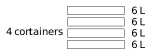
Question: A bar model shows 4 equal bars representing containers of milk, each holding \(6\) liters. How many liters in total?

Example 2

  • A. \(10\) L
  • B. \(16\) L
  • C. \(24\) L
  • D. \(30\) L
  1. The bar model shows 4 containers, each holding 6 liters.
  2. Multiply: \(4 \times 6 = 24\) liters.
  3. The total is \(\mathbf{24}\) liters.

Answer: \(24\) L

real world

Connect It to a Real Situation

Problem 1

Question: Sam has \(5\) liters of juice. He uses \(2\) liters to make punch. How many liters of juice does he have left?

  • A. \(2\) L
  • B. \(3\) L
  • C. \(5\) L
  • D. \(7\) L

Why it works: Sam starts with 5 liters and uses 2 liters for punch. Subtract to find what's left: \(5 - 2 = 3\) liters. He has \(\mathbf{3}\) liters remaining.

Answer: \(3\) L

strategy

Avoid Mistakes and Choose a Strategy

  • Rushing before identifying what the numbers represent.
  • Choosing an operation that does not match the situation.
  • Dropping labels, units, or context from the answer.
  • Skipping the estimate or reasonableness check.
  • Underline the question being asked.
  • Use a model before jumping to computation.
  • Write an equation that matches the story or picture.
  • Explain the final answer in a sentence.
summary

Remember the Key Idea

Measurement Word Problems becomes easier when students connect the question to a model, use clear steps, and explain why the answer fits.

GOLDEN RULE

Understand the model before choosing the operation.

Guided to independent practice

Solve before opening the answer

Use scratch paper. The explanation matters more than simply seeing whether the choice is correct.

warmup

2 questions
G4-C07-T02-Q001 About 1 min

A race track is \(400\) meters long. If Maria runs around it \(3\) times, how many meters does she run in total?

  1. A \(400\) m
  2. B \(800\) m
  3. C \(1{,}200\) m
  4. D \(1{,}500\) m
Check answer and explanation

Answer C: \(1{,}200\) m

Maria runs one lap of 400 meters three times. Multiply to find the total: \(3 \times 400 = 1{,}200\) meters. That's \(\mathbf{1{,}200}\) meters in all!

G4-C07-T02-Q002 About 1 min

Sam has \(5\) liters of juice. He uses \(2\) liters to make punch. How many liters of juice does he have left?

  1. A \(2\) L
  2. B \(3\) L
  3. C \(5\) L
  4. D \(7\) L
Check answer and explanation

Answer B: \(3\) L

Sam starts with 5 liters and uses 2 liters for punch. Subtract to find what's left: \(5 - 2 = 3\) liters. He has \(\mathbf{3}\) liters remaining.

guided

1 question
G4-C07-T02-Q003 About 1 min

Ava's pencil is \(19\) centimeters long. Diego's pencil is \(24\) centimeters long. What is the difference in length?

  1. A \(5\) cm
  2. B \(7\) cm
  3. C \(43\) cm
  4. D \(19\) cm
Check answer and explanation

Answer A: \(5\) cm

Diego's pencil is 24 cm and Ava's is 19 cm. Find the difference by subtracting: \(24 - 19 = 5\) cm. The difference is \(\mathbf{5}\) centimeters.

practice

5 questions
G4-C07-T02-Q004 About 1 min

Mia weighs \(42\) pounds. Her dog weighs \(18\) pounds. How much more does Mia weigh than her dog?

  1. A \(24\) pounds
  2. B \(60\) pounds
  3. C \(18\) pounds
  4. D \(42\) pounds
Check answer and explanation

Answer A: \(24\) pounds

Mia weighs 42 pounds and her dog weighs 18 pounds. Subtract to compare: \(42 - 18 = 24\) pounds. Mia weighs \(\mathbf{24}\) pounds more.

G4-C07-T02-Q005 About 1 min

Noah buys \(3\) bottles of water, each containing \(500\) milliliters. How many milliliters of water does he buy in total?

  1. A \(500\) mL
  2. B \(1{,}000\) mL
  3. C \(1{,}500\) mL
  4. D \(2{,}000\) mL
Check answer and explanation

Answer C: \(1{,}500\) mL

Noah buys 3 bottles, each holding 500 mL. Multiply: \(3 \times 500 = 1{,}500\) mL. He buys \(\mathbf{1{,}500}\) milliliters in total.

G4-C07-T02-Q006 About 1 min

A recipe calls for \(8\) cups of flour. If the baker wants to make \(4\) batches, how many cups of flour are needed?

  1. A \(12\) cups
  2. B \(24\) cups
  3. C \(32\) cups
  4. D \(36\) cups
Check answer and explanation

Answer C: \(32\) cups

One batch needs 8 cups of flour. For 4 batches, multiply: \(8 \times 4 = 32\) cups. The baker needs \(\mathbf{32}\) cups of flour.

G4-C07-T02-Q007 About 1 min

During lunch, the cafeteria used \(6\) gallons of milk on Monday and \(8\) gallons on Tuesday. How many gallons did they use in total?

  1. A \(2\) gallons
  2. B \(8\) gallons
  3. C \(14\) gallons
  4. D \(48\) gallons
Check answer and explanation

Answer C: \(14\) gallons

The cafeteria used 6 gallons on Monday and 8 gallons on Tuesday. Add them: \(6 + 8 = 14\) gallons. They used \(\mathbf{14}\) gallons in total.

G4-C07-T02-Q008 About 1 min

Ethan has \($35\) and spends \($12\) on a book. How much money does he have left?

  1. A \($12\)
  2. B \($23\)
  3. C \($47\)
  4. D \($35\)
Check answer and explanation

Answer B: \($23\)

Ethan has $35 and spends $12 on a book. Subtract: \(35 - 12 = 23\) dollars. He has \(\mathbf{$23}\) left.

exit

3 questions
G4-C07-T02-Q009 About 1 min

A container holds \(2\) kilograms of rice. How much rice is in \(7\) identical containers?

  1. A \(5\) kg
  2. B \(9\) kg
  3. C \(14\) kg
  4. D \(12\) kg
Check answer and explanation

Answer C: \(14\) kg

Each container holds 2 kilograms of rice. With 7 containers, multiply: \(2 \times 7 = 14\) kg. The total is \(\mathbf{14}\) kilograms.

G4-C07-T02-Q010 About 1 min

Sophia reads for \(15\) minutes in the morning and \(20\) minutes in the evening. How many minutes does she read in total each day?

  1. A \(5\) minutes
  2. B \(25\) minutes
  3. C \(35\) minutes
  4. D \(300\) minutes
Check answer and explanation

Answer C: \(35\) minutes

Sophia reads 15 minutes in the morning and 20 minutes in the evening. Add: \(15 + 20 = 35\) minutes. She reads \(\mathbf{35}\) minutes each day.

G4-C07-T02-Q011 About 1 min

A rope is \(48\) inches long. If it is cut into \(6\) equal pieces, how long is each piece?

  1. A \(6\) inches
  2. B \(8\) inches
  3. C \(42\) inches
  4. D \(54\) inches
Check answer and explanation

Answer B: \(8\) inches

A 48-inch rope is cut into 6 equal pieces. Divide: \(48 \div 6 = 8\) inches. Each piece is \(\mathbf{8}\) inches long.

Page UP