Visual Model 1
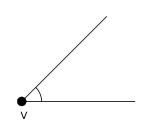
Question: What is labeled with the letter \(V\) in the diagram above?

- A. A ray
- B. The vertex
- C. The arc
- D. A side
Why it works: Point \(V\) marks the \(\mathbf{\text{vertex}}\)---the point where the two rays meet.
Answer: The vertex


A focused Grade 4 learning session for Angles as Geometric Shapes using visual models, worked examples, strategy guidance, and a short mastery check.
Student goal: I can identify an angle and explain how it is formed.
Angles as Geometric Shapes means looking at attributes such as sides, angles, equal parts, and shape categories.
Question: What is labeled with the letter \(V\) in the diagram above?
Why it works: Point \(V\) marks the \(\mathbf{\text{vertex}}\)---the point where the two rays meet.
Answer: The vertex
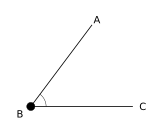
Question: The angle below is named \(\angle ABC\). Where is point \(B\)?

Answer: At the vertex
Question: The diagram shows an angle with a small opening. Which type of angle is this?

Answer: acute
Question: Which pair of items from a classroom has right angles?
Why it works: Desks and books have rectangular corners, which are \(\mathbf{\text{right}}\) angles.
Answer: A desk and a book
Angles as Geometric Shapes becomes easier when students connect the question to a model, use clear steps, and explain why the answer fits.
Attributes prove the shape name.
Use scratch paper. The explanation matters more than simply seeing whether the choice is correct.
An angle is formed wherever two rays share a common:
Answer B: endpoint
An angle is formed by two rays that share a common endpoint, called the \(\mathbf{\text{vertex}}\).
Which part of an angle is the point where the two rays meet?
Answer B: The vertex
The \(\mathbf{\text{vertex}}\) is the point where the two rays of an angle meet.
How many rays make up an angle?
Answer B: 2
An angle always has exactly \(\mathbf{2}\) rays that start at a common endpoint.
The sides of an angle are:
Answer C: rays
The two rays forming an angle are called the \(\mathbf{\text{sides}}\) (or rays) of the angle.
What is labeled with the letter \(V\) in the diagram above?
Answer B: The vertex
Point \(V\) marks the \(\mathbf{\text{vertex}}\)---the point where the two rays meet.
The space inside an angle is called:
Answer C: the interior
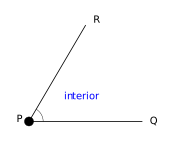
The \(\mathbf{\text{interior}}\) of an angle is the space inside, between the two rays.
The space outside an angle is called:
Answer B: the exterior
The \(\mathbf{\text{exterior}}\) of an angle is all the space outside the angle.
When naming an angle, what do we put in the middle?
Answer B: The vertex
When naming an angle with three letters, the \(\mathbf{\text{vertex}}\) is always the middle letter, like \(\angle ABC\).
Which part of the angle is labeled blue?
Answer C: The interior
The blue-labeled region is the \(\mathbf{\text{interior}}\), the space between the two rays.
Look at this angle diagram. If point \(M\) is the vertex, what are the two rays called?
Answer C: Sides (or rays)
The two rays forming an angle are called the \(\mathbf{\text{sides}}\) of the angle.
The angle below is named \(\angle ABC\). Where is point \(B\)?
Answer B: At the vertex
In \(\angle ABC\), point \(B\) is the \(\mathbf{\text{vertex}}\) because it's the middle letter.
