




Introduction
Angles as Geometric Shapes is an important Grade 4 math skill because students are moving from simple answers toward explaining how the math works.
In this lesson, students use models, real questions, worked examples, practice problems, and two online quizzes to build confidence with angles as geometric shapes.
What Is Angles as Geometric Shapes?
Angles as Geometric Shapes means looking at attributes such as sides, angles, equal parts, and shape categories.
The goal is not only to get the answer. Students should be able to show the idea, explain the strategy, and check whether the answer makes sense.
Understanding Angles as Geometric Shapes
Before solving, students should slow down and decide what each number, shape, unit, or label represents.
- Look for attributes such as side count, equal sides, angles, and parallel sides.
- Classify shapes using evidence instead of only how the shape looks.
- Remember that one shape can belong to more than one category.
- Use drawings to test whether the attributes really match the name.
Visual Models
Visual Model 1
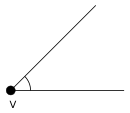
Question: What is labeled with the letter \(V\) in the diagram above?
- A. A ray
- B. The vertex
- C. The arc
- D. A side
Why it works: Point \(V\) marks the \(\mathbf{\text{vertex}}\)---the point where the two rays meet.
Answer: The vertex
Visual Model 2
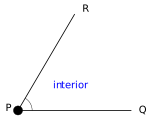
Question: Which part of the angle is labeled blue?
- A. The vertex
- B. The sides
- C. The interior
- D. The exterior
Why it works: The blue-labeled region is the \(\mathbf{\text{interior}}\), the space between the two rays.
Answer: The interior
Worked Examples
Example 1
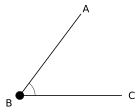
Question: The angle below is named \(\angle ABC\). Where is point \(B\)?
- A. At point \(A\)
- B. At the vertex
- C. At point \(C\)
- D. In the exterior
- In \(\angle ABC\), point \(B\) is the \(\mathbf{\text{vertex}}\) because it's the middle letter.
Answer: At the vertex
Example 2
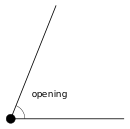
Question: The diagram shows an angle with a small opening. Which type of angle is this?
- A. A right angle
- B. An acute angle
- C. An obtuse angle
- D. A straight angle
- An \(\mathbf{\text{acute}}\) angle has a small opening, smaller than a right angle.
Answer: acute
Example 3
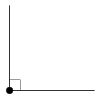
Question: Which of these angles is a right angle?
- A. No, it is acute
- B. Yes, it has a small opening
- C. Yes, it has a square corner
- D. No, it is straight
- A \(\mathbf{\text{right}}\) angle has a perfect square corner, like the corner of a piece of paper.
Answer: Yes, it has a square corner
Real-World Word Problems
Problem 1
Question: Which pair of items from a classroom has right angles?
- A. A pencil and a ball
- B. A desk and a book
- C. A rope and a ball
- D. A clock and a spiral notebook
Why it works: Desks and books have rectangular corners, which are \(\mathbf{\text{right}}\) angles.
Answer: A desk and a book
Problem 2
Question: An angle is formed wherever two rays share a common:
- A. line
- B. endpoint
- C. segment
- D. circle
Why it works: An angle is formed by two rays that share a common endpoint, called the \(\mathbf{\text{vertex}}\).
Answer: endpoint
Common Mistakes
- Naming a shape from appearance instead of attributes.
- Forgetting that squares are also rectangles and quadrilaterals.
- Mixing up sides and angles.
- Assuming a rotated shape changed its category.
Strategy Tips
- List attributes before naming the shape.
- Use examples and non-examples to test a category.
- Look for shared attributes across shape groups.
- Draw a quick sketch when the wording feels abstract.
Practice Questions
Question 1
Which part of an angle is the point where the two rays meet?
- A. The side
- B. The vertex
- C. The arc
- D. The exterior
Question 2
How many rays make up an angle?
- A. 1
- B. 2
- C. 3
- D. 4
Question 3
The sides of an angle are:
- A. segments
- B. lines
- C. rays
- D. circles
Question 4
The space inside an angle is called:
- A. the exterior
- B. the arc
- C. the interior
- D. the vertex
Question 5
The space outside an angle is called:
- A. the interior
- B. the exterior
- C. the vertex
- D. a side
Question 6
When naming an angle, what do we put in the middle?
- A. Any point on a side
- B. The vertex
- C. A point in the exterior
- D. A point in the arc
Full Answer Explanations Click to show all answers and explanations
Question 1
Answer: vertex
The \(\mathbf{\text{vertex}}\) is the point where the two rays of an angle meet.
Question 2
Answer: 2
An angle always has exactly \(\mathbf{2}\) rays that start at a common endpoint.
Question 3
Answer: rays
The two rays forming an angle are called the \(\mathbf{\text{sides}}\) (or rays) of the angle.
Question 4
Answer: interior
The \(\mathbf{\text{interior}}\) of an angle is the space inside, between the two rays.
Question 5
Answer: exterior
The \(\mathbf{\text{exterior}}\) of an angle is all the space outside the angle.
Question 6
Answer: The vertex
When naming an angle with three letters, the \(\mathbf{\text{vertex}}\) is always the middle letter, like \(\angle ABC\).
Connection to Standards
This lesson supports Grade 4 math expectations for reasoning, modeling, problem solving, and explaining answers clearly. It connects classroom skills to the kind of questions students see on state math assessments.
Summary
Angles as Geometric Shapes becomes easier when students connect the question to a model, use clear steps, and explain why the answer fits.
GOLDEN RULE
Attributes prove the shape name.