Which of the following is a right angle?
- An angle less than 90°
- An angle equal to 90°
- An angle greater than 90° but less than 180°
- An angle equal to 180°


Students will identify and draw points, lines, line segments, rays, and different types of angles.
Which of the following is a right angle?
Which of the following best describes a line segment?
Which geometric figure has exactly one endpoint?
What does a point represent in geometry?
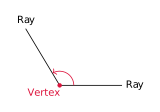
Look at this angle: What type of angle is this?
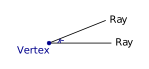
Look at this angle: What type of angle is shown?
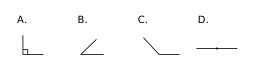
Which diagram shows a right angle?
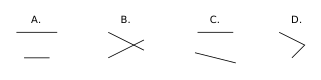
Which diagram shows two parallel lines?
A right angle is a special angle that measures exactly 90°. Think of the corner of your notebook — that's a right angle! Acute angles are smaller, obtuse angles are bigger, and straight angles are perfectly flat at 180°.
A line segment is like a piece of string with two knots at each end — it stops at both points. A line keeps going forever both ways, and a ray has just one starting point and goes forever in one direction.
A ray is like a beam of light from a flashlight — it starts at one point and shines forever in one direction only. A line keeps going both ways, a segment stops at both ends, and a point is just one spot with no size at all.
A point is simply a precise spot in space — like marking a location on a map with a pin. It has no length, width, or height; we just draw it as a tiny dot to show where it is.
This angle opens up a small amount, much less than a right angle. Since it's less than 90°, it's an acute angle.
This angle opens wide — wider than a right angle but not as wide as a straight line. That makes it an obtuse angle, which is between 90° and 180°.
Look for the small square symbol in the corner — that's geometry's way of saying "this is a right angle!" Only Diagram A has that special marker.
Parallel lines are like train tracks — they go the same direction and never bump into each other. The matching tick marks on Diagram A confirm these lines stay the same distance apart forever.
