CH08-01 lesson

Points, Lines, Rays, and Angles Learning Activity

A focused Grade 4 learning session for Points, Lines, Rays, and Angles using visual models, worked examples, strategy guidance, and a short mastery check.

15
minutes
6
lesson parts
11
practice items
Learning goal

Students will identify and draw points, lines, line segments, rays, and different types of angles.

Student goal: I can identify and draw points, lines, rays, segments, and angles.

concept

Learn the Idea

Points, Lines, Rays, and Angles means choosing a model, naming what each number means, and explaining the strategy.

  • Read the question carefully and identify what is being asked.
  • Choose a model, equation, table, or diagram that matches the situation.
  • Solve one step at a time and keep units or labels attached.
  • Use the answer explanation to check that the result makes sense.
visual model

See the Math

Visual Model 1

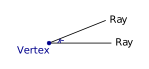
Question: Look at this angle: What type of angle is this?

Visual Model 1

  • A. An acute angle
  • B. A right angle
  • C. An obtuse angle
  • D. A straight angle

Why it works: This angle opens up a small amount, much less than a right angle. Since it's less than \(90\degree\), it's an acute angle.

Answer: An acute angle

worked example

Follow a Worked Example

Example 1

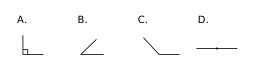
Question: Which diagram shows a right angle?

Example 1

  • A. Diagram A
  • B. Diagram B
  • C. Diagram C
  • D. Diagram D
  1. Look for the small square symbol in the corner — that's geometry's way of saying "this is a right angle!" Only Diagram A has that special marker.

Answer: Diagram A

Example 2

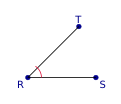
Question: Look at this diagram: Using three points, how would you name the angle shown by the red arc?

Example 2

  • A. Angle \(S\)
  • B. Angle \(TRS\)
  • C. Angle \(ST\)
  • D. Angle \(R\)
  1. When you name an angle with three letters, always put the vertex (the corner point) in the middle.
  2. Here \(R\) is where the two rays meet, so it goes in the middle: angle \(TRS\).

Answer: Angle \(TRS\)

real world

Connect It to a Real Situation

Problem 1

Question: Which of the following is a right angle?

  • A. An angle less than \(90\degree\)
  • B. An angle equal to \(90\degree\)
  • C. An angle greater than \(90\degree\) but less than \(180\degree\)
  • D. An angle equal to \(180\degree\)

Why it works: A right angle is a special angle that measures exactly \(90\degree\). Think of the corner of your notebook — that's a right angle! Acute angles are smaller, obtuse angles are bigger, and straight angles are perfectly flat at \(180\degree\).

Answer: An angle equal to \(90\degree\)

strategy

Avoid Mistakes and Choose a Strategy

  • Rushing before identifying what the numbers represent.
  • Choosing an operation that does not match the situation.
  • Dropping labels, units, or context from the answer.
  • Skipping the estimate or reasonableness check.
  • Underline the question being asked.
  • Use a model before jumping to computation.
  • Write an equation that matches the story or picture.
  • Explain the final answer in a sentence.
summary

Remember the Key Idea

Points, Lines, Rays, and Angles becomes easier when students connect the question to a model, use clear steps, and explain why the answer fits.

GOLDEN RULE

Understand the model before choosing the operation.

Guided to independent practice

Solve before opening the answer

Use scratch paper. The explanation matters more than simply seeing whether the choice is correct.

warmup

2 questions
G4-C08-T01-Q001 About 1 min

Which of the following is a right angle?

  1. A An angle less than 90°
  2. B An angle equal to 90°
  3. C An angle greater than 90° but less than 180°
  4. D An angle equal to 180°
Check answer and explanation

Answer B: An angle equal to 90°

A right angle is a special angle that measures exactly 90°. Think of the corner of your notebook — that's a right angle! Acute angles are smaller, obtuse angles are bigger, and straight angles are perfectly flat at 180°.

G4-C08-T01-Q002 About 1 min

Which of the following best describes a line segment?

  1. A A line that goes on forever in both directions
  2. B A straight path between two points with a definite start and end
  3. C A straight path that has a start but goes on forever in one direction
  4. D A point that marks the middle of a line
Check answer and explanation

Answer B: A straight path between two points with a definite start and end

A line segment is like a piece of string with two knots at each end — it stops at both points. A line keeps going forever both ways, and a ray has just one starting point and goes forever in one direction.

guided

1 question
G4-C08-T01-Q003 About 1 min

Which geometric figure has exactly one endpoint?

  1. A A line
  2. B A line segment
  3. C A ray
  4. D A point
Check answer and explanation

Answer C: A ray

A ray is like a beam of light from a flashlight — it starts at one point and shines forever in one direction only. A line keeps going both ways, a segment stops at both ends, and a point is just one spot with no size at all.

practice

5 questions
G4-C08-T01-Q004 About 1 min

What does a point represent in geometry?

  1. A An exact location with no size or shape
  2. B A small circle on a diagram
  3. C The corner of a shape
  4. D The space between two lines
Check answer and explanation

Answer A: An exact location with no size or shape

A point is simply a precise spot in space — like marking a location on a map with a pin. It has no length, width, or height; we just draw it as a tiny dot to show where it is.

G4-C08-T01-Q005 About 1 min

Look at this angle: What type of angle is this?

Points, Lines, Rays, and Angles visual for G4-C08-T01-Q005
  1. A An acute angle
  2. B A right angle
  3. C An obtuse angle
  4. D A straight angle
Check answer and explanation

Answer A: An acute angle

This angle opens up a small amount, much less than a right angle. Since it's less than 90°, it's an acute angle.

G4-C08-T01-Q006 About 1 min

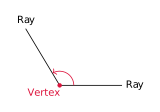
Look at this angle: What type of angle is shown?

Points, Lines, Rays, and Angles visual for G4-C08-T01-Q006
  1. A An acute angle
  2. B A right angle
  3. C An obtuse angle
  4. D A straight angle
Check answer and explanation

Answer C: An obtuse angle

This angle opens wide — wider than a right angle but not as wide as a straight line. That makes it an obtuse angle, which is between 90° and 180°.

G4-C08-T01-Q007 About 1 min

Which diagram shows a right angle?

Points, Lines, Rays, and Angles visual for G4-C08-T01-Q007
  1. A Diagram A
  2. B Diagram B
  3. C Diagram C
  4. D Diagram D
Check answer and explanation

Answer A: Diagram A

Look for the small square symbol in the corner — that's geometry's way of saying "this is a right angle!" Only Diagram A has that special marker.

G4-C08-T01-Q008 About 1 min

Look at this diagram: Using three points, how would you name the angle shown by the red arc?

Points, Lines, Rays, and Angles visual for G4-C08-T01-Q008
  1. A Angle \(S\)
  2. B Angle \(TRS\)
  3. C Angle \(ST\)
  4. D Angle \(R\)
Check answer and explanation

Answer B: Angle \(TRS\)

When you name an angle with three letters, always put the vertex (the corner point) in the middle. Here \(R\) is where the two rays meet, so it goes in the middle: angle \(TRS\).

exit

3 questions
G4-C08-T01-Q009 About 1 min

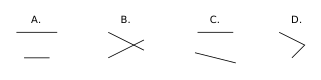
Which diagram shows two parallel lines?

Points, Lines, Rays, and Angles visual for G4-C08-T01-Q009
  1. A Diagram A
  2. B Diagram B
  3. C Diagram C
  4. D Diagram D
Check answer and explanation

Answer A: Diagram A

Parallel lines are like train tracks — they go the same direction and never bump into each other. The matching tick marks on Diagram A confirm these lines stay the same distance apart forever.

G4-C08-T01-Q010 About 1 min

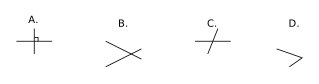
Which diagram shows two perpendicular lines?

Points, Lines, Rays, and Angles visual for G4-C08-T01-Q010
  1. A Diagram A
  2. B Diagram B
  3. C Diagram C
  4. D Diagram D
Check answer and explanation

Answer A: Diagram A

Perpendicular lines cross at a right angle — exactly 90° — and you can spot them by the tiny square symbol at the corner. Diagram A shows this perfect corner square.

G4-C08-T01-Q011 About 1 min

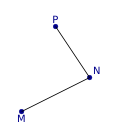
Which points are the endpoints of segment \(MN\) in this diagram?

Points, Lines, Rays, and Angles visual for G4-C08-T01-Q011
  1. A \(M\) and \(N\)
  2. B \(N\) and \(P\)
  3. C \(M\) and \(P\)
  4. D All three points
Check answer and explanation

Answer A: \(M\) and \(N\)

When a segment is called \(MN\), that means it starts at \(M\) and ends at \(N\) — those are the two endpoints. Point \(P\) is somewhere else entirely.

Page UP