




Introduction
Points, Lines, Rays, and Angles is an important Grade 4 math skill because students are moving from simple answers toward explaining how the math works.
In this lesson, students use models, real questions, worked examples, practice problems, and two online quizzes to build confidence with points, lines, rays, and angles.
What Is Points, Lines, Rays, and Angles?
Points, Lines, Rays, and Angles means choosing a model, naming what each number means, and explaining the strategy.
The goal is not only to get the answer. Students should be able to show the idea, explain the strategy, and check whether the answer makes sense.
Understanding Points, Lines, Rays, and Angles
Before solving, students should slow down and decide what each number, shape, unit, or label represents.
- Read the question carefully and identify what is being asked.
- Choose a model, equation, table, or diagram that matches the situation.
- Solve one step at a time and keep units or labels attached.
- Use the answer explanation to check that the result makes sense.
Visual Models
Visual Model 1
Question: Look at this angle: What type of angle is this?
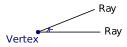
- A. An acute angle
- B. A right angle
- C. An obtuse angle
- D. A straight angle
Why it works: This angle opens up a small amount, much less than a right angle. Since it's less than \(90\degree\), it's an acute angle.
Answer: An acute angle
Visual Model 2
Question: Look at this angle: What type of angle is shown?
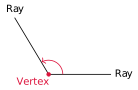
- A. An acute angle
- B. A right angle
- C. An obtuse angle
- D. A straight angle
Why it works: This angle opens wide — wider than a right angle but not as wide as a straight line. That makes it an obtuse angle, which is between \(90\degree\) and \(180\degree\).
Answer: An obtuse angle
Worked Examples
Example 1
Question: Which diagram shows a right angle?
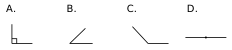
- A. Diagram A
- B. Diagram B
- C. Diagram C
- D. Diagram D
- Look for the small square symbol in the corner — that's geometry's way of saying "this is a right angle!" Only Diagram A has that special marker.
Answer: Diagram A
Example 2
Question: Look at this diagram: Using three points, how would you name the angle shown by the red arc?

- A. Angle \(S\)
- B. Angle \(TRS\)
- C. Angle \(ST\)
- D. Angle \(R\)
- When you name an angle with three letters, always put the vertex (the corner point) in the middle.
- Here \(R\) is where the two rays meet, so it goes in the middle: angle \(TRS\).
Answer: Angle \(TRS\)
Example 3
Question: Which diagram shows two parallel lines?

- A. Diagram A
- B. Diagram B
- C. Diagram C
- D. Diagram D
- Parallel lines are like train tracks — they go the same direction and never bump into each other.
- The matching tick marks on Diagram A confirm these lines stay the same distance apart forever.
Answer: Diagram A
Real-World Word Problems
Problem 1
Question: Which of the following is a right angle?
- A. An angle less than \(90\degree\)
- B. An angle equal to \(90\degree\)
- C. An angle greater than \(90\degree\) but less than \(180\degree\)
- D. An angle equal to \(180\degree\)
Why it works: A right angle is a special angle that measures exactly \(90\degree\). Think of the corner of your notebook — that's a right angle! Acute angles are smaller, obtuse angles are bigger, and straight angles are perfectly flat at \(180\degree\).
Answer: An angle equal to \(90\degree\)
Problem 2
Question: Which of the following best describes a line segment?
- A. A line that goes on forever in both directions
- B. A straight path between two points with a definite start and end
- C. A straight path that has a start but goes on forever in one direction
- D. A point that marks the middle of a line
Why it works: A line segment is like a piece of string with two knots at each end — it stops at both points. A line keeps going forever both ways, and a ray has just one starting point and goes forever in one direction.
Answer: A straight path between two points with a definite start and end
Common Mistakes
- Rushing before identifying what the numbers represent.
- Choosing an operation that does not match the situation.
- Dropping labels, units, or context from the answer.
- Skipping the estimate or reasonableness check.
Strategy Tips
- Underline the question being asked.
- Use a model before jumping to computation.
- Write an equation that matches the story or picture.
- Explain the final answer in a sentence.
Practice Questions
Question 1
Which geometric figure has exactly one endpoint?
- A. A line
- B. A line segment
- C. A ray
- D. A point
Question 2
What does a point represent in geometry?
- A. An exact location with no size or shape
- B. A small circle on a diagram
- C. The corner of a shape
- D. The space between two lines
Question 3
Which diagram shows two perpendicular lines?
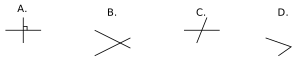
- A. Diagram A
- B. Diagram B
- C. Diagram C
- D. Diagram D
Question 4
Which points are the endpoints of segment \(MN\) in this diagram?
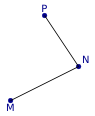
- A. \(M\) and \(N\)
- B. \(N\) and \(P\)
- C. \(M\) and \(P\)
- D. All three points
Question 5
Which statement correctly compares these two angles?
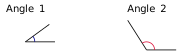
- A. Angle 1 is obtuse; Angle 2 is acute
- B. Angle 1 is acute; Angle 2 is obtuse
- C. Both angles are right angles
- D. Both angles are the same size
Question 6
What do you call two angles that share a vertex and their sides form two straight lines?
- A. Supplementary angles
- B. Vertical angles
- C. Adjacent angles
- D. Right angles
Full Answer Explanations Click to show all answers and explanations
Question 1
Answer: A ray
A ray is like a beam of light from a flashlight — it starts at one point and shines forever in one direction only. A line keeps going both ways, a segment stops at both ends, and a point is just one spot with no size at all.
Question 2
Answer: An exact location with no size or shape
A point is simply a precise spot in space — like marking a location on a map with a pin. It has no length, width, or height; we just draw it as a tiny dot to show where it is.
Question 3
Answer: Diagram A
Perpendicular lines cross at a right angle — exactly \(90\degree\) — and you can spot them by the tiny square symbol at the corner. Diagram A shows this perfect corner square.
Question 4
Answer: \(M\) and \(N\)
When a segment is called \(MN\), that means it starts at \(M\) and ends at \(N\) — those are the two endpoints. Point \(P\) is somewhere else entirely.
Question 5
Answer: Angle 1 is acute; Angle 2 is obtuse
Angle 1 is a small opening — less than \(90\degree\) — so it's acute. Angle 2 opens much wider, more than \(90\degree\), making it obtuse.
Question 6
Answer: Vertical angles
When two lines cross, they form angles opposite each other. These opposite angles are called vertical angles, and here's the cool part: they're always exactly the same size!
Connection to Standards
This lesson supports Grade 4 math expectations for reasoning, modeling, problem solving, and explaining answers clearly. It connects classroom skills to the kind of questions students see on state math assessments.
Summary
Points, Lines, Rays, and Angles becomes easier when students connect the question to a model, use clear steps, and explain why the answer fits.
GOLDEN RULE
Understand the model before choosing the operation.