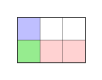
An area model can show \(\frac{1}{2} \times \frac{1}{3}\). What is the product?
- \(\frac{2}{3}\)
- \(\frac{1}{5}\)
- \(\frac{2}{5}\)
- \(\frac{1}{6}\)


Students will find area with fractional side lengths and connect area models to fraction multiplication.
An area model can show \(\frac{1}{2} \times \frac{1}{3}\). What is the product?
The area model below represents a multiplication problem. The rectangle is divided into 3 equal columns and 4 equal rows. The double-shaded region (where blue and red overlap) shows the product. Which multiplication expression matches this model?
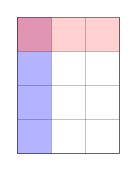
Use the area model to find \(\frac{3}{5} \times \frac{2}{4}\). The grid is split into 5 columns and 4 rows. The first factor marks 3 of the 5 columns, and the second factor marks 2 of the 4 rows. The overlap is the part counted for the product. What is the product?
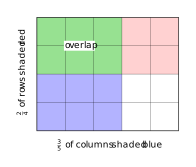
A rectangular piece of fabric has length \(\frac{2}{3}\) yard and width \(\frac{1}{4}\) yard. The area model below shows the product. What is the area in square yards?
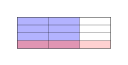
Below is an area model for \(\frac{2}{5} \times \frac{3}{4}\). Which statement is true?
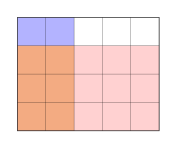
Find the product: \(\frac{1}{4} \times \frac{2}{5}\)
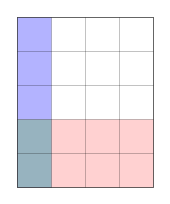
A garden is \(\frac{3}{4}\) mile long and \(\frac{1}{2}\) mile wide. What is the area of the garden?
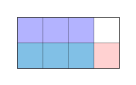
The area model shown represents \(\frac{1}{5} \times \frac{3}{4}\). What is the product?
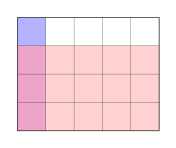
In an area model, divide one dimension into 2 equal parts (for \(\frac{1}{2}\)) and the other into 3 equal parts (for \(\frac{1}{3}\)). The overlapping shaded region is 1 out of 6 total squares, so the product is \(\frac{1}{6}\).
The blue stripe on the left covers 1 out of 3 columns. The red stripe at the top covers 1 out of 4 rows. The overlap is \(\frac{1}{3} \times \frac{1}{4} = \frac{1}{12}\).
The model marks 3 of the 5 columns and 2 of the 4 rows. Their overlap covers \(3 \times 2=6\) of the 20 total squares, so \(\frac{3}{5} \times \frac{2}{4} = \frac{6}{20} = \frac{3}{10}\).
Area = length \(\times\) width \(= \frac{2}{3} \times \frac{1}{4} = \frac{2}{12} = \frac{1}{6}\) square yard.
The blue region is 2 out of 5. The red region is 3 out of 4. The double-shaded overlap has 6 squares out of a total of 20, so the product is \(\frac{6}{20}\).
The overlap region has 2 shaded squares out of 20 total squares, giving \(\frac{1}{4} \times \frac{2}{5} = \frac{2}{20}=\frac{1}{10}\).
Area = \(\frac{3}{4} \times \frac{1}{2} = \frac{3}{8}\) square miles.
The blue region is 1 out of 5. The red region is 3 out of 4. The overlap is 3 out of 20 squares: \(\frac{1}{5} \times \frac{3}{4} = \frac{3}{20}\).
