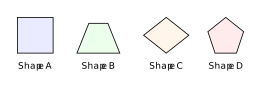
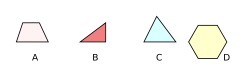
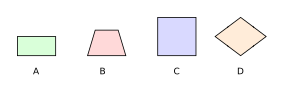
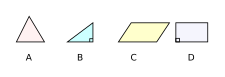
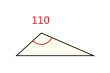
Classifying two-dimensional figures means naming flat shapes by the properties you can prove. Those properties include number of sides, pairs of parallel sides, equal side lengths, and angle measures.
Ask this first: Which properties does the figure definitely have?
A square is a strong example. It has 4 sides, 4 equal sides, 4 right angles, and 2 pairs of parallel sides. Because of that, it belongs to more than one category.
Students should connect shape names to evidence:
- A quadrilateral has 4 sides.
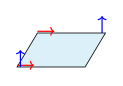
- A parallelogram has 2 pairs of opposite parallel sides.
- A rectangle has 4 right angles.
- A rhombus has 4 equal sides.
- A square has both 4 equal sides and 4 right angles.
- A trapezoid has exactly 1 pair of parallel sides in this Grade 5 treatment.
The big idea is hierarchy. A shape can belong to a smaller group and a larger group at the same time. That is why every square is also a rectangle, a rhombus, a parallelogram, and a quadrilateral.