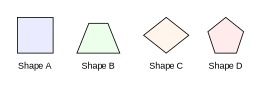
Look at the shapes below. Which shape has two pairs of parallel sides, all sides the same length, and no right angles?
- Shape A
- Shape B
- Shape C
- Shape D


Students will classify two-dimensional figures based on shared attributes.
Choose a free PDF. Each has different questions and worked solutions. The preview shows the student question page; open the PDF to read or print it at full size.
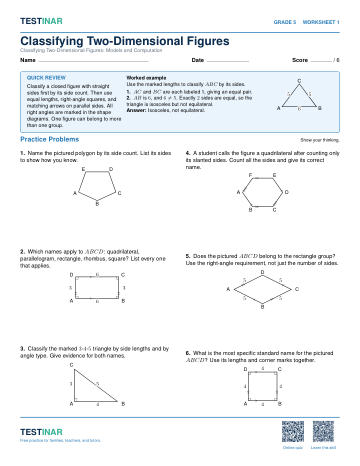 Worksheet 1
6 problems
Models and Computation.
Open PDF
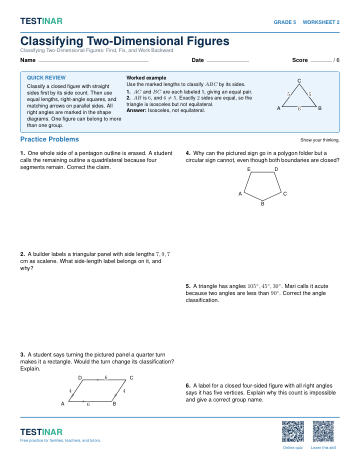 Worksheet 2
6 problems
Find, Fix, and Work Backward.
Open PDF
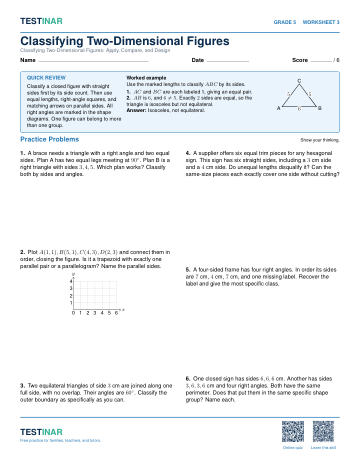 Worksheet 3
6 problems
Apply, Compare, and Design.
Open PDF
Print page 1 for students. Page 2 has the solutions; page 3 has optional book recommendations.
These online questions are separate from the three PDF worksheets above.
Look at the shapes below. Which shape has two pairs of parallel sides, all sides the same length, and no right angles?
How many right angles does a rectangle have?
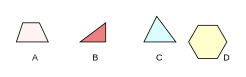
Which polygon is a regular polygon?
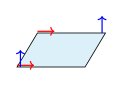
Look at the parallelogram below. How many pairs of parallel sides does it have?
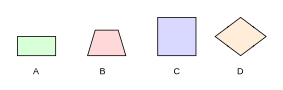
Which marked non-square shape has all sides of equal length?
Which description identifies a quadrilateral that is not a parallelogram?
Which polygon has 8 sides and 8 vertices?
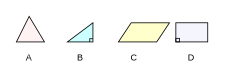
Use the markings in the figures. Which shape has no parallel sides and no right angles?
Shape C is a rhombus. It has two pairs of parallel sides, all sides the same length, and no right angles.
A rectangle has 4 right angles (one at each corner). All angles measure 90 degrees.
A regular polygon has all sides of equal length and all angles of equal measure. The hexagon (D) is regular.
A parallelogram has 2 pairs of parallel sides. The red arrows show one pair; the blue arrows show the other.
A square also has all sides equal, but the question asks for the non-square shape. The matching tick marks show the rhombus (D) has all four sides the same length, while its angles are not all right angles.
A figure with four sides is a quadrilateral. The phrase "exactly one pair of parallel sides" describes the needed attribute without relying on a state-specific trapezoid definition.
An octagon has 8 sides and 8 vertices. (A pentagon has 5, a hexagon has 6, a nonagon has 9.)
Figure A is a triangle with no parallel sides and no right angle. Figures B, C, and D do not match both conditions.
