Visual Model 1
Question: A number line shows where a product lands. What point represents \(0.5 \times 8\)?

- A. \(2\)
- B. \(3\)
- C. \(4\)
- D. \(5\)
How the model helps: \(0.5 \times 8 = 4\), so the point belongs exactly at \(4\) on the number line.


A focused Grade 5 learning session for Dividing Decimals by Whole Numbers using visual models, worked examples, strategy guidance, and a short mastery check.
Student goal: I can divide decimals by whole numbers.
Dividing Decimals by Whole Numbers is the Grade 5 skill of students divide decimals by whole numbers using place value understanding and the relationship between multiplication and division. They connect to money contexts such as splitting a bill equally among friends.
Strong understanding comes from naming what the numbers, shapes, units, or data values represent, then showing the idea with a model or clear steps before solving.
The key to this topic is understanding the structure behind the work, not just following a rule. Students should be able to talk through what is happening, point to a model, and explain why the answer makes sense.
Question: A number line shows where a product lands. What point represents \(0.5 \times 8\)?
How the model helps: \(0.5 \times 8 = 4\), so the point belongs exactly at \(4\) on the number line.
Question: A number line shows division. If you divide 4.5 by 5, where does the quotient fall?

Answer: Between 0 and 1
Question: Which model correctly shows \(0.6 \times 4\)?

Answer: Option A
Question: Maria buys 5 erasers at $0.75 each. How much does she spend?
Answer: $3.75
Why it works: Multiply \(5 \times 0.75 = 3.75\). Since \(0.75\) has 2 decimal places and 5 has 0, the product has 2 decimal places: $3.75.
Dividing Decimals by Whole Numbers gets easier when students read the model, track what each number means, and explain why the answer fits the situation.
Name the place value first, then compute or compare with aligned digits.
Use scratch paper. The explanation matters more than simply seeing whether the choice is correct.
What is \(3.6 \times 2.4\)?
Answer A: \(8.64\)
Multiply as if the numbers were whole numbers: \(36 \times 24 = 864\). The factors \(3.6\) and \(2.4\) have a total of \(1 + 1 = 2\) decimal places, so place the decimal point two places from the right: \(864 arrow 8.64\). Therefore, \(3.6 \times 2.4 = 8.64\).
Maria buys 5 erasers at $0.75 each. How much does she spend?
Answer C: $3.75
Multiply \(5 \times 0.75 = 3.75\). Since \(0.75\) has 2 decimal places and 5 has 0, the product has 2 decimal places: $3.75.
Estimate: \(6.8 \times 4.9\). Which is the best estimate?
Answer D: \(35\)
Round \(6.8 \approx 7\) and \(4.9 \approx 5\). Then \(7 \times 5 = 35\).
What is \(2.4 \div 3\)?
Answer A: \(0.8\)
Divide: \(2.4 \div 3 = 0.8\). You can think of this as \(24 \div 3 = 8\), then place the decimal one place from the right: \(0.8\).
A number line shows where a product lands. What point represents \(0.5 \times 8\)?
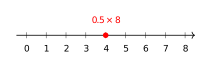
Answer C: \(4\)
\(0.5 \times 8 = 4\), so the point belongs exactly at \(4\) on the number line.
When you multiply 7.2 by a number less than 1, what will be true about the product?
Answer B: The product is smaller than 7.2
When a number is multiplied by a factor less than 1, the product is smaller than the original number.
Which multiplication problem is set up correctly to solve \(5.4 \times 3\)?
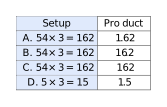
Answer D: Option B
\(5.4\) has 1 decimal place. \(54 \times 3 = 162\), so we move the decimal 1 place left: \(16.2\).
A baker uses \(0.25\) kg of sugar in each batch of cookies. How much sugar for 4 batches?
Answer C: \(1.0\) kg
\(0.25 \times 4 = 1.0\) kg. Multiply: \(25 \times 4 = 100\), then place decimal two places from right.
What is \(6.3 \div 3\)?
Answer C: \(2.1\)
\(6.3 \div 3 = 2.1\). Think of \(63 \div 3 = 21\), then place decimal one place from right: \(2.1\).
A number line shows division. If you divide 4.5 by 5, where does the quotient fall?
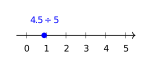
Answer A: Between 0 and 1
\(4.5 \div 5 = 0.9\), which is between 0 and 1.
Estimate: \(7.9 \div 2.1\). Which is the best estimate?
Answer B: \(4\)
Round \(7.9 \approx 8\) and \(2.1 \approx 2\). Then \(8 \div 2 = 4\).
