What is \(3.6 \times 2.4\)?
- \(8.64\)
- \(8.84\)
- \(9.44\)
- \(9.64\)


Students will divide decimals by whole numbers using place value and estimation.
What is \(3.6 \times 2.4\)?
Maria buys 5 erasers at $0.75 each. How much does she spend?
Estimate: \(6.8 \times 4.9\). Which is the best estimate?
What is \(2.4 \div 3\)?
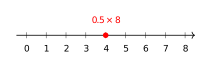
A number line shows where a product lands. What point represents \(0.5 \times 8\)?
When you multiply 7.2 by a number less than 1, what will be true about the product?
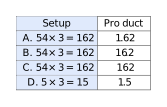
Which multiplication problem is set up correctly to solve \(5.4 \times 3\)?
What is \(6.3 \div 3\)?
Multiply as if the numbers were whole numbers: \(36 \times 24 = 864\). The factors \(3.6\) and \(2.4\) have a total of \(1 + 1 = 2\) decimal places, so place the decimal point two places from the right: \(864 arrow 8.64\). Therefore, \(3.6 \times 2.4 = 8.64\).
Multiply \(5 \times 0.75 = 3.75\). Since \(0.75\) has 2 decimal places and 5 has 0, the product has 2 decimal places: $3.75.
Round \(6.8 \approx 7\) and \(4.9 \approx 5\). Then \(7 \times 5 = 35\).
Divide: \(2.4 \div 3 = 0.8\). You can think of this as \(24 \div 3 = 8\), then place the decimal one place from the right: \(0.8\).
\(0.5 \times 8 = 4\), so the point belongs exactly at \(4\) on the number line.
When a number is multiplied by a factor less than 1, the product is smaller than the original number.
\(5.4\) has 1 decimal place. \(54 \times 3 = 162\), so we move the decimal 1 place left: \(16.2\).
\(6.3 \div 3 = 2.1\). Think of \(63 \div 3 = 21\), then place decimal one place from right: \(2.1\).
