A baker has \(\frac{1}{2}\) pound of butter. She uses an equal amount in each of \(4\) batches of cookies. How many pounds of butter does each batch use?
- \(\frac{1}{2}\) pound
- \(\frac{1}{4}\) pound
- \(\frac{1}{6}\) pound
- \(\frac{1}{8}\) pound


Students will solve real-world problems involving fraction division.
A baker has \(\frac{1}{2}\) pound of butter. She uses an equal amount in each of \(4\) batches of cookies. How many pounds of butter does each batch use?
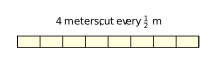
A 4-meter ribbon is cut into pieces that are each \(\frac{1}{2}\) meter long. How many pieces are there?
A teacher has \(\frac{1}{4}\) pound of clay and wants to share it equally among \(5\) students. How much clay does each student get?
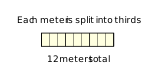
A rope is 12 meters long. It is cut into pieces that are each \(\frac{1}{3}\) meter long. How many pieces are there?
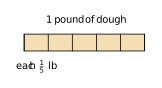
A baker has \(1\) pound of cookie dough. Each cookie uses \(\frac{1}{5}\) pound of dough. How many cookies can she make?
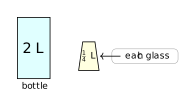
A bottle holds 2 liters of juice. If each glass holds \(\frac{1}{4}\) liter, how many glasses can be filled?
Maria pours \(3\) cups of juice into glasses, putting \(\frac{1}{2}\) cup in each glass. How many glasses can she fill?
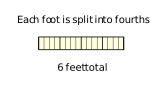
A ribbon is 6 feet long. How many \(\frac{1}{4}\)-foot pieces can be cut from it?
Divide a unit fraction by a whole number: \(\frac{1}{2} \div 4 = \frac{1}{2} \times \frac{1}{4} = \frac{1}{8}\) pound per batch.
Divide a whole number by a unit fraction: \(4 \div \frac{1}{2} = 4 \times 2 = 8\) pieces.
Divide a unit fraction by a whole number: \(\frac{1}{4} \div 5 = \frac{1}{4} \times \frac{1}{5} = \frac{1}{20}\) pound per student.
\(12 \div \frac{1}{3} = 12 \times 3 = 36\) pieces.
Think, "How many one-fifth-pound groups are in one pound?" Since \(1 \div \frac{1}{5} = 5\), she can make 5 cookies.
\(2 \div \frac{1}{4} = 2 \times 4 = 8\) glasses.
Divide a whole number by a unit fraction: \(3 \div \frac{1}{2} = 3 \times 2 = 6\) glasses.
Divide a whole number by a unit fraction: \(6 \div \frac{1}{4} = 6 \times 4 = 24\) pieces.
