CH06-03 lesson

Solving Real-World Problems with Fraction Division Learning Activity

A focused Grade 5 learning session for Solving Real-World Problems with Fraction Division using visual models, worked examples, strategy guidance, and a short mastery check.

18
minutes
6
lesson parts
11
practice items
Learning goal

Students will solve real-world problems involving fraction division.

Student goal: I can solve real-world fraction division problems.

concept

Learn the Idea

Solving Real-World Problems with Fraction Division is the Grade 5 skill of students solve real-world problems involving division of unit fractions by whole numbers and division of whole numbers by unit fractions. They use visual models, equations, and reasoning to explain their solutions.


What does the fraction represent, and how does the model prove it?

Strong understanding comes from naming what the numbers, shapes, units, or data values represent, then showing the idea with a model or clear steps before solving.

The key to this topic is understanding the structure behind the work, not just following a rule. Students should be able to talk through what is happening, point to a model, and explain why the answer makes sense.

  • Identify the whole first so every fraction part keeps the same meaning.
  • Use equal parts, number lines, or area models to show the relationship.
  • Check whether the answer should be larger, smaller, or equivalent before finishing.
  • Use the topic language from class discussions: Students solve real-world problems involving division of unit fractions by whole numbers and division of whole numbers by unit fractions. They use visual models, equations, and reasoning to explain their solutions.
visual model

See the Math

Visual Model 1

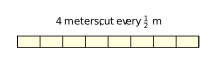
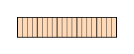
Question: A 4-meter ribbon is cut into pieces that are each \(\frac{1}{2}\) meter long. How many pieces are there?

Grade 5 Solving Real-World Problems with Fraction Division figure 1

  • A. 2 pieces
  • B. 4 pieces
  • C. 6 pieces
  • D. 8 pieces

How the model helps: Divide a whole number by a unit fraction: \(4 \div \frac{1}{2} = 4 \times 2 = 8\) pieces.

worked example

Follow a Worked Example

Example 1

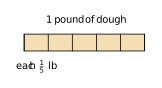
Question: A baker has \(1\) pound of cookie dough. Each cookie uses \(\frac{1}{5}\) pound of dough. How many cookies can she make?

Grade 5 Solving Real-World Problems with Fraction Division figure 3

  • A. 5 cookies
  • B. 3 cookies
  • C. 6 cookies
  • D. 9 cookies
  1. Think, "How many one-fifth-pound groups are in one pound?" Since \(1 \div \frac{1}{5} = 5\), she can make 5 cookies.

Answer: 5 cookies

Example 2

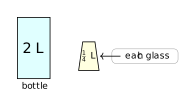
Question: A bottle holds 2 liters of juice. If each glass holds \(\frac{1}{4}\) liter, how many glasses can be filled?

Grade 5 Solving Real-World Problems with Fraction Division figure 4

  • A. 8 glasses
  • B. 6 glasses
  • C. 4 glasses
  • D. 10 glasses
  1. \(2 \div \frac{1}{4} = 2 \times 4 = 8\) glasses.

Answer: 8 glasses

real world

Connect It to a Real Situation

Problem 1

Question: A teacher has \(\frac{1}{4}\) pound of clay and wants to share it equally among \(5\) students. How much clay does each student get?

  • A. \(\frac{1}{20}\) pound
  • B. \(\frac{1}{9}\) pound
  • C. \(\frac{1}{5}\) pound
  • D. \(\frac{1}{4}\) pound

Answer: \(\frac{1}{20}\) pound

Why it works: Divide a unit fraction by a whole number: \(\frac{1}{4} \div 5 = \frac{1}{4} \times \frac{1}{5} = \frac{1}{20}\) pound per student.

strategy

Avoid Mistakes and Choose a Strategy

  • Starting the computation before identifying what the numbers, units, or parts represent.
  • Combining numerators and denominators without first checking whether the fraction pieces match in size.
  • Forgetting to estimate, which makes it easier to miss an unreasonable answer.
  • Stopping at a number without explaining what the answer means in context.
  • Read the situation slowly and name what each number or label represents.
  • Draw fraction bars, area models, or number lines so equal parts stay visible.
  • Estimate first so you already know the answer's approximate size.
  • Check the answer with an inverse operation, another representation, or a sentence explanation.
  • Say the math idea out loud in simple words before writing the final answer.
summary

Remember the Key Idea

Solving Real-World Problems with Fraction Division gets easier when students read the model, track what each number means, and explain why the answer fits the situation.

GOLDEN RULE

Keep the whole consistent, show equal parts clearly, and explain what the fraction means.

Guided to independent practice

Solve before opening the answer

Use scratch paper. The explanation matters more than simply seeing whether the choice is correct.

warmup

2 questions
G5-C05-T05-Q001 About 1 min

A baker has \(\frac{1}{2}\) pound of butter. She uses an equal amount in each of \(4\) batches of cookies. How many pounds of butter does each batch use?

  1. A \(\frac{1}{2}\) pound
  2. B \(\frac{1}{4}\) pound
  3. C \(\frac{1}{6}\) pound
  4. D \(\frac{1}{8}\) pound
Check answer and explanation

Answer D: \(\frac{1}{8}\) pound

Divide a unit fraction by a whole number: \(\frac{1}{2} \div 4 = \frac{1}{2} \times \frac{1}{4} = \frac{1}{8}\) pound per batch.

G5-C05-T05-Q002 About 1 min

A 4-meter ribbon is cut into pieces that are each \(\frac{1}{2}\) meter long. How many pieces are there?

Solving Real-World Problems with Fraction Division visual for G5-C05-T05-Q002
  1. A 2 pieces
  2. B 4 pieces
  3. C 6 pieces
  4. D 8 pieces
Check answer and explanation

Answer D: 8 pieces

Divide a whole number by a unit fraction: \(4 \div \frac{1}{2} = 4 \times 2 = 8\) pieces.

guided

1 question
G5-C05-T05-Q003 About 1 min

A teacher has \(\frac{1}{4}\) pound of clay and wants to share it equally among \(5\) students. How much clay does each student get?

  1. A \(\frac{1}{20}\) pound
  2. B \(\frac{1}{9}\) pound
  3. C \(\frac{1}{5}\) pound
  4. D \(\frac{1}{4}\) pound
Check answer and explanation

Answer A: \(\frac{1}{20}\) pound

Divide a unit fraction by a whole number: \(\frac{1}{4} \div 5 = \frac{1}{4} \times \frac{1}{5} = \frac{1}{20}\) pound per student.

practice

5 questions
G5-C05-T05-Q004 About 1 min

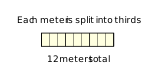
A rope is 12 meters long. It is cut into pieces that are each \(\frac{1}{3}\) meter long. How many pieces are there?

Solving Real-World Problems with Fraction Division visual for G5-C05-T05-Q004
  1. A 36 pieces
  2. B 24 pieces
  3. C 18 pieces
  4. D 48 pieces
Check answer and explanation

Answer A: 36 pieces

\(12 \div \frac{1}{3} = 12 \times 3 = 36\) pieces.

G5-C05-T05-Q005 About 1 min

A baker has \(1\) pound of cookie dough. Each cookie uses \(\frac{1}{5}\) pound of dough. How many cookies can she make?

Solving Real-World Problems with Fraction Division visual for G5-C05-T05-Q005
  1. A 5 cookies
  2. B 3 cookies
  3. C 6 cookies
  4. D 9 cookies
Check answer and explanation

Answer A: 5 cookies

Think, "How many one-fifth-pound groups are in one pound?" Since \(1 \div \frac{1}{5} = 5\), she can make 5 cookies.

G5-C05-T05-Q006 About 1 min

A bottle holds 2 liters of juice. If each glass holds \(\frac{1}{4}\) liter, how many glasses can be filled?

Solving Real-World Problems with Fraction Division visual for G5-C05-T05-Q006
  1. A 8 glasses
  2. B 6 glasses
  3. C 4 glasses
  4. D 10 glasses
Check answer and explanation

Answer A: 8 glasses

\(2 \div \frac{1}{4} = 2 \times 4 = 8\) glasses.

G5-C05-T05-Q007 About 1 min

Maria pours \(3\) cups of juice into glasses, putting \(\frac{1}{2}\) cup in each glass. How many glasses can she fill?

  1. A \(1\frac{1}{2}\) glasses
  2. B \(3\) glasses
  3. C \(6\) glasses
  4. D \(9\) glasses
Check answer and explanation

Answer C: \(6\) glasses

Divide a whole number by a unit fraction: \(3 \div \frac{1}{2} = 3 \times 2 = 6\) glasses.

G5-C05-T05-Q008 About 1 min

A farmer fills bags with apples. Each bag holds \(\frac{1}{4}\) of a crate. How many bags can the farmer fill from \(5\) full crates of apples?

Solving Real-World Problems with Fraction Division visual for G5-C05-T05-Q008
  1. A 5 bags
  2. B 9 bags
  3. C 16 bags
  4. D 20 bags
Check answer and explanation

Answer D: 20 bags

Divide a whole number by a unit fraction: \(5 \div \frac{1}{4} = 5 \times 4 = 20\) bags.

exit

3 questions
G5-C05-T05-Q009 About 1 min

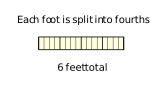
A ribbon is 6 feet long. How many \(\frac{1}{4}\)-foot pieces can be cut from it?

Solving Real-World Problems with Fraction Division visual for G5-C05-T05-Q009
  1. A 18 pieces
  2. B 24 pieces
  3. C 12 pieces
  4. D 6 pieces
Check answer and explanation

Answer B: 24 pieces

Divide a whole number by a unit fraction: \(6 \div \frac{1}{4} = 6 \times 4 = 24\) pieces.

G5-C05-T05-Q010 About 1 min

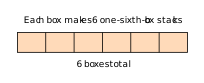
A library has 6 boxes of books. Each display stack uses \(\frac{1}{6}\) of a box. How many display stacks can the librarian make?

Solving Real-World Problems with Fraction Division visual for G5-C05-T05-Q010
  1. A 36 stacks
  2. B 30 stacks
  3. C 24 stacks
  4. D 40 stacks
Check answer and explanation

Answer A: 36 stacks

This asks how many \(\frac{1}{6}\)-box groups fit in 6 boxes. \(6 \div \frac{1}{6} = 6 \times 6 = 36\) stacks.

G5-C05-T05-Q011 About 1 min

A trail crew checks 3 miles of track. Each section is \(\frac{1}{6}\) mile long. How many sections does the crew check?

  1. A 18 sections
  2. B 15 sections
  3. C 27 sections
  4. D 30 sections
Check answer and explanation

Answer A: 18 sections

Each mile has 6 sixth-mile sections. So \(3 \div \frac{1}{6} = 3 \times 6 = 18\) sections.

Page UP