Visual Model 1
Question: Find \(\frac{1}{2}\) of \(20\).

- A. \(5\)
- B. \(20\)
- C. \(15\)
- D. \(10\)
How the model helps: \(\frac{1}{2} \times 20 = \frac{20}{2} = 10\).


A focused Grade 5 learning session for Solving Real-World Problems with Fraction Multiplication using visual models, worked examples, strategy guidance, and a short mastery check.
Student goal: I can solve real-world fraction multiplication problems.
Solving Real-World Problems with Fraction Multiplication is the Grade 5 skill of students solve real-world problems involving multiplication of fractions and mixed numbers. They use visual models or equations to represent the situation and interpret the product in context.
Strong understanding comes from naming what the numbers, shapes, units, or data values represent, then showing the idea with a model or clear steps before solving.
The key to this topic is understanding the structure behind the work, not just following a rule. Students should be able to talk through what is happening, point to a model, and explain why the answer makes sense.
Question: Find \(\frac{1}{2}\) of \(20\).
How the model helps: \(\frac{1}{2} \times 20 = \frac{20}{2} = 10\).
Question: A recipe uses \(\frac{3}{4}\) cup of oats for each batch. How many cups of oats are needed for 24 batches?

Answer: \(18\) cups
Question: Find \(\frac{1}{3}\) of \(30\).

Answer: \(10\)
Question: A recipe calls for \(\frac{3}{4}\) cup of flour. Maria is making \(\frac{2}{3}\) of the recipe. How much flour does she need?
Answer: \(\frac{1}{2}\) cup
Why it works: Multiply the fractions: \(\frac{2}{3} \times \frac{3}{4} = \frac{6}{12} = \frac{1}{2}\). Therefore, Maria needs \(\frac{1}{2}\) cup of flour.
Solving Real-World Problems with Fraction Multiplication gets easier when students read the model, track what each number means, and explain why the answer fits the situation.
Keep the whole consistent, show equal parts clearly, and explain what the fraction means.
Use scratch paper. The explanation matters more than simply seeing whether the choice is correct.
Multiply: \(2\frac{1}{3} \times 3\)
Answer D: \(7\)
Convert to an improper fraction: \(2\frac{1}{3} = \frac{7}{3}\). Multiply: \(\frac{7}{3} \times 3 = \frac{7 \times 3}{3} = 7\).
Multiply: \(1\frac{1}{2} \times 4\)
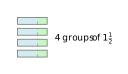
Answer A: \(6\)
Each row shows one group of \(1\frac{1}{2}\). Four groups make \(4\times 1\frac{1}{2}=4\times\frac{3}{2}=\frac{12}{2}=6\).
Multiply: \(3\frac{1}{4} \times 2\)
Answer A: \(6\frac{1}{2}\)
\(3\frac{1}{4} = \frac{13}{4}\). Then \(\frac{13}{4} \times 2 = \frac{26}{4} = 6\frac{2}{4} = 6\frac{1}{2}\).
The area model below represents \(2\frac{1}{2} \times 1\frac{1}{3}\) by breaking both mixed numbers into parts. What is the total area?
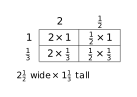
Answer B: \(3\frac{1}{3}\)
Convert: \(2\frac{1}{2} = \frac{5}{2}\) and \(1\frac{1}{3} = \frac{4}{3}\). Multiply: \(\frac{5}{2} \times \frac{4}{3} = \frac{20}{6} = 3\frac{2}{6} = 3\frac{1}{3}\).
A recipe calls for \(1\frac{1}{2}\) cups of flour. If you triple the recipe, how many cups do you need?
Answer D: \(4\frac{1}{2}\)
\(1\frac{1}{2} \times 3 = \frac{3}{2} \times 3 = \frac{9}{2} = 4\frac{1}{2}\) cups.
Multiply: \(2\frac{1}{4} \times 2\frac{2}{3}\)
Answer A: \(6\)
\(2\frac{1}{4} = \frac{9}{4}\) and \(2\frac{2}{3} = \frac{8}{3}\). Multiply: \(\frac{9}{4} \times \frac{8}{3} = \frac{72}{12} = 6\).
A rectangular garden has length \(3\frac{1}{2}\) meters and width \(2\) meters. What is the area?
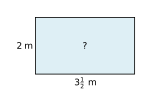
Answer C: \(7\)
\(3\frac{1}{2} \times 2 = \frac{7}{2} \times 2 = \frac{14}{2} = 7\) square meters.
Which student correctly found \(1\frac{3}{4}\times2\)?
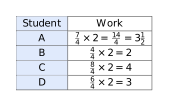
Answer D: Student A
\(1\frac{3}{4} = \frac{1 \times 4 + 3}{4} = \frac{7}{4}\). Then \(\frac{7}{4}\times2=\frac{14}{4}=3\frac{1}{2}\).
Multiply: \(1\frac{1}{3} \times 1\frac{1}{2}\)

Answer D: \(2\)
\(1\frac{1}{3} = \frac{4}{3}\) and \(1\frac{1}{2} = \frac{3}{2}\). Multiply: \(\frac{4}{3} \times \frac{3}{2} = \frac{12}{6} = 2\).
Which multiplication matches the area model showing \(3 \times 1\frac{2}{5}\)?
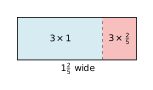
Answer D: \(3 \times 1 + 3 \times \frac{2}{5}\)
The area model shows the distributive property: \(3 \times 1\frac{2}{5} = 3 \times 1 + 3 \times \frac{2}{5} = 3 + \frac{6}{5} = 4\frac{1}{5}\).
Which product is missing from the table?
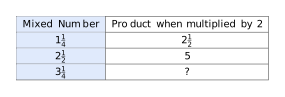
Answer D: \(6\frac{1}{2}\)
\(3\frac{1}{4} \times 2 = \frac{13}{4} \times 2 = \frac{26}{4} = 6\frac{1}{2}\).
