Multiply: \(2\frac{1}{3} \times 3\)
- \(8\)
- \(9\)
- \(6\)
- \(7\)


Students will solve real-world problems involving fraction multiplication.
Multiply: \(2\frac{1}{3} \times 3\)
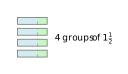
Multiply: \(1\frac{1}{2} \times 4\)
Multiply: \(3\frac{1}{4} \times 2\)
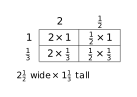
The area model below represents \(2\frac{1}{2} \times 1\frac{1}{3}\) by breaking both mixed numbers into parts. What is the total area?
A recipe calls for \(1\frac{1}{2}\) cups of flour. If you triple the recipe, how many cups do you need?
Multiply: \(2\frac{1}{4} \times 2\frac{2}{3}\)
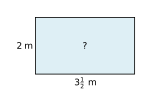
A rectangular garden has length \(3\frac{1}{2}\) meters and width \(2\) meters. What is the area?
Multiply: \(1\frac{1}{3} \times 1\frac{1}{2}\)

Convert to an improper fraction: \(2\frac{1}{3} = \frac{7}{3}\). Multiply: \(\frac{7}{3} \times 3 = \frac{7 \times 3}{3} = 7\).
Each row shows one group of \(1\frac{1}{2}\). Four groups make \(4\times 1\frac{1}{2}=4\times\frac{3}{2}=\frac{12}{2}=6\).
\(3\frac{1}{4} = \frac{13}{4}\). Then \(\frac{13}{4} \times 2 = \frac{26}{4} = 6\frac{2}{4} = 6\frac{1}{2}\).
Convert: \(2\frac{1}{2} = \frac{5}{2}\) and \(1\frac{1}{3} = \frac{4}{3}\). Multiply: \(\frac{5}{2} \times \frac{4}{3} = \frac{20}{6} = 3\frac{2}{6} = 3\frac{1}{3}\).
\(1\frac{1}{2} \times 3 = \frac{3}{2} \times 3 = \frac{9}{2} = 4\frac{1}{2}\) cups.
\(2\frac{1}{4} = \frac{9}{4}\) and \(2\frac{2}{3} = \frac{8}{3}\). Multiply: \(\frac{9}{4} \times \frac{8}{3} = \frac{72}{12} = 6\).
\(3\frac{1}{2} \times 2 = \frac{7}{2} \times 2 = \frac{14}{2} = 7\) square meters.
\(1\frac{1}{3} = \frac{4}{3}\) and \(1\frac{1}{2} = \frac{3}{2}\). Multiply: \(\frac{4}{3} \times \frac{3}{2} = \frac{12}{6} = 2\).
