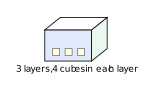
A storage box is filled with 3 layers of unit cubes. Each layer has 4 unit cubes. What is the volume of the box?
- 7 cubic units
- 12 cubic units
- 24 square units
- 3 units


Students will understand volume as an attribute of solid figures measured in cubic units.
A storage box is filled with 3 layers of unit cubes. Each layer has 4 unit cubes. What is the volume of the box?
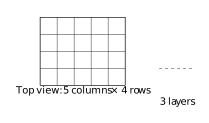
A rectangular prism is built from unit cubes arranged in 3 layers. Each layer has 4 rows and 5 columns of cubes. How many unit cubes are in the entire prism?
Which of the following is the best metric unit for measuring the volume of a small juice box?

A rectangular prism has a volume of 24 cubic units. Which dimensions could create this volume?
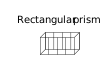
What is the volume of a rectangular prism with length 6 cm, width 4 cm, and height 2 cm?
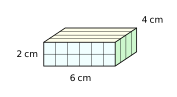
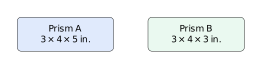
Two rectangular prisms have the same base dimensions of 3 in. \(\times\) 4 in. Prism A is 5 inches tall, and Prism B is 3 inches tall. What is the difference in their volumes?
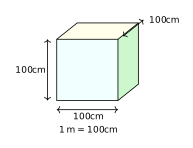
A cubic meter is made of how many cubic centimeters?
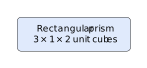
A rectangular prism has dimensions 3 by 1 by 2 unit cubes. What is its volume?
Volume describes how many unit cubes fit inside a solid. With 3 layers of 4 cubes, the volume is \(3\times4=12\) cubic units.
\(5 \times 4 \times 3 = 60\) unit cubes. Volume is the product of length, width, and height.
A small juice box needs a small unit. In the metric system, cubic centimeters are a good fit. Cubic meters are too large, and cubic feet or cubic inches are customary units rather than metric units.
\(2 \times 4 \times 3 = 24\) cubic units. Choice A: \(2 \times 3 \times 3 = 18\). Choice C: \(2 \times 2 \times 5 = 20\). Choice D: \(3 \times 3 \times 2 = 18\).
\(V = l \times w \times h = 6 \times 4 \times 2 = 48\) cubic centimeters.
Prism A: \(3 \times 4 \times 5 = 60\) cu. in. Prism B: \(3 \times 4 \times 3 = 36\) cu. in. Difference: \(60 - 36 = 24\) cu. in.
A cube that is 1 meter on each edge is 100 centimeters on each edge. It would have 100 layers, with \(100 \times 100 = 10{,}000\) cubic centimeters in each layer. So \(10{,}000 \times 100 = 1{,}000{,}000\) cubic centimeters.
The prism shows dimensions of length 3, width 1, and height 2. Volume: \(3 \times 1 \times 2 = 6\) cubic units.
