CH09-01 lesson

Understanding Volume Learning Activity

A focused Grade 5 learning session for Understanding Volume using visual models, worked examples, strategy guidance, and a short mastery check.

15
minutes
6
lesson parts
11
practice items
Learning goal

Students will understand volume as an attribute of solid figures measured in cubic units.

Student goal: I can explain what volume measures.

concept

Learn the Idea

Understanding Volume is the Grade 5 skill of students recognize volume as an attribute of solid figures. They understand that a unit cube has a side length of 1 unit and a volume of 1 cubic unit, and that volume is measured by the number of unit cubes needed to fill a solid figure without gaps or overlaps.

How many equal-sized cubic units fill the solid without gaps or overlaps?

Strong understanding comes from naming what the numbers, shapes, units, or data values represent, then showing the idea with a model or clear steps before solving.


Understanding Volume is the Grade 5 skill of students recognize volume as an attribute of solid figures. They understand that a unit cube has a side length of 1 unit and a volume of 1 cubic unit, and that volume is measured by the number of unit cubes needed to fill a solid figure without gaps or overlaps.

How many equal-sized cubic units fill the solid without gaps or overlaps?

Strong understanding comes from naming what the numbers, shapes, units, or data values represent, then showing the idea with a model or clear steps before solving.

visual model

See the Math

Visual Model 1

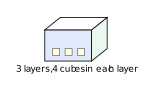
Question: A storage box is filled with 3 layers of unit cubes. Each layer has 4 unit cubes. What is the volume of the box?

Grade 5 Understanding Volume figure 1

  • A. 7 cubic units
  • B. 12 cubic units
  • C. 24 square units
  • D. 3 units

How the model helps: Volume describes how many unit cubes fit inside a solid. With 3 layers of 4 cubes, the volume is \(3\times4=12\) cubic units.

worked example

Follow a Worked Example

Example 1

Question: Which of the following is the best metric unit for measuring the volume of a small juice box?

Grade 5 Understanding Volume figure 3

  • A. Cubic meters
  • B. Cubic feet
  • C. Cubic centimeters
  • D. Cubic inches
  1. A small juice box needs a small unit.
  2. In the metric system, cubic centimeters are a good fit.
  3. Cubic meters are too large, and cubic feet or cubic inches are customary units rather than metric units.

Answer: Cubic centimeters

Example 2

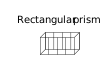
Question: A rectangular prism has a volume of 24 cubic units. Which dimensions could create this volume?

Grade 5 Understanding Volume figure 4

  • A. Length 2, width 3, height 3
  • B. Length 2, width 4, height 3
  • C. Length 2, width 2, height 5
  • D. Length 3, width 3, height 2
  1. \(2 \times 4 \times 3 = 24\) cubic units.
  2. Choice A: \(2 \times 3 \times 3 = 18\).
  3. Choice C: \(2 \times 2 \times 5 = 20\).
  4. Choice D: \(3 \times 3 \times 2 = 18\).

Answer: Length 2, width 4, height 3

real world

Connect It to a Real Situation

Problem 1

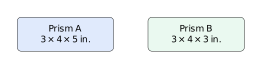
Question: Two rectangular prisms have the same base dimensions of 3 in. \(\times\) 4 in. Prism A is 5 inches tall, and Prism B is 3 inches tall. What is the difference in their volumes?

Grade 5 Understanding Volume figure 6

  • A. 12 cubic in.
  • B. 60 cubic in.
  • C. 36 cubic in.
  • D. 24 cubic in.

Answer: 24 cubic in.

Why it works: Prism A: \(3 \times 4 \times 5 = 60\) cu. in. Prism B: \(3 \times 4 \times 3 = 36\) cu. in. Difference: \(60 - 36 = 24\) cu. in.

strategy

Avoid Mistakes and Choose a Strategy

  • Starting the computation before identifying what the numbers, units, or parts represent.
  • Confusing area and volume or forgetting that volume is measured in cubic units.
  • Forgetting to estimate, which makes it easier to miss an unreasonable answer.
  • Stopping at a number without explaining what the answer means in context.
  • Read the situation slowly and name what each number or label represents.
  • Think in layers of cubes or base-area groups before using a formula.
  • Estimate first so you already know the answer's approximate size.
  • Check the answer with an inverse operation, another representation, or a sentence explanation.
  • Say the math idea out loud in simple words before writing the final answer.
summary

Remember the Key Idea

Understanding Volume gets easier when students read the model, track what each number means, and explain why the answer fits the situation.

GOLDEN RULE

Think in layers of cubic units, then justify the formula with the model.

Guided to independent practice

Solve before opening the answer

Use scratch paper. The explanation matters more than simply seeing whether the choice is correct.

warmup

2 questions
G5-C07-T01-Q001 About 1 min

A storage box is filled with 3 layers of unit cubes. Each layer has 4 unit cubes. What is the volume of the box?

Understanding Volume as an Attribute of Solid Figures visual for G5-C07-T01-Q001
  1. A 7 cubic units
  2. B 12 cubic units
  3. C 24 square units
  4. D 3 units
Check answer and explanation

Answer B: 12 cubic units

Volume describes how many unit cubes fit inside a solid. With 3 layers of 4 cubes, the volume is \(3\times4=12\) cubic units.

G5-C07-T01-Q002 About 1 min

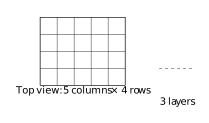
A rectangular prism is built from unit cubes arranged in 3 layers. Each layer has 4 rows and 5 columns of cubes. How many unit cubes are in the entire prism?

Understanding Volume as an Attribute of Solid Figures visual for G5-C07-T01-Q002
  1. A 12
  2. B 20
  3. C 60
  4. D 80
Check answer and explanation

Answer C: 60

\(5 \times 4 \times 3 = 60\) unit cubes. Volume is the product of length, width, and height.

guided

1 question
G5-C07-T01-Q003 About 1 min

Which of the following is the best metric unit for measuring the volume of a small juice box?

Understanding Volume as an Attribute of Solid Figures visual for G5-C07-T01-Q003
  1. A Cubic meters
  2. B Cubic feet
  3. C Cubic centimeters
  4. D Cubic inches
Check answer and explanation

Answer C: Cubic centimeters

A small juice box needs a small unit. In the metric system, cubic centimeters are a good fit. Cubic meters are too large, and cubic feet or cubic inches are customary units rather than metric units.

practice

5 questions
G5-C07-T01-Q004 About 1 min

A rectangular prism has a volume of 24 cubic units. Which dimensions could create this volume?

Understanding Volume as an Attribute of Solid Figures visual for G5-C07-T01-Q004
  1. A Length 2, width 3, height 3
  2. B Length 2, width 4, height 3
  3. C Length 2, width 2, height 5
  4. D Length 3, width 3, height 2
Check answer and explanation

Answer B: Length 2, width 4, height 3

\(2 \times 4 \times 3 = 24\) cubic units. Choice A: \(2 \times 3 \times 3 = 18\). Choice C: \(2 \times 2 \times 5 = 20\). Choice D: \(3 \times 3 \times 2 = 18\).

G5-C07-T01-Q005 About 1 min

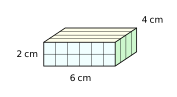
What is the volume of a rectangular prism with length 6 cm, width 4 cm, and height 2 cm?

Understanding Volume as an Attribute of Solid Figures visual for G5-C07-T01-Q005
  1. A 12 cubic cm
  2. B 24 cubic cm
  3. C 36 cubic cm
  4. D 48 cubic cm
Check answer and explanation

Answer D: 48 cubic cm

\(V = l \times w \times h = 6 \times 4 \times 2 = 48\) cubic centimeters.

G5-C07-T01-Q006 About 1 min

Two rectangular prisms have the same base dimensions of 3 in. \(\times\) 4 in. Prism A is 5 inches tall, and Prism B is 3 inches tall. What is the difference in their volumes?

Understanding Volume as an Attribute of Solid Figures visual for G5-C07-T01-Q006
  1. A 12 cubic in.
  2. B 60 cubic in.
  3. C 36 cubic in.
  4. D 24 cubic in.
Check answer and explanation

Answer D: 24 cubic in.

Prism A: \(3 \times 4 \times 5 = 60\) cu. in. Prism B: \(3 \times 4 \times 3 = 36\) cu. in. Difference: \(60 - 36 = 24\) cu. in.

G5-C07-T01-Q007 About 1 min

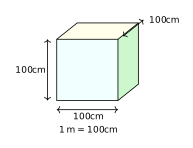
A cubic meter is made of how many cubic centimeters?

Understanding Volume as an Attribute of Solid Figures visual for G5-C07-T01-Q007
  1. A 100
  2. B 1,000
  3. C 100,000
  4. D 1,000,000
Check answer and explanation

Answer D: 1,000,000

A cube that is 1 meter on each edge is 100 centimeters on each edge. It would have 100 layers, with \(100 \times 100 = 10{,}000\) cubic centimeters in each layer. So \(10{,}000 \times 100 = 1{,}000{,}000\) cubic centimeters.

G5-C07-T01-Q008 About 1 min

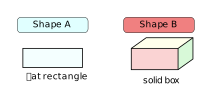
Which choice correctly distinguishes between area and volume?

Understanding Volume as an Attribute of Solid Figures visual for G5-C07-T01-Q008
  1. A Area is flat; volume fills space
  2. B Area is larger than volume
  3. C Volume is 2D; area is 3D
  4. D Area and volume are the same
Check answer and explanation

Answer A: Area is flat; volume fills space

Area measures flat 2D shapes; volume measures 3D solid figures. Area uses square units, volume uses cubic units.

exit

3 questions
G5-C07-T01-Q009 About 1 min

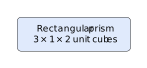
A rectangular prism has dimensions 3 by 1 by 2 unit cubes. What is its volume?

Understanding Volume as an Attribute of Solid Figures visual for G5-C07-T01-Q009
  1. A 4 cubic units
  2. B 12 cubic units
  3. C 8 cubic units
  4. D 6 cubic units
Check answer and explanation

Answer D: 6 cubic units

The prism shows dimensions of length 3, width 1, and height 2. Volume: \(3 \times 1 \times 2 = 6\) cubic units.

G5-C07-T01-Q010 About 1 min

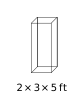
A refrigerator is 2 feet wide, 3 feet deep, and 5 feet tall. What is its volume?

Understanding Volume as an Attribute of Solid Figures visual for G5-C07-T01-Q010
  1. A 10 cubic feet
  2. B 15 cubic feet
  3. C 25 cubic feet
  4. D 30 cubic feet
Check answer and explanation

Answer D: 30 cubic feet

\(V = 2 \times 3 \times 5 = 30\) cubic feet.

G5-C07-T01-Q011 About 1 min

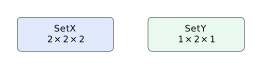
Which set of dimensions gives the larger volume?

Understanding Volume as an Attribute of Solid Figures visual for G5-C07-T01-Q011
  1. A Set X
  2. B Set Y
  3. C Both are equal
  4. D Cannot be determined
Check answer and explanation

Answer A: Set X

Set X: \(2 \times 2 \times 2 = 8\) cubic units. Set Y: \(1 \times 2 \times 1 = 2\) cubic units. Since \(8 > 2\), Set X gives the larger volume.

Page UP