Visual Model 1
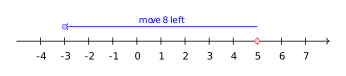
Question: Use the number line to find \(5+(-8)\).

- A. \(-13\)
- B. \(-3\)
- C. \(3\)
- D. \(13\)
Why it works: Start at \(5\) on a number line and move \(8\) units left. The result is \(5+(-8)=-3\).
Answer: \(-3\)


A focused Grade 6 learning session for Integer Addition and Subtraction using visual models, worked examples, strategy guidance, and a short mastery check.
Student goal: I can solve problems involving integer addition and subtraction.
Integer Addition and Subtraction means using place value, operations, and equations to reason accurately with numbers.
Question: Use the number line to find \(5+(-8)\).
Why it works: Start at \(5\) on a number line and move \(8\) units left. The result is \(5+(-8)=-3\).
Answer: \(-3\)
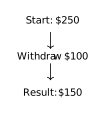
Question: A bank account starts at \($250\). After a withdrawal of \($100\), what is the new balance?

Answer: \($150\)
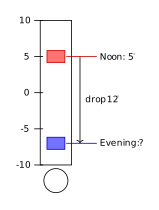
Question: The temperature at noon was \(5°\text{C}\). By evening, it dropped \(12°\text{C}\). Use the thermometer to find the evening temperature.

Answer: \(-7°\text{C}\)
Question: A hiker starts at elevation \(1{,}200\) feet and climbs to \(1{,}850\) feet. What is the change in elevation?
Why it works: Change in elevation: \(1{,}850-1{,}200=650\) feet.
Answer: \(650\) feet
Integer Addition and Subtraction becomes easier when students connect the question to a model, use clear steps, and explain why the answer fits.
Understand the model before choosing the operation.
Use scratch paper. The explanation matters more than simply seeing whether the choice is correct.
What is \(-7+3\)?
Answer B: \(-4\)
Start at \(-7\) on a number line and move \(3\) units right: \(-7+3=-4\).
Use the number line to find \(5+(-8)\).
Answer B: \(-3\)
Start at \(5\) on a number line and move \(8\) units left. The result is \(5+(-8)=-3\).
Which chip model shows \(-4+6\)? (Red chips = \(-1\), Blue chips = \(+1\))
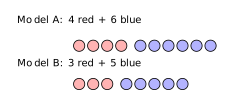
Answer A: Model A; answer is \(2\)
\(-4+6\): use 4 red and 6 blue chips. Pair and remove red-blue pairs. Result: 2 blue chips remaining, so \(-4+6=2\).
A bank account starts at \($250\). After a withdrawal of \($100\), what is the new balance?
Answer A: \($150\)
Starting balance: \(250\). Withdrawal is \(-100\). So \(250+(-100)=150\).
The temperature at noon was \(5°\text{C}\). By evening, it dropped \(12°\text{C}\). Use the thermometer to find the evening temperature.
Answer D: \(-7°\text{C}\)
Start at 5° and drop (subtract) 12°: \(5+(-12)=-7°\).
Show \(-5+(-3)\) on a number line.
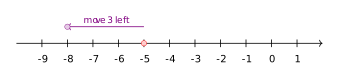
Answer A: Starts at \(-5\), ends at \(-8\), sum is \(-8\)
\(-5+(-3)=-8\). Start at \(-5\) and move 3 units left, landing at \(-8\).
A golf player has a score of \(-5\) (5 under par). She then plays another hole and her score drops by \(2\) more strokes. What is her new total score?
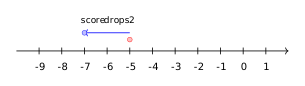
Answer A: \(-7\)
Starting score: \(-5\). Dropping 2 more means \(-5+(-2)=-7\).
Which number line correctly shows \(-4+6=2\)?
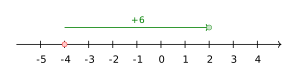
Answer A: Arrow goes from \(-4\) right \(6\) to \(2\)
Starting at \(-4\) and moving right \(6\) units: \(-4+6=2\).
Using a chip model where red chips represent \(-1\) and blue chips represent \(+1\), what is the sum?
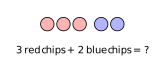
Answer A: \(-1\)
Red chips = negative. Blue chips = positive. Three red chips = \(-3\). Two blue chips = \(+2\). Total: \(-3+2=-1\).
What is \(2+(-2)\)?
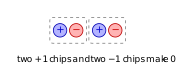
Answer B: \(0\)
A number and its opposite always sum to zero: \(2+(-2)=0\).
An elevator is at floor \(8\). It descends \(11\) floors. At which floor is the elevator now?
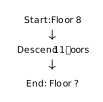
Answer A: \(-3\)
Starting floor: \(8\). Descending 11 floors: \(8+(-11)=-3\).
