What is \(-7+3\)?
- \(-10\)
- \(-4\)
- \(4\)
- \(10\)


Students will build Grade 6 mastery of integer addition and subtraction using models, equations, and test-style reasoning.
What is \(-7+3\)?
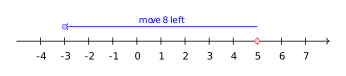
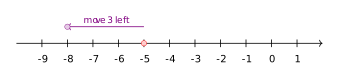
Use the number line to find \(5+(-8)\).
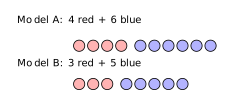
Which chip model shows \(-4+6\)? (Red chips = \(-1\), Blue chips = \(+1\))
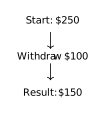
A bank account starts at \($250\). After a withdrawal of \($100\), what is the new balance?
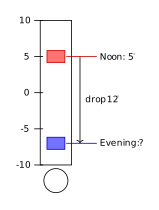
The temperature at noon was \(5°\text{C}\). By evening, it dropped \(12°\text{C}\). Use the thermometer to find the evening temperature.
Show \(-5+(-3)\) on a number line.
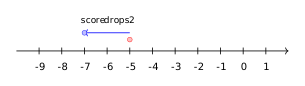
A golf player has a score of \(-5\) (5 under par). She then plays another hole and her score drops by \(2\) more strokes. What is her new total score?
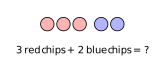
Using a chip model where red chips represent \(-1\) and blue chips represent \(+1\), what is the sum?
Start at \(-7\) on a number line and move \(3\) units right: \(-7+3=-4\).
Start at \(5\) on a number line and move \(8\) units left. The result is \(5+(-8)=-3\).
\(-4+6\): use 4 red and 6 blue chips. Pair and remove red-blue pairs. Result: 2 blue chips remaining, so \(-4+6=2\).
Starting balance: \(250\). Withdrawal is \(-100\). So \(250+(-100)=150\).
Start at 5° and drop (subtract) 12°: \(5+(-12)=-7°\).
\(-5+(-3)=-8\). Start at \(-5\) and move 3 units left, landing at \(-8\).
Starting score: \(-5\). Dropping 2 more means \(-5+(-2)=-7\).
Red chips = negative. Blue chips = positive. Three red chips = \(-3\). Two blue chips = \(+2\). Total: \(-3+2=-1\).
