A cube has an edge length of \(4\) cm. What is its total surface area?
- \(16\) cm\(^2\)
- \(64\) cm\(^2\)
- \(96\) cm\(^2\)
- \(128\) cm\(^2\)


Students will build Grade 6 mastery of nets and surface area using models, equations, and test-style reasoning.
A cube has an edge length of \(4\) cm. What is its total surface area?
A rectangular prism has length \(5\) cm, width \(3\) cm, and height \(2\) cm. What is its surface area using the formula \(SA = 2LW + 2LH + 2WH\)?
Which shape is a valid net of a cube?
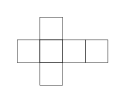
A rectangular prism has length \(8\) m, width \(4\) m, and height \(3\) m. Find the surface area.
Which net cannot fold into a cube without overlapping faces?
A triangular prism has a triangular base with area \(12\) cm\(^2\) and a perimeter of \(18\) cm. The height of the prism is \(5\) cm. What is the lateral surface area (the area of the three rectangular faces)?
A cube has a surface area of \(54\) cm\(^2\). What is the length of one edge?
A triangular prism has two congruent triangular bases (each with area \(20\) cm\(^2\)) and three rectangular faces with areas \(30\) cm\(^2\), \(40\) cm\(^2\), and \(50\) cm\(^2\). What is the total surface area?
A cube has \(6\) equal square faces. Each face has area \(4\times4=16\) cm\(^2\). Total surface area \(=6\times16=96\) cm\(^2\).
\(SA = 2(5)(3) + 2(5)(2) + 2(3)(2) = 30 + 20 + 12 = 62\) cm\(^2\).
A valid net for a cube has exactly 6 square faces arranged so that when folded, they form a cube without overlap. A cross pattern and other valid arrangements work; a line of only 4 squares cannot fold into a cube.
\(SA = 2(8)(4) + 2(8)(3) + 2(4)(3) = 64 + 48 + 24 = 152\) m\(^2\).
A straight line of 6 squares cannot fold into a cube. Valid cube nets require the squares to be arranged in 2D such that when folded in 3D, no faces overlap and all edges meet properly. A straight line does not satisfy this geometric constraint.
Lateral surface area (the three rectangles) \(=\) perimeter of base \(\times\) height \(= 18 \times 5 = 90\) cm\(^2\).
A cube has \(6\) equal square faces. If \(SA = 54\), then each face has area \(54 \div 6 = 9\) cm\(^2\). Since each face is a square, \(s^2 = 9\), so \(s = 3\) cm.
Total surface area \(=\) (area of two triangular bases) \(+\) (area of three rectangles) \(= 2(20) + 30 + 40 + 50 = 40 + 120 = 180\) cm\(^2\).
