CH04-06 lesson

Nets and Surface Area Learning Activity

A focused Grade 6 learning session for Nets and Surface Area using visual models, worked examples, strategy guidance, and a short mastery check.

18
minutes
6
lesson parts
11
practice items
Learning goal

Students will build Grade 6 mastery of nets and surface area using models, equations, and test-style reasoning.

Student goal: I can solve problems involving nets and surface area.

concept

Learn the Idea

Nets and Surface Area means measuring how much flat space a figure covers by using equal-sized square units.

  • Use square units that cover the figure without gaps or overlaps.
  • Count rows and columns when the unit squares are arranged in an array.
  • Connect repeated addition to multiplication when finding area.
  • Break complex figures into smaller rectangles when that makes the work clearer.
visual model

See the Math

Visual Model 1

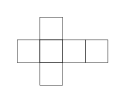
Question: Which shape is a valid net of a cube?

Visual Model 1

  • A. Cross pattern with 6 squares
  • B. Line of 5 squares with 1 attached
  • C. 2\(\times\)3 rectangle
  • D. Line of 4 squares only

Why it works: A valid net for a cube has exactly 6 square faces arranged so that when folded, they form a cube without overlap. A cross pattern and other valid arrangements work; a line of only 4 squares cannot fold into a cube.

Answer: Cross pattern with 6 squares

worked example

Follow a Worked Example

Example 1

Question: In the net of a cube, which arrangement would result in faces 1 and 2 being on opposite sides of the cube?

Example 1

  • A. 1 and 2
  • B. 3 and 6
  • C. 2 and 5
  • D. 1 and 4
  1. In this net arrangement (1-2-3-4 in a row, 5 above 2, 6 above 3), faces 1 and 4 are on opposite ends of the center line and will be opposite when the net is folded into a cube.

Answer: 1 and 4

Example 2

Question: A net shows a rectangle in the center with 4 rectangles attached to each side and 1 more rectangle on top. How many faces does the solid have?

Example 2

  • A. 4
  • B. 5
  • C. 6
  • D. 7
  1. A net with a central rectangle surrounded by 4 rectangles and 1 more makes 6 rectangles total, corresponding to the 6 faces of a rectangular prism.

Answer: 6

real world

Connect It to a Real Situation

Problem 1

Question: A student is trying to identify which face is missing from an incomplete cube net. The net shows 5 faces: a center square, with four squares attached to the four sides. Which position should the 6th face be attached to form a valid cube net?

  • A. One of the four outer sides of the outer squares
  • B. Any position that adds 1 face
  • C. Directly above one of the outer squares
  • D. It cannot form a valid cube net with only one more face

Why it works: A 5-square net (center + 4 adjacent) needs exactly 1 more face. Attaching it to any of the outer edges of the 4 surrounding squares will complete a valid cube net (e.g., a T-shape or an extended cross).

Answer: One of the four outer sides of the outer squares

strategy

Avoid Mistakes and Choose a Strategy

  • Counting only the outside squares instead of all squares inside the figure.
  • Leaving gaps or overlaps when using unit squares.
  • Multiplying side lengths before checking whether the figure is a rectangle.
  • Forgetting to write square units with an area answer.
  • Trace the rectangle or figure before counting.
  • Use rows and columns to organize unit squares.
  • Write an equation after the model makes sense.
  • Check whether the answer needs square units.
summary

Remember the Key Idea

Nets and Surface Area becomes easier when students connect the question to a model, use clear steps, and explain why the answer fits.

GOLDEN RULE

Area means every square unit inside the figure.

Guided to independent practice

Solve before opening the answer

Use scratch paper. The explanation matters more than simply seeing whether the choice is correct.

warmup

2 questions
G6-C04-T06-Q001 About 1 min

A cube has an edge length of \(4\) cm. What is its total surface area?

  1. A \(16\) cm\(^2\)
  2. B \(64\) cm\(^2\)
  3. C \(96\) cm\(^2\)
  4. D \(128\) cm\(^2\)
Check answer and explanation

Answer C: \(96\) cm\(^2\)

A cube has \(6\) equal square faces. Each face has area \(4\times4=16\) cm\(^2\). Total surface area \(=6\times16=96\) cm\(^2\).

G6-C04-T06-Q002 About 1 min

A rectangular prism has length \(5\) cm, width \(3\) cm, and height \(2\) cm. What is its surface area using the formula \(SA = 2LW + 2LH + 2WH\)?

  1. A \(30\) cm\(^2\)
  2. B \(52\) cm\(^2\)
  3. C \(62\) cm\(^2\)
  4. D \(124\) cm\(^2\)
Check answer and explanation

Answer C: \(62\) cm\(^2\)

\(SA = 2(5)(3) + 2(5)(2) + 2(3)(2) = 30 + 20 + 12 = 62\) cm\(^2\).

guided

1 question
G6-C04-T06-Q003 About 1 min

Which shape is a valid net of a cube?

Nets and Surface Area visual for G6-C04-T06-Q003
  1. A Cross pattern with 6 squares
  2. B Line of 5 squares with 1 attached
  3. C 2\(\times\)3 rectangle
  4. D Line of 4 squares only
Check answer and explanation

Answer A: Cross pattern with 6 squares

A valid net for a cube has exactly 6 square faces arranged so that when folded, they form a cube without overlap. A cross pattern and other valid arrangements work; a line of only 4 squares cannot fold into a cube.

practice

5 questions
G6-C04-T06-Q004 About 1 min

A rectangular prism has length \(8\) m, width \(4\) m, and height \(3\) m. Find the surface area.

  1. A \(96\) m\(^2\)
  2. B \(152\) m\(^2\)
  3. C \(192\) m\(^2\)
  4. D \(288\) m\(^2\)
Check answer and explanation

Answer B: \(152\) m\(^2\)

\(SA = 2(8)(4) + 2(8)(3) + 2(4)(3) = 64 + 48 + 24 = 152\) m\(^2\).

G6-C04-T06-Q005 About 1 min

Which net cannot fold into a cube without overlapping faces?

  1. A T-shaped net with 6 squares
  2. B Zigzag with 6 squares
  3. C Cross with 6 squares
  4. D Straight line of 6 squares
Check answer and explanation

Answer D: Straight line of 6 squares

A straight line of 6 squares cannot fold into a cube. Valid cube nets require the squares to be arranged in 2D such that when folded in 3D, no faces overlap and all edges meet properly. A straight line does not satisfy this geometric constraint.

G6-C04-T06-Q006 About 1 min

A triangular prism has a triangular base with area \(12\) cm\(^2\) and a perimeter of \(18\) cm. The height of the prism is \(5\) cm. What is the lateral surface area (the area of the three rectangular faces)?

  1. A \(60\) cm\(^2\)
  2. B \(90\) cm\(^2\)
  3. C \(120\) cm\(^2\)
  4. D \(132\) cm\(^2\)
Check answer and explanation

Answer B: \(90\) cm\(^2\)

Lateral surface area (the three rectangles) \(=\) perimeter of base \(\times\) height \(= 18 \times 5 = 90\) cm\(^2\).

G6-C04-T06-Q007 About 1 min

A cube has a surface area of \(54\) cm\(^2\). What is the length of one edge?

  1. A \(3\) cm
  2. B \(6\) cm
  3. C \(9\) cm
  4. D \(27\) cm
Check answer and explanation

Answer A: \(3\) cm

A cube has \(6\) equal square faces. If \(SA = 54\), then each face has area \(54 \div 6 = 9\) cm\(^2\). Since each face is a square, \(s^2 = 9\), so \(s = 3\) cm.

G6-C04-T06-Q008 About 1 min

A rectangular prism has dimensions \(6\) m \(\times\) \(4\) m \(\times\) \(2\) m. Which expression correctly computes its surface area?

  1. A \(2(6 + 4 + 2)\)
  2. B \(6 + 4 + 2 + 6 + 4 + 2\)
  3. C \(2(6 \times 4) + 2(6 \times 2) + 2(4 \times 2)\)
  4. D \(6 \times 4 \times 2\)
Check answer and explanation

Answer C: \(2(6 \times 4) + 2(6 \times 2) + 2(4 \times 2)\)

The surface area of a rectangular prism is \(SA = 2LW + 2LH + 2WH\). This accounts for all 6 faces: two \(L \times W\) faces, two \(L \times H\) faces, and two \(W \times H\) faces. Choice C is the correct formula.

exit

3 questions
G6-C04-T06-Q009 About 1 min

A triangular prism has two congruent triangular bases (each with area \(20\) cm\(^2\)) and three rectangular faces with areas \(30\) cm\(^2\), \(40\) cm\(^2\), and \(50\) cm\(^2\). What is the total surface area?

  1. A \(140\) cm\(^2\)
  2. B \(160\) cm\(^2\)
  3. C \(180\) cm\(^2\)
  4. D \(200\) cm\(^2\)
Check answer and explanation

Answer C: \(180\) cm\(^2\)

Total surface area \(=\) (area of two triangular bases) \(+\) (area of three rectangles) \(= 2(20) + 30 + 40 + 50 = 40 + 120 = 180\) cm\(^2\).

G6-C04-T06-Q010 About 1 min

Which net is NOT a valid net for a rectangular prism?

  1. A Cross with \(1 \times 4\) center and two squares on opposite sides
  2. B Two \(2 \times 3\) rectangles stacked vertically
  3. C Line of 6 squares
  4. D T-shape with \(3 \times 2\) base and three rectangles attached
Check answer and explanation

Answer C: Line of 6 squares

A rectangular prism net must have 6 rectangles (not necessarily squares) arranged such that opposite faces are congruent. A line of 6 identical unit squares cannot fold into a rectangular prism without severe overlap or gaps.

G6-C04-T06-Q011 About 1 min

A cube has edge length \(5\) cm. One face is painted red. How many edges of the cube are adjacent to the red face?

  1. A 2
  2. B 4
  3. C 6
  4. D 8
Check answer and explanation

Answer B: 4

A square face has 4 edges. These 4 edges form the boundary of the square and are shared with 4 adjacent faces on the cube.

Page UP