A rectangle has vertices at \((1,1)\), \((7,1)\), \((7,4)\), and \((1,4)\). What is its perimeter?
- \(9\) units
- \(15\) units
- \(18\) units
- \(24\) units


Students will build Grade 6 mastery of polygons on the coordinate plane using models, equations, and test-style reasoning.
A rectangle has vertices at \((1,1)\), \((7,1)\), \((7,4)\), and \((1,4)\). What is its perimeter?
A triangle has vertices at \((2,1)\), \((8,1)\), and \((5,5)\). What is the length of the base?
What type of polygon is shown?
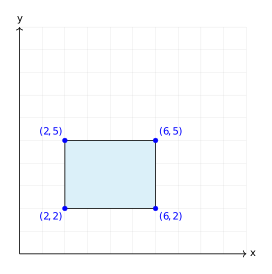
A quadrilateral has vertices at \((1,2)\), \((4,2)\), \((5,6)\), and \((2,6)\). What is the length of the top side?
What is the perimeter of the rectangle shown above?
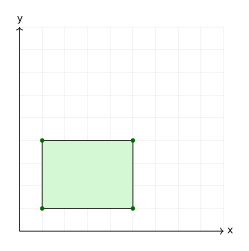
A rectangle has vertices at \((3,2)\), \((8,2)\), \((8,6)\), and \((3,6)\). If a point is at \((8,2)\), which vertex is diagonally opposite?
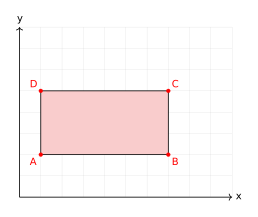
What is the length of side AB?
What is the length of a horizontal segment from \((2,4)\) to \((8,4)\)?
Length \(=7-1=6\) units; width \(=4-1=3\) units. Perimeter \(=2(6+3)=18\) units.
The base goes from \((2,1)\) to \((8,1)\), which are both on the same horizontal line. The distance is \(8-2=6\) units.
The shape has four sides with opposite sides parallel and all angles at \(90\) degrees. It is a rectangle but not a square since length \(\neq\) width.
The top side goes from \((2,6)\) to \((5,6)\), both at \(y=6\). Distance is \(5-2=3\) units.
Width \(=5-1=4\) units; height \(=4-1=3\) units. Perimeter \(=2(4+3)=14\) units.
Diagonal corners of a rectangle are \((3,2)\) with \((8,6)\), and \((8,2)\) with \((3,6)\). The diagonally opposite vertex to \((8,2)\) is \((3,6)\).
Side AB is horizontal from \((1,2)\) to \((7,2)\). Length \(=7-1=6\) units.
For a horizontal segment, subtract the \(x\)-coordinates: \(8-2=6\) units.
