CH04-04 lesson

Polygons on the Coordinate Plane Learning Activity

A focused Grade 6 learning session for Polygons on the Coordinate Plane using visual models, worked examples, strategy guidance, and a short mastery check.

18
minutes
6
lesson parts
11
practice items
Learning goal

Students will build Grade 6 mastery of polygons on the coordinate plane using models, equations, and test-style reasoning.

Student goal: I can solve problems involving polygons on the coordinate plane.

concept

Learn the Idea

Polygons on the Coordinate Plane means looking at attributes such as sides, angles, equal parts, and shape categories.

  • Look for attributes such as side count, equal sides, angles, and parallel sides.
  • Classify shapes using evidence instead of only how the shape looks.
  • Remember that one shape can belong to more than one category.
  • Use drawings to test whether the attributes really match the name.
visual model

See the Math

Visual Model 1

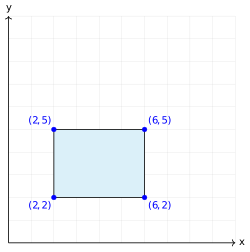
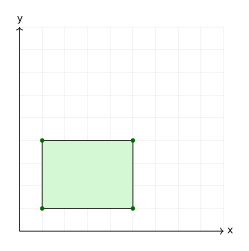
Question: What type of polygon is shown?

Visual Model 1

  • A. Square
  • B. Pentagon
  • C. Trapezoid
  • D. Rectangle

Why it works: The shape has four sides with opposite sides parallel and all angles at \(90\) degrees. It is a rectangle but not a square since length \(\neq\) width.

Answer: Rectangle

worked example

Follow a Worked Example

Example 1

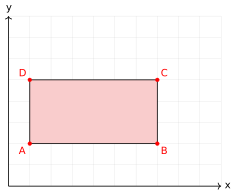
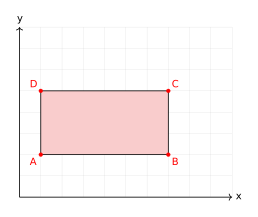
Question: What is the length of side AB?

Example 1

  • A. \(3\) units
  • B. \(4\) units
  • C. \(8\) units
  • D. \(6\) units
  1. Side AB is horizontal from \((1,2)\) to \((7,2)\).
  2. Length \(=7-1=6\) units.

Answer: \(6\) units

Example 2

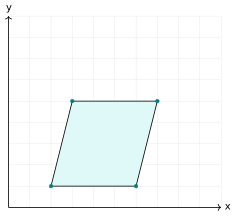
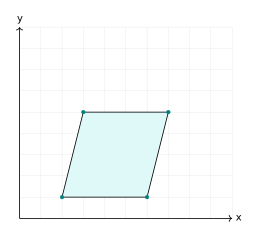
Question: What is the name of this quadrilateral?

Example 2

  • A. Parallelogram
  • B. Rectangle
  • C. Quadrilateral
  • D. Trapezoid
  1. The quadrilateral has one pair of parallel sides (top and bottom are parallel).
  2. This makes it a trapezoid.

Answer: Trapezoid

real world

Connect It to a Real Situation

Problem 1

Question: A student plots a rectangle and claims it has vertices at \((2,2)\), \((5,2)\), \((5,5)\), and \((3,5)\). What is the error?

  • A. The shape is not a rectangle because the sides are not parallel.
  • B. The \(y\)-coordinates are wrong.
  • C. The shape is a rectangle but with incorrect dimensions.
  • D. There is no error.

Why it works: The vertices \((2,2)\), \((5,2)\), \((5,5)\), and \((3,5)\) do not form a rectangle. The bottom side goes from \(x=2\) to \(x=5\) (length \(3\)), but the top side goes from \(x=3\) to \(x=5\) (length \(2\)). The sides are not parallel, so it is not a rectangle.

Answer: The shape is not a rectangle because the sides are not parallel.

strategy

Avoid Mistakes and Choose a Strategy

  • Naming a shape from appearance instead of attributes.
  • Forgetting that squares are also rectangles and quadrilaterals.
  • Mixing up sides and angles.
  • Assuming a rotated shape changed its category.
  • List attributes before naming the shape.
  • Use examples and non-examples to test a category.
  • Look for shared attributes across shape groups.
  • Draw a quick sketch when the wording feels abstract.
summary

Remember the Key Idea

Polygons on the Coordinate Plane becomes easier when students connect the question to a model, use clear steps, and explain why the answer fits.

GOLDEN RULE

Attributes prove the shape name.

Guided to independent practice

Solve before opening the answer

Use scratch paper. The explanation matters more than simply seeing whether the choice is correct.

warmup

2 questions
G6-C04-T04-Q001 About 1 min

A rectangle has vertices at \((1,1)\), \((7,1)\), \((7,4)\), and \((1,4)\). What is its perimeter?

  1. A \(9\) units
  2. B \(15\) units
  3. C \(18\) units
  4. D \(24\) units
Check answer and explanation

Answer C: \(18\) units

Length \(=7-1=6\) units; width \(=4-1=3\) units. Perimeter \(=2(6+3)=18\) units.

G6-C04-T04-Q002 About 1 min

A triangle has vertices at \((2,1)\), \((8,1)\), and \((5,5)\). What is the length of the base?

  1. A \(4\) units
  2. B \(6\) units
  3. C \(8\) units
  4. D \(10\) units
Check answer and explanation

Answer B: \(6\) units

The base goes from \((2,1)\) to \((8,1)\), which are both on the same horizontal line. The distance is \(8-2=6\) units.

guided

1 question
G6-C04-T04-Q003 About 1 min

What type of polygon is shown?

Polygons on the Coordinate Plane visual for G6-C04-T04-Q003
  1. A Square
  2. B Pentagon
  3. C Trapezoid
  4. D Rectangle
Check answer and explanation

Answer D: Rectangle

The shape has four sides with opposite sides parallel and all angles at \(90\) degrees. It is a rectangle but not a square since length \(\neq\) width.

practice

5 questions
G6-C04-T04-Q004 About 1 min

A quadrilateral has vertices at \((1,2)\), \((4,2)\), \((5,6)\), and \((2,6)\). What is the length of the top side?

  1. A \(2\) units
  2. B \(3\) units
  3. C \(4\) units
  4. D \(5\) units
Check answer and explanation

Answer B: \(3\) units

The top side goes from \((2,6)\) to \((5,6)\), both at \(y=6\). Distance is \(5-2=3\) units.

G6-C04-T04-Q005 About 1 min

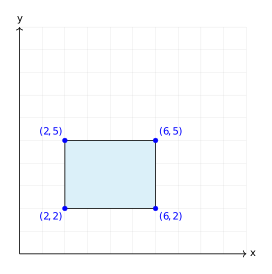
What is the perimeter of the rectangle shown above?

Polygons on the Coordinate Plane visual for G6-C04-T04-Q005
  1. A \(9\) units
  2. B \(12\) units
  3. C \(14\) units
  4. D \(16\) units
Check answer and explanation

Answer C: \(14\) units

Width \(=5-1=4\) units; height \(=4-1=3\) units. Perimeter \(=2(4+3)=14\) units.

G6-C04-T04-Q006 About 1 min

A rectangle has vertices at \((3,2)\), \((8,2)\), \((8,6)\), and \((3,6)\). If a point is at \((8,2)\), which vertex is diagonally opposite?

  1. A \((3,6)\)
  2. B \((3,2)\)
  3. C \((8,6)\)
  4. D \((8,2)\)
Check answer and explanation

Answer A: \((3,6)\)

Diagonal corners of a rectangle are \((3,2)\) with \((8,6)\), and \((8,2)\) with \((3,6)\). The diagonally opposite vertex to \((8,2)\) is \((3,6)\).

G6-C04-T04-Q007 About 1 min

What is the length of side AB?

Polygons on the Coordinate Plane visual for G6-C04-T04-Q007
  1. A \(3\) units
  2. B \(4\) units
  3. C \(8\) units
  4. D \(6\) units
Check answer and explanation

Answer D: \(6\) units

Side AB is horizontal from \((1,2)\) to \((7,2)\). Length \(=7-1=6\) units.

G6-C04-T04-Q008 About 1 min

A polygon has vertices at \((2,3)\), \((2,7)\), and \((6,3)\). What shape is this?

  1. A Triangle
  2. B Trapezoid
  3. C Square
  4. D Pentagon
Check answer and explanation

Answer A: Triangle

Three vertices form a triangle, which is a three-sided polygon.

exit

3 questions
G6-C04-T04-Q009 About 1 min

What is the length of a horizontal segment from \((2,4)\) to \((8,4)\)?

  1. A \(4\) units
  2. B \(5\) units
  3. C \(7\) units
  4. D \(6\) units
Check answer and explanation

Answer D: \(6\) units

For a horizontal segment, subtract the \(x\)-coordinates: \(8-2=6\) units.

G6-C04-T04-Q010 About 1 min

A vertical segment goes from \((5,2)\) to \((5,8)\). What is its length?

  1. A \(4\) units
  2. B \(5\) units
  3. C \(7\) units
  4. D \(6\) units
Check answer and explanation

Answer D: \(6\) units

For a vertical segment, subtract the \(y\)-coordinates: \(8-2=6\) units.

G6-C04-T04-Q011 About 1 min

What is the name of this quadrilateral?

Polygons on the Coordinate Plane visual for G6-C04-T04-Q011
  1. A Parallelogram
  2. B Rectangle
  3. C Quadrilateral
  4. D Trapezoid
Check answer and explanation

Answer D: Trapezoid

The quadrilateral has one pair of parallel sides (top and bottom are parallel). This makes it a trapezoid.

Page UP