A printer prints \(30\) pages in \(5\) minutes. At this rate, how many pages will it print in \(12\) minutes?
- \(36\)
- \(60\)
- \(90\)
- \(72\)


Students will build Grade 6 mastery of solving rate and ratio word problems using models, equations, and test-style reasoning.
A printer prints \(30\) pages in \(5\) minutes. At this rate, how many pages will it print in \(12\) minutes?
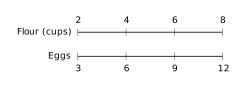
A recipe uses \(2\) cups of flour for every \(3\) eggs. How many cups of flour are needed for \(12\) eggs?
A sports team won \(15\) games and lost \(5\) games. What is the ratio of wins to total games played?
Store A sells \(8\) oranges for $2. Store B sells \(12\) oranges for $3. Which store offers the better price per orange?
If \(\frac{4}{6} = \frac{x}{15}\), what is the value of \(x\)?
A model train is built at a scale of \(1:50\). If the model is \(8\) inches long, how many inches long is the real train?
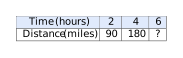
The table below shows a proportional relationship between distance and time. What is the missing value?
A car travels \(120\) miles in \(2\) hours. At the same rate, how far will it travel in \(5\) hours?
The unit rate is \(30\div5=6\) pages per minute. In \(12\) minutes the printer prints \(6\times12=72\) pages.
The ratio is \(2:3\) (flour to eggs). For \(12\) eggs, multiply both parts by \(4\): \(2 \times 4 = 8\) cups of flour.
Total games: \(15 + 5 = 20\). Ratio of wins to total is \(15:20\), which simplifies to \(3:4\) by dividing both by \(5\).
Store A: \(2 \div 8 = 0.25\) per orange. Store B: \(3 \div 12 = 0.25\) per orange. Same unit rate.
Cross-multiply: \(4 \times 15 = 6 \times x\), so \(60 = 6x\), thus \(x = 10\).
At a scale of \(1:50\), the real object is \(50\) times larger. \(8 \times 50 = 400\) inches.
Rate is \(90 \div 2 = 45\) miles per hour. For \(6\) hours: \(45 \times 6 = 270\) miles.
Step 1: Rate is \(120 \div 2 = 60\) mph. Step 2: Distance in \(5\) hours is \(60 \times 5 = 300\) miles.
