Visual Model 1
Question: Study the labeled expression diagram below: What is the coefficient in Term 3?

- A. \(2\)
- B. \(7\)
- C. \(y\)
- D. \(4\)
Why it works: Term 3 is \(2y\), so the coefficient is \(2\).
Answer: \(2\)


A focused Grade 6 learning session for Terms, Factors, and Coefficients using visual models, worked examples, strategy guidance, and a short mastery check.
Student goal: I can solve problems involving terms, factors, and coefficients.
Terms, Factors, and Coefficients means choosing a model, naming what each number means, and explaining the strategy.
Question: Study the labeled expression diagram below: What is the coefficient in Term 3?
Why it works: Term 3 is \(2y\), so the coefficient is \(2\).
Answer: \(2\)
Question: In the expression shown, what is the sum of all coefficients?

Answer: \(4\)
Question: Complete the table by identifying the number of terms in each expression: What is the total of the two missing numbers?
| Expression | Number of Terms |
|---|---|
| \(7a\) | \(1\) |
| \(4x + 2y\) | ? |
| \(5m + 3n + 2p + 1\) | ? |
Answer: \(6\)
Question: A garden is \(8\) meters long and \(w\) meters wide. The area is \(8w\) square meters. In the expression \(8w\), what are the factors?
Why it works: In a product, factors are the numbers or variables being multiplied. Here, \(8 \times w = 8w\), so the factors are \(8\) and \(w\).
Answer: \(8\) and \(w\)
Terms, Factors, and Coefficients becomes easier when students connect the question to a model, use clear steps, and explain why the answer fits.
Understand the model before choosing the operation.
Use scratch paper. The explanation matters more than simply seeing whether the choice is correct.
In the expression \(5x+3y+8\), what is the coefficient of \(y\)?
Answer B: \(3\)
The coefficient is the number multiplied by the variable. The term \(3y\) has coefficient \(3\).
Which expression has exactly 4 terms?
Answer B: \(3x+2y+4z+1\)
Counting each separated term: \(3x\), \(2y\), \(4z\), and \(1\) gives 4 terms.
What is the coefficient of \(x\) in the expression \(-4x+9+2y\)?
Answer D: \(-4\)
The coefficient includes the sign. Since the term is \(-4x\), the coefficient is \(-4\), not \(4\).
In the expression \(6a+3b+7\), which is the constant term?
Answer C: \(7\)
A constant term is a number with no variable attached. Here, \(7\) is the only constant.
What is the coefficient of \(m\) in the expression \(m+5n+2\)?
Answer B: \(1\)
When a variable appears with no visible number, the coefficient is \(1\). So \(m = 1m\).
Study the labeled expression diagram below: What is the coefficient in Term 3?
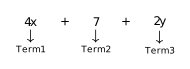
Answer A: \(2\)
Term 3 is \(2y\), so the coefficient is \(2\).
Which pair are like terms?
Answer D: \(2m\) and \(2m\)
Like terms have the same variable raised to the same power. Both \(2m\) and \(2m\) are identical terms.
Which pair are unlike terms?
Answer C: \(4a\) and \(4b\)
\(4a\) and \(4b\) have different variables (\(a\) vs.\ \(b\)), so they are unlike terms.
Use the table to match each term to its coefficient: What is the coefficient of the third term (a constant with no variable)?
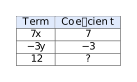
Answer A: The constant has no coefficient
A constant term like \(12\) is a number with no variable. Constants do not have coefficients; coefficients are numbers that multiply variables.
A garden is \(8\) meters long and \(w\) meters wide. The area is \(8w\) square meters. In the expression \(8w\), what are the factors?
Answer A: \(8\) and \(w\)
In a product, factors are the numbers or variables being multiplied. Here, \(8 \times w = 8w\), so the factors are \(8\) and \(w\).
How many terms does the expression \(9a+4b+3c+2\) have?
Answer C: \(4\)
Each term separated by \(+\) or \(-\) counts as one term. Here: \(9a\), \(4b\), \(3c\), \(2\).
