In the expression \(5x+3y+8\), what is the coefficient of \(y\)?
- \(5\)
- \(3\)
- \(8\)
- \(y\)


Students will build Grade 6 mastery of terms, factors, and coefficients using models, equations, and test-style reasoning.
In the expression \(5x+3y+8\), what is the coefficient of \(y\)?
Which expression has exactly 4 terms?
What is the coefficient of \(x\) in the expression \(-4x+9+2y\)?
In the expression \(6a+3b+7\), which is the constant term?
What is the coefficient of \(m\) in the expression \(m+5n+2\)?
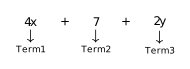
Study the labeled expression diagram below: What is the coefficient in Term 3?
Which pair are like terms?
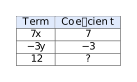
Use the table to match each term to its coefficient: What is the coefficient of the third term (a constant with no variable)?
The coefficient is the number multiplied by the variable. The term \(3y\) has coefficient \(3\).
Counting each separated term: \(3x\), \(2y\), \(4z\), and \(1\) gives 4 terms.
The coefficient includes the sign. Since the term is \(-4x\), the coefficient is \(-4\), not \(4\).
A constant term is a number with no variable attached. Here, \(7\) is the only constant.
When a variable appears with no visible number, the coefficient is \(1\). So \(m = 1m\).
Term 3 is \(2y\), so the coefficient is \(2\).
Like terms have the same variable raised to the same power. Both \(2m\) and \(2m\) are identical terms.
A constant term like \(12\) is a number with no variable. Constants do not have coefficients; coefficients are numbers that multiply variables.
