CH02-09 lesson

The Coordinate Plane Learning Activity

A focused Grade 6 learning session for The Coordinate Plane using visual models, worked examples, strategy guidance, and a short mastery check.

18
minutes
6
lesson parts
11
practice items
Learning goal

Students will build Grade 6 mastery of the coordinate plane using models, equations, and test-style reasoning.

Student goal: I can solve problems involving the coordinate plane.

concept

Learn the Idea

The Coordinate Plane means choosing a model, naming what each number means, and explaining the strategy.

  • Read the question carefully and identify what is being asked.
  • Choose a model, equation, table, or diagram that matches the situation.
  • Solve one step at a time and keep units or labels attached.
  • Use the answer explanation to check that the result makes sense.
visual model

See the Math

Visual Model 1

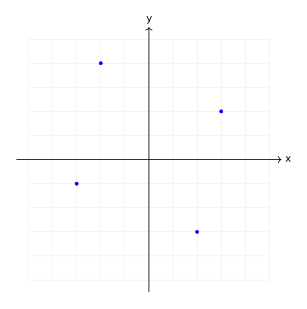
Question: Which point is in Quadrant II?

Visual Model 1

  • A. \((3, 2)\)
  • B. \((-2, 4)\)
  • C. \((-3, -1)\)
  • D. \((2, -3)\)

Why it works: From the graph, the point in Quadrant II (upper left) is \((-2, 4)\), which has a negative \(x\)-coordinate and positive \(y\)-coordinate.

Answer: \((-2, 4)\)

worked example

Follow a Worked Example

Example 1

Question: How many of the plotted points are in Quadrant I?

Example 1

  • A. 1
  • B. 2
  • C. 3
  • D. 4
  1. Only the point \((3, 1)\) has both positive \(x\) and positive \(y\) coordinates, placing it in Quadrant I.

Answer: 1

Example 2

Question: Point \(R\) is reflected across the \(y\)-axis. In which quadrant does the reflected point lie?

Example 2

  • A. Quadrant I
  • B. Quadrant II
  • C. Quadrant III
  • D. Quadrant IV
  1. Point \(R\) is at \((4, -3)\).
  2. Reflecting across the \(y\)-axis gives \((-4, -3)\), which is in Quadrant III (both coordinates negative).

Answer: Quadrant III

real world

Connect It to a Real Situation

Problem 1

Question: A student plotted a point and said it was at \((-4, -2)\) in Quadrant II. What mistake did the student make?

  • A. The \(x\)-coordinate should be positive
  • B. Both coordinates should be negative for Quadrant II
  • C. The coordinates are swapped
  • D. The point is actually in Quadrant III

Why it works: The point \((-4, -2)\) has both negative coordinates, placing it in Quadrant III (lower left), not Quadrant II. Quadrant II requires a negative \(x\) and positive \(y\).

Answer: The point is actually in Quadrant III

strategy

Avoid Mistakes and Choose a Strategy

  • Rushing before identifying what the numbers represent.
  • Choosing an operation that does not match the situation.
  • Dropping labels, units, or context from the answer.
  • Skipping the estimate or reasonableness check.
  • Underline the question being asked.
  • Use a model before jumping to computation.
  • Write an equation that matches the story or picture.
  • Explain the final answer in a sentence.
summary

Remember the Key Idea

The Coordinate Plane becomes easier when students connect the question to a model, use clear steps, and explain why the answer fits.

GOLDEN RULE

Understand the model before choosing the operation.

Guided to independent practice

Solve before opening the answer

Use scratch paper. The explanation matters more than simply seeing whether the choice is correct.

warmup

2 questions
G6-C02-T09-Q001 About 1 min

In which quadrant is the point \((-3,4)\) located?

  1. A Quadrant I
  2. B Quadrant II
  3. C Quadrant III
  4. D Quadrant IV
Check answer and explanation

Answer B: Quadrant II

The point \((-3,4)\) has a negative \(x\)-coordinate and a positive \(y\)-coordinate. Points with \((-,+)\) are in Quadrant II.

G6-C02-T09-Q002 About 1 min

Which ordered pair is located in Quadrant III?

  1. A \((2, 5)\)
  2. B \((-1, 3)\)
  3. C \((-4, -2)\)
  4. D \((3, -6)\)
Check answer and explanation

Answer C: \((-4, -2)\)

Quadrant III contains points where both coordinates are negative. The point \((-4, -2)\) has negative \(x\) and negative \(y\), so it is in Quadrant III.

guided

1 question
G6-C02-T09-Q003 About 1 min

What are the coordinates of a point on the positive \(x\)-axis?

  1. A \((0, 5)\)
  2. B \((0, -2)\)
  3. C \((-3, 0)\)
  4. D \((4, 0)\)
Check answer and explanation

Answer D: \((4, 0)\)

Points on the \(x\)-axis have a \(y\)-coordinate of \(0\). For a point to be on the positive \(x\)-axis, the \(x\)-coordinate must be positive. The point \((4, 0)\) satisfies both conditions.

practice

5 questions
G6-C02-T09-Q004 About 1 min

The point \((5, -3)\) is located in which quadrant?

  1. A Quadrant I
  2. B Quadrant II
  3. C Quadrant III
  4. D Quadrant IV
Check answer and explanation

Answer D: Quadrant IV

The point \((5, -3)\) has a positive \(x\)-coordinate and a negative \(y\)-coordinate. Points with \((+,-)\) are located in Quadrant IV.

G6-C02-T09-Q005 About 1 min

If a point is reflected across the \(y\)-axis, which coordinate changes?

  1. A Only the \(x\)-coordinate
  2. B Only the \(y\)-coordinate
  3. C Both coordinates
  4. D Neither coordinate
Check answer and explanation

Answer A: Only the \(x\)-coordinate

When reflecting across the \(y\)-axis, the point flips left to right. This changes the sign of the \(x\)-coordinate while the \(y\)-coordinate stays the same.

G6-C02-T09-Q006 About 1 min

What is the reflection of the point \((2, 6)\) across the \(x\)-axis?

  1. A \((-2, 6)\)
  2. B \((2, -6)\)
  3. C \((-2, -6)\)
  4. D \((6, 2)\)
Check answer and explanation

Answer B: \((2, -6)\)

Reflection across the \(x\)-axis changes the sign of the \(y\)-coordinate while the \(x\)-coordinate remains the same. The point \((2, 6)\) becomes \((2, -6)\).

G6-C02-T09-Q007 About 1 min

Which point is in Quadrant II?

The Coordinate Plane visual for G6-C02-T09-Q007
  1. A \((3, 2)\)
  2. B \((-2, 4)\)
  3. C \((-3, -1)\)
  4. D \((2, -3)\)
Check answer and explanation

Answer B: \((-2, 4)\)

From the graph, the point in Quadrant II (upper left) is \((-2, 4)\), which has a negative \(x\)-coordinate and positive \(y\)-coordinate.

G6-C02-T09-Q008 About 1 min

A point on the \(y\)-axis must have which coordinate equal to zero?

  1. A The \(x\)-coordinate
  2. B The \(y\)-coordinate
  3. C Both coordinates
  4. D Neither (the origin only)
Check answer and explanation

Answer A: The \(x\)-coordinate

All points on the \(y\)-axis have an \(x\)-coordinate of \(0\), regardless of the \(y\)-coordinate value.

exit

3 questions
G6-C02-T09-Q009 About 1 min

Which ordered pair is in Quadrant I?

  1. A \((-5, 7)\)
  2. B \((1, -8)\)
  3. C \((-2, -4)\)
  4. D \((8, 3)\)
Check answer and explanation

Answer D: \((8, 3)\)

Quadrant I contains points with positive \(x\) and positive \(y\) coordinates. The point \((8, 3)\) has both coordinates positive.

G6-C02-T09-Q010 About 1 min

When the point \((a, b)\) is reflected across the \(y\)-axis, the new point is:

  1. A \((-a, b)\)
  2. B \((a, -b)\)
  3. C \((-a, -b)\)
  4. D \((b, a)\)
Check answer and explanation

Answer A: \((-a, b)\)

Reflecting across the \(y\)-axis flips the \(x\)-coordinate to its opposite, giving \((-a, b)\).

G6-C02-T09-Q011 About 1 min

What is the reflection of \((-4, -5)\) across the \(x\)-axis?

  1. A \((4, 5)\)
  2. B \((-4, 5)\)
  3. C \((4, -5)\)
  4. D \((-4, -5)\)
Check answer and explanation

Answer B: \((-4, 5)\)

Reflection across the \(x\)-axis changes the sign of the \(y\)-coordinate only. The point \((-4, -5)\) becomes \((-4, 5)\).

Page UP