In which quadrant is the point \((-3,4)\) located?
- Quadrant I
- Quadrant II
- Quadrant III
- Quadrant IV


Students will build Grade 6 mastery of the coordinate plane using models, equations, and test-style reasoning.
In which quadrant is the point \((-3,4)\) located?
Which ordered pair is located in Quadrant III?
What are the coordinates of a point on the positive \(x\)-axis?
The point \((5, -3)\) is located in which quadrant?
If a point is reflected across the \(y\)-axis, which coordinate changes?
What is the reflection of the point \((2, 6)\) across the \(x\)-axis?
Which point is in Quadrant II?
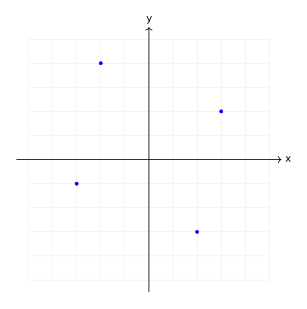
Which ordered pair is in Quadrant I?
The point \((-3,4)\) has a negative \(x\)-coordinate and a positive \(y\)-coordinate. Points with \((-,+)\) are in Quadrant II.
Quadrant III contains points where both coordinates are negative. The point \((-4, -2)\) has negative \(x\) and negative \(y\), so it is in Quadrant III.
Points on the \(x\)-axis have a \(y\)-coordinate of \(0\). For a point to be on the positive \(x\)-axis, the \(x\)-coordinate must be positive. The point \((4, 0)\) satisfies both conditions.
The point \((5, -3)\) has a positive \(x\)-coordinate and a negative \(y\)-coordinate. Points with \((+,-)\) are located in Quadrant IV.
When reflecting across the \(y\)-axis, the point flips left to right. This changes the sign of the \(x\)-coordinate while the \(y\)-coordinate stays the same.
Reflection across the \(x\)-axis changes the sign of the \(y\)-coordinate while the \(x\)-coordinate remains the same. The point \((2, 6)\) becomes \((2, -6)\).
From the graph, the point in Quadrant II (upper left) is \((-2, 4)\), which has a negative \(x\)-coordinate and positive \(y\)-coordinate.
Quadrant I contains points with positive \(x\) and positive \(y\) coordinates. The point \((8, 3)\) has both coordinates positive.
