Evaluate: \(-\frac{3}{4}+\frac{1}{2}\)
- \(-\frac{5}{4}\)
- \(-\frac{1}{4}\)
- \(\frac{1}{4}\)
- \(\frac{5}{4}\)


Students will build Grade 7 mastery of adding and subtracting rational numbers using models, equations, and test-style reasoning.
Evaluate: \(-\frac{3}{4}+\frac{1}{2}\)
What is \(-\frac{3}{5}+\frac{4}{5}\)?
Evaluate: \(5.2 - 7.1\)
Add: \(1\frac{1}{3} + 2\frac{1}{6}\)
Which expression is equivalent to \(8 - 3\)?
Evaluate: \(-\frac{5}{6} - \frac{1}{3}\)
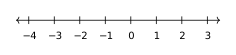
Use the number line below. Start at \(-2\) and add \(3\). Where do you end?
Subtract: \(\frac{7}{8} - \frac{1}{4}\)
Find a common denominator: \(-\frac{3}{4}+\frac{2}{4}=-\frac{1}{4}\).
When denominators are the same, add the numerators: \(-\frac{3}{5}+\frac{4}{5}=\frac{1}{5}\).
Since \(5.2 < 7.1\), the difference is negative: \(5.2 - 7.1 = -1.9\).
Convert to common denominator 6: \(1\frac{2}{6} + 2\frac{1}{6} = 3\frac{3}{6} = 3\frac{1}{2}\).
Subtraction can be rewritten as adding the opposite: \(8 - 3 = 8 + (-3) = 5\).
Common denominator is 6: \(-\frac{5}{6} - \frac{2}{6} = -\frac{7}{6} = -1\frac{1}{6}\).
Starting at \(-2\) and moving right 3 units: \(-2 + 3 = 1\).
Common denominator is 8: \(\frac{7}{8} - \frac{2}{8} = \frac{5}{8}\).
