

CH01-06 lesson

Applying Proportional Reasoning to Real-World Problems Learning Activity

A focused Grade 7 learning session for Applying Proportional Reasoning to Real-World Problems using visual models, worked examples, strategy guidance, and a short mastery check.

18
minutes
6
lesson parts
11
practice items
Learning goal

Students will build Grade 7 mastery of applying proportional reasoning to real-world problems using models, equations, and test-style reasoning.

Student goal: I can solve problems involving applying proportional reasoning to real-world problems.

concept

Learn the Idea

Applying Proportional Reasoning to Real-World Problems is part of Grade 7 Ratios and Proportional Relationships. This activity focuses on the central idea students need before they move into independent practice.

Students will build Grade 7 mastery of applying proportional reasoning to real-world problems using models, equations, and test-style reasoning.

visual model

See the Math

What to noticeHow to use it
Numbers, units, labels, diagrams, or graphsIdentify what each part represents before calculating.
The relationship in the problemConnect the model to an equation, comparison, or explanation.

Use the figures and worked questions in the practice set below as the visual model for this skill.

worked example

Follow a Worked Example

Read the first practice question slowly. Decide what the question is asking, choose a strategy, solve, and then compare your reasoning with the answer explanation.

For Applying Proportional Reasoning to Real-World Problems, a strong worked example should show the setup, the calculation or model, and a final answer that matches the context.

real world

Connect It to a Real Situation

Many Grade 7 test questions use real situations. Look for quantities, units, rates, measures, expressions, or data values that connect the math to the story.

After solving, explain what the answer means in the situation, not just the number you calculated.

strategy

Avoid Mistakes and Choose a Strategy

  • Underline the exact question before solving.
  • Label units, variables, or graph axes when they appear.
  • Estimate first so unreasonable answers are easier to catch.
  • Review missed questions and write the reason for each mistake.
summary

Remember the Key Idea

I can solve problems involving applying proportional reasoning to real-world problems.

Use the warmup, guided question, practice set, and exit questions below to check whether this skill is ready or needs more practice.

Guided to independent practice

Solve before opening the answer

Use scratch paper. The explanation matters more than simply seeing whether the choice is correct.

warmup

2 questions
G7-C01-T06-Q001 About 1 min

A fruit stand sells apples and oranges in the ratio \(12:8\). In simplest form, what is the ratio?

  1. A \(6:4\)
  2. B \(4:3\)
  3. C \(2:3\)
  4. D \(3:2\)
Check answer and explanation

Answer D: \(3:2\)

Divide both \(12\) and \(8\) by their GCD, which is \(4\): \(12 \div 4 = 3\) and \(8 \div 4 = 2\). So the simplest form is \(3:2\).
G7-C01-T06-Q002 About 1 min

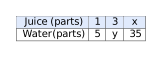
A beverage mix uses \(1\) part juice concentrate for every \(5\) parts water. Complete the ratio table: What is \(x + y\)?

Applying Proportional Reasoning to Real-World Problems visual for G7-C01-T06-Q002
  1. A \(17\)
  2. B \(20\)
  3. C \(22\)
  4. D \(25\)
Check answer and explanation

Answer C: \(22\)

Ratio is \(1:5\). When juice \(= 3\): water \(= 3 \times 5 = 15\), so \(y = 15\). When water \(= 35\): juice \(= 35 \div 5 = 7\), so \(x = 7\). Thus \(x + y = 7 + 15 = 22\).

guided

1 question
G7-C01-T06-Q003 About 1 min

A recipe for lemonade uses \(2\) cups lemon juice and \(8\) cups water. Which statement is true?

  1. A The ratio of lemon to water is \(1:3\)
  2. B The ratio of lemon to water is \(1:4\)
  3. C For every \(3\) cups of lemon, there are \(12\) cups of water
  4. D The ratio of water to lemon is \(3:1\)
Check answer and explanation

Answer B: The ratio of lemon to water is \(1:4\)

Ratio \(2:8\) simplifies to \(1:4\) (divide both by 2). Option D incorrectly states \(3:1\) instead of \(4:1\).

practice

5 questions
G7-C01-T06-Q004 About 1 min

A recipe for cookies uses a flour-to-butter ratio of \(8:3\). Which of the following quantities represents the same ratio?

  1. A \(12\) cups flour, \(4\) cups butter
  2. B \(24\) cups flour, \(8\) cups butter
  3. C \(8\) cups flour, \(6\) cups butter
  4. D \(16\) cups flour, \(6\) cups butter
Check answer and explanation

Answer D: \(16\) cups flour, \(6\) cups butter

Ratio \(8:3\) scaled by \(2\) gives \(16:6\). Check: \(\frac{16}{6} = \frac{8}{3}\) (divide numerator and denominator by 2). Option B reduces to \(3:1\). Option C reduces to \(4:3\) (not \(8:3\)).

G7-C01-T06-Q005 About 1 min

A salt water solution uses a ratio of \(2\) parts salt to \(9\) parts water. If you use \(18\) cups of water, how many cups of salt are needed?

  1. A \(2\) cups
  2. B \(3\) cups
  3. C \(4\) cups
  4. D \(6\) cups
Check answer and explanation

Answer C: \(4\) cups

Ratio \(2:9\). If water \(= 18\), then \(\frac{2}{9} = \frac{x}{18}\), so \(x = 2 \times 2 = 4\) cups salt.

G7-C01-T06-Q006 About 1 min

A store sells \(6\) notebooks for $15. What is the unit price (cost per notebook)?

  1. A $1.50
  2. B $5.00
  3. C $4.00
  4. D $2.50
Check answer and explanation

Answer D: $2.50

Unit price \(= $15 \div 6 = $2.50\) per notebook.

G7-C01-T06-Q007 About 1 min

A cyclist travels at an average speed of \(15\) miles per hour. How far does the cyclist travel in \(2.5\) hours?

  1. A \(27.5\) miles
  2. B \(30\) miles
  3. C \(35\) miles
  4. D \(37.5\) miles
Check answer and explanation

Answer D: \(37.5\) miles

Distance \(= \text{speed} \times \text{time} = 15 \times 2.5 = 37.5\) miles.

G7-C01-T06-Q008 About 1 min

A train travels at a constant speed of \(60\) miles per hour. If the train travels for \(3.5\) hours, how many miles does it cover?

  1. A \(180\) miles
  2. B \(200\) miles
  3. C \(210\) miles
  4. D \(240\) miles
Check answer and explanation

Answer C: \(210\) miles

Distance \(= \text{speed} \times \text{time} = 60 \times 3.5 = 210\) miles.

exit

3 questions
G7-C01-T06-Q009 About 1 min

A sedan travels \(210\) miles on \(10\) gallons of gas. An SUV travels \(180\) miles on \(12\) gallons of gas. Which vehicle has the better fuel efficiency (miles per gallon)?

  1. A Cannot be determined
  2. B The SUV (\(15\) mpg vs.~\(21\) mpg)
  3. C They are equal
  4. D The sedan (\(21\) mpg vs.~\(15\) mpg)
Check answer and explanation

Answer D: The sedan (\(21\) mpg vs.~\(15\) mpg)

Sedan: \(210 \div 10 = 21\) mpg. SUV: \(180 \div 12 = 15\) mpg. The sedan has better fuel efficiency.

G7-C01-T06-Q010 About 1 min

The cost \(C\) (in dollars) of buying \(n\) pounds of apples is given by \(C = 0.75n\). What does \(0.75\) represent?

  1. A The number of apples
  2. B The weight of apples
  3. C The total cost
  4. D The cost per pound of apples
Check answer and explanation

Answer D: The cost per pound of apples

In a proportional relationship \(C = kn\), the constant \(k\) represents the unit rate. Here, \(k = 0.75\) dollars per pound.

G7-C01-T06-Q011 About 1 min

Which of the following represents a proportional relationship between \(x\) and \(y\)?

  1. A \(y = 2x + 3\)
  2. B \(y = \frac{1}{x}\)
  3. C \(y = x^2\)
  4. D \(y = 5x\)
Check answer and explanation

Answer D: \(y = 5x\)

A proportional relationship has the form \(y = kx\) (no constant term). Only \(y=5x\) fits this form.

Page UP