The graph shows a proportional relationship between hours worked and dollars earned. It passes through the origin and the point \((2,30)\). What is the unit rate (dollars per hour)?
- \($2\) per hour
- \($60\) per hour
- \($28\) per hour
- \($15\) per hour


Students will build Grade 7 mastery of graphing proportional relationships using models, equations, and test-style reasoning.
The graph shows a proportional relationship between hours worked and dollars earned. It passes through the origin and the point \((2,30)\). What is the unit rate (dollars per hour)?
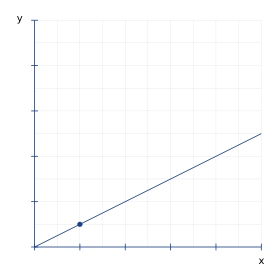
The graph shows a proportional relationship. What is the unit rate (the value of \(y\) at \(x=1\))?
Maya runs at a constant speed. The relationship between distance (miles) and time (hours) is proportional and passes through \((3, 18)\). How far does she run per hour?
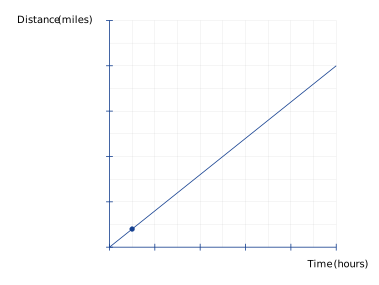
A car drives at a constant speed shown by this graph with unit-rate point \((1, 0.8)\). Which equation represents this relationship?
A recipe for lemonade uses a constant ratio of sugar to water. The graph shows a proportional relationship that passes through the point \((4,6)\), where \(x\) = cups of sugar and \(y\) = cups of water. How many cups of water are needed for 8 cups of sugar?
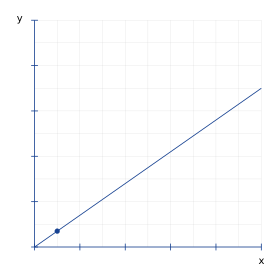
Which equation represents this proportional relationship?
A book club orders books in bulk at a constant price per book. If 10 books cost \($120\), how much do 15 books cost?
A store sells apples at a constant unit price. A customer buys 6 apples for \($4.50\). How much does one apple cost?
The unit rate is the \(y\)-value when \(x=1\). Because \((2,30)\) is on the line through the origin, \(k=30/2=15\), so earning rate is \($15\) per hour.
A proportional relationship passes through the origin. The marked point is \((2,1)\), so the unit rate \(k = 1/2 = 0.5\). The line equation is \(y = 0.5x\).
From the point \((3,18)\), the unit rate is \(18 \div 3 = 6\) miles per hour.
The unit-rate point \((1, 0.8)\) shows \(k = 0.8\), so the equation is \(y = 0.8x\).
The unit rate is \(6 \div 4 = 1.5\). So \(y = 1.5x\). At \(x = 8\), \(y = 1.5 \times 8 = 12\) cups.
The unit-rate marker at \((1, 0.7)\) shows \(k = 0.7\). So the equation is \(y = 0.7x\).
Unit rate is \($120 \div 10 = $12\) per book. For 15 books: \(15 \times $12 = $180\).
Unit price = \($4.50 \div 6 = $0.75\) per apple.
