A circle has a diameter of \(14\) cm. What is its radius?
- A \(7\) cm
- B \(14\) cm
- C \(21\) cm
- D \(28\) cm
Check answer and explanation
Answer A: \(7\) cm
The radius is half the diameter: \(14\div2=7\) cm.


A focused Grade 7 learning session for Parts of a Circle using visual models, worked examples, strategy guidance, and a short mastery check.
Student goal: I can solve problems involving parts of a circle.
Parts of a Circle is part of Grade 7 Measurement Geometry. This activity focuses on the central idea students need before they move into independent practice.
Students will build Grade 7 mastery of parts of a circle using models, equations, and test-style reasoning.
| What to notice | How to use it |
|---|---|
| Numbers, units, labels, diagrams, or graphs | Identify what each part represents before calculating. |
| The relationship in the problem | Connect the model to an equation, comparison, or explanation. |
Use the figures and worked questions in the practice set below as the visual model for this skill.
Read the first practice question slowly. Decide what the question is asking, choose a strategy, solve, and then compare your reasoning with the answer explanation.
For Parts of a Circle, a strong worked example should show the setup, the calculation or model, and a final answer that matches the context.
Many Grade 7 test questions use real situations. Look for quantities, units, rates, measures, expressions, or data values that connect the math to the story.
After solving, explain what the answer means in the situation, not just the number you calculated.
I can solve problems involving parts of a circle.
Use the warmup, guided question, practice set, and exit questions below to check whether this skill is ready or needs more practice.
Use scratch paper. The explanation matters more than simply seeing whether the choice is correct.
A circle has a diameter of \(14\) cm. What is its radius?
Answer A: \(7\) cm
The radius is half the diameter: \(14\div2=7\) cm.
The diagram below shows a circle with center \(O\). Which line segment is the radius of the circle?
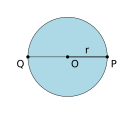
Answer A: \(OP\)
The radius is any segment from the center to the circle. \(OP\) is labeled and is a radius.
A circle has a radius of \(5\) inches. What is its diameter?
Answer C: \(10\) inches
Diameter is twice the radius: \(2 \times 5 = 10\) inches.
In the circle below, which line segment is a chord?
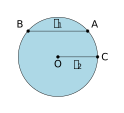
Answer A: \(\ell_1\) (segment \(AB\))
A chord connects two points on the circle. \(AB\) is a chord. \(OC\) is a radius, not a chord.
Which point is the center of the circle?
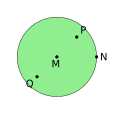
Answer B: \(M\)
The center is the point inside the circle equidistant from all points on the circle. \(M\) is at the center.
A circle has a diameter of \(\frac{30}{7}\) meters. What is its radius?
Answer A: \(\frac{15}{7}\) meters
\(r = \frac{d}{2} = \frac{30}{7} \div 2 = \frac{30}{14} = \frac{15}{7}\) meters.
In the circle below, which of the following is an arc?
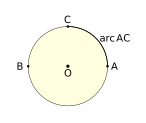
Answer B: The curve from \(A\) to \(C\)
An arc is a part of the circle's circumference. The curve from \(A\) to \(C\) is an arc.
If the radius of a circle is \(12\) units, how many times larger is the diameter than the radius?
Answer B: \(2\) times
The diameter is always \(2\) times the radius: \(d = 2r\).
In the circle below, which region is a sector?
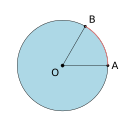
Answer B: The region bounded by \(OA\), arc \(AB\), and \(OB\)
A sector is a pie-shaped region formed by two radii and the arc between them.
Which is the best approximation for \(\pi\)?
Answer A: \(\frac{22}{7}\)
\(\pi \approx 3.14159\ldots\). The common approximations are \(3.14\) and \(\frac{22}{7} \approx 3.142857\).
Every diameter of a circle is also a:
Answer C: Chord
A diameter is a chord that passes through the center. All diameters are chords.
