A circle has a diameter of \(14\) cm. What is its radius?
- \(7\) cm
- \(14\) cm
- \(21\) cm
- \(28\) cm


Students will build Grade 7 mastery of parts of a circle using models, equations, and test-style reasoning.
A circle has a diameter of \(14\) cm. What is its radius?
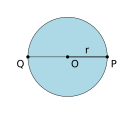
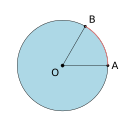
The diagram below shows a circle with center \(O\). Which line segment is the radius of the circle?
A circle has a radius of \(5\) inches. What is its diameter?
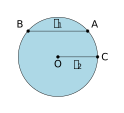
In the circle below, which line segment is a chord?
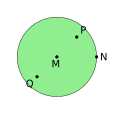
Which point is the center of the circle?
A circle has a diameter of \(\frac{30}{7}\) meters. What is its radius?
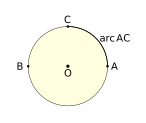
In the circle below, which of the following is an arc?
In the circle below, which region is a sector?
The radius is half the diameter: \(14\div2=7\) cm.
The radius is any segment from the center to the circle. \(OP\) is labeled and is a radius.
Diameter is twice the radius: \(2 \times 5 = 10\) inches.
A chord connects two points on the circle. \(AB\) is a chord. \(OC\) is a radius, not a chord.
The center is the point inside the circle equidistant from all points on the circle. \(M\) is at the center.
\(r = \frac{d}{2} = \frac{30}{7} \div 2 = \frac{30}{14} = \frac{15}{7}\) meters.
An arc is a part of the circle's circumference. The curve from \(A\) to \(C\) is an arc.
A sector is a pie-shaped region formed by two radii and the arc between them.
