CH02-08 lesson

Personal Financial Literacy Learning Activity

A focused Grade 7 learning session for Personal Financial Literacy using visual models, worked examples, strategy guidance, and a short mastery check.

15
minutes
6
lesson parts
11
practice items
Learning goal

Students will build Grade 7 mastery of personal financial literacy using models, equations, and test-style reasoning.

Student goal: I can solve problems involving personal financial literacy.

concept

Learn the Idea

Personal Financial Literacy is part of Grade 7 Percents and Financial Literacy. This activity focuses on the central idea students need before they move into independent practice.

Students will build Grade 7 mastery of personal financial literacy using models, equations, and test-style reasoning.

visual model

See the Math

What to noticeHow to use it
Numbers, units, labels, diagrams, or graphsIdentify what each part represents before calculating.
The relationship in the problemConnect the model to an equation, comparison, or explanation.

Use the figures and worked questions in the practice set below as the visual model for this skill.

worked example

Follow a Worked Example

Read the first practice question slowly. Decide what the question is asking, choose a strategy, solve, and then compare your reasoning with the answer explanation.

For Personal Financial Literacy, a strong worked example should show the setup, the calculation or model, and a final answer that matches the context.

real world

Connect It to a Real Situation

Many Grade 7 test questions use real situations. Look for quantities, units, rates, measures, expressions, or data values that connect the math to the story.

After solving, explain what the answer means in the situation, not just the number you calculated.

strategy

Avoid Mistakes and Choose a Strategy

  • Underline the exact question before solving.
  • Label units, variables, or graph axes when they appear.
  • Estimate first so unreasonable answers are easier to catch.
  • Review missed questions and write the reason for each mistake.
summary

Remember the Key Idea

I can solve problems involving personal financial literacy.

Use the warmup, guided question, practice set, and exit questions below to check whether this skill is ready or needs more practice.

Guided to independent practice

Solve before opening the answer

Use scratch paper. The explanation matters more than simply seeing whether the choice is correct.

warmup

2 questions
G7-C02-T08-Q001 About 1 min

Maya earns \($200\) a week. If she puts \(12\%\) of her earnings into a savings account each week, how much does she save weekly?

  1. A \($12\)
  2. B \($20\)
  3. C \($24\)
  4. D \($30\)
Check answer and explanation

Answer C: \($24\)

Savings \(=0.12\times200=$24\) per week.
G7-C02-T08-Q002 About 1 min

A savings account offers \(2\%\) annual interest on a balance of \($500\). How much interest will be earned in one year?

  1. A \($5\)
  2. B \($25\)
  3. C \($15\)
  4. D \($10\)
Check answer and explanation

Answer D: \($10\)

Interest \(=0.02\times500=$10\) in one year.

guided

1 question
G7-C02-T08-Q003 About 1 min

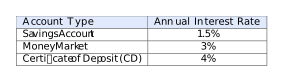
Keisha has \($2\,000\) to deposit. If she wants to maximize her interest earnings in one year without restrictions, which account should she choose?

Personal Financial Literacy visual for G7-C02-T08-Q003
  1. A Savings Account
  2. B Money Market
  3. C Certificate of Deposit
  4. D None; interest rates are equal
Check answer and explanation

Answer C: Certificate of Deposit

The CD has the highest rate at \(4\%\), earning \(0.04\times2000=$80\) in one year.

practice

5 questions
G7-C02-T08-Q004 About 1 min

A debit card withdraws money directly from your bank account. A credit card lets you borrow money and pay it back later. Which statement best describes a disadvantage of using a credit card?

  1. A You can spend more money than you have in your account
  2. B You build a credit history over time
  3. C You may pay interest if you do not pay the full balance
  4. D You do not have to carry cash
Check answer and explanation

Answer C: You may pay interest if you do not pay the full balance

Credit cards charge interest on unpaid balances, making them more expensive than using debit cards or cash.

G7-C02-T08-Q005 About 1 min

Aisha earns \($1\,800\) per month. Her net income (take-home pay) is \($1\,530\) after taxes and deductions. What percentage of her gross income is her net income?

  1. A \(80\%\)
  2. B \(82\%\)
  3. C \(85\%\)
  4. D \(90\%\)
Check answer and explanation

Answer C: \(85\%\)

Net income percent: \(\frac{1530}{1800}=0.85=85\%\).

G7-C02-T08-Q006 About 1 min

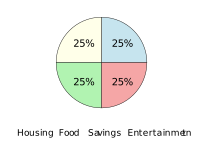
Marcus has a monthly budget of \($2\,000\) divided equally among four categories. How much is budgeted for food?

Personal Financial Literacy visual for G7-C02-T08-Q006
  1. A \($400\)
  2. B \($800\)
  3. C \($600\)
  4. D \($500\)
Check answer and explanation

Answer D: \($500\)

Each category is \(25\%\) of \($2\,000\): \(0.25\times2000=$500\).

G7-C02-T08-Q007 About 1 min

A checking account allows you to write checks and make debit card purchases, but typically offers little to no interest. A savings account accrues interest but limits withdrawals. If you want to access your money frequently for bills, which account is better?

  1. A Savings account
  2. B Neither; use credit instead
  3. C Both equally
  4. D Checking account
Check answer and explanation

Answer D: Checking account

Checking accounts allow frequent, unrestricted access, making them ideal for regular bill payments and daily expenses.

G7-C02-T08-Q008 About 1 min

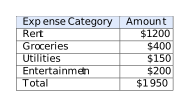
If David's net income is \($2\,500\) per month, how much can he save?

Personal Financial Literacy visual for G7-C02-T08-Q008
  1. A \($350\)
  2. B \($400\)
  3. C \($550\)
  4. D \($750\)
Check answer and explanation

Answer C: \($550\)

Savings: \($2\,500-$1\,950=$550\) remaining after expenses.

exit

3 questions
G7-C02-T08-Q009 About 1 min

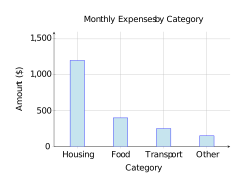
Based on the chart, how much is spent on housing?

Personal Financial Literacy visual for G7-C02-T08-Q009
  1. A \($400\)
  2. B \($600\)
  3. C \($1\,200\)
  4. D \($2\,000\)
Check answer and explanation

Answer C: \($1\,200\)

The housing bar reaches \($1\,200\) on the vertical axis.

G7-C02-T08-Q010 About 1 min

A checking account has a monthly fee of \($10\). If you maintain a minimum balance of \($1\,000\), the fee is waived. Carlos has \($850\) in the account. How much more must he deposit to avoid the fee?

  1. A \($100\)
  2. B \($250\)
  3. C \($200\)
  4. D \($150\)
Check answer and explanation

Answer D: \($150\)

Needed deposit: \($1\,000-$850=$150\).

G7-C02-T08-Q011 About 1 min

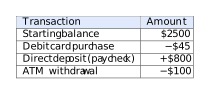
A bank statement shows the following transactions in one week: What is the ending balance?

Personal Financial Literacy visual for G7-C02-T08-Q011
  1. A \($2\,145\)
  2. B \($2\,255\)
  3. C \($3\,155\)
  4. D \($3\,255\)
Check answer and explanation

Answer C: \($3\,155\)

Balance: \($2{,}500-$45+$800-$100=$3{,}155\).

Page UP