Maya earns \($200\) a week. If she puts \(12\%\) of her earnings into a savings account each week, how much does she save weekly?
- \($12\)
- \($20\)
- \($24\)
- \($30\)


Students will build Grade 7 mastery of personal financial literacy using models, equations, and test-style reasoning.
Maya earns \($200\) a week. If she puts \(12\%\) of her earnings into a savings account each week, how much does she save weekly?
A savings account offers \(2\%\) annual interest on a balance of \($500\). How much interest will be earned in one year?
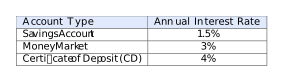
Keisha has \($2\,000\) to deposit. If she wants to maximize her interest earnings in one year without restrictions, which account should she choose?
A debit card withdraws money directly from your bank account. A credit card lets you borrow money and pay it back later. Which statement best describes a disadvantage of using a credit card?
Aisha earns \($1\,800\) per month. Her net income (take-home pay) is \($1\,530\) after taxes and deductions. What percentage of her gross income is her net income?
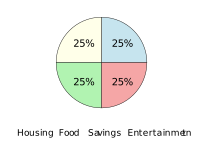
Marcus has a monthly budget of \($2\,000\) divided equally among four categories. How much is budgeted for food?
A checking account allows you to write checks and make debit card purchases, but typically offers little to no interest. A savings account accrues interest but limits withdrawals. If you want to access your money frequently for bills, which account is better?
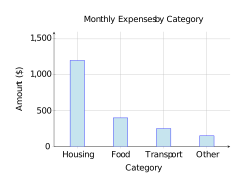
Based on the chart, how much is spent on housing?
Savings \(=0.12\times200=$24\) per week.
Interest \(=0.02\times500=$10\) in one year.
The CD has the highest rate at \(4\%\), earning \(0.04\times2000=$80\) in one year.
Credit cards charge interest on unpaid balances, making them more expensive than using debit cards or cash.
Net income percent: \(\frac{1530}{1800}=0.85=85\%\).
Each category is \(25\%\) of \($2\,000\): \(0.25\times2000=$500\).
Checking accounts allow frequent, unrestricted access, making them ideal for regular bill payments and daily expenses.
The housing bar reaches \($1\,200\) on the vertical axis.
