A rectangular prism has length \(4\) cm, width \(3\) cm, and height \(5\) cm. What is its surface area?
- \(47\) cm\(^2\)
- \(60\) cm\(^2\)
- \(94\) cm\(^2\)
- \(120\) cm\(^2\)


Students will build Grade 7 mastery of surface area of three-dimensional objects using models, equations, and test-style reasoning.
A rectangular prism has length \(4\) cm, width \(3\) cm, and height \(5\) cm. What is its surface area?
A cube has edge length \(6\) cm. Find its surface area.
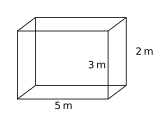
A rectangular prism with dimensions \(5\) m \(\times\) \(3\) m \(\times\) \(2\) m is shown above. Calculate its surface area.
A rectangular prism has length \(7\) cm, width \(2\) cm, and height \(4\) cm. What is the total surface area?
A cube has surface area \(150\) cm\(^2\). What is the edge length of the cube?
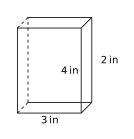
The rectangular prism shown has dimensions \(3\) in \(\times\) \(2\) in \(\times\) \(4\) in. What is its surface area?
A cube has edge length \(4\) cm. What is the total surface area?
A rectangular prism has dimensions \(6\) cm \(\times\) \(4\) cm \(\times\) \(3\) cm. What is its surface area?
\(SA=2(lw+lh+wh)=2(4\cdot3+4\cdot5+3\cdot5)=2(12+20+15)=2(47)=94\) cm\(^2\).
A cube has 6 faces, each a square with side length \(6\) cm. \(SA = 6s^2 = 6(6)^2 = 6(36) = 216\) cm\(^2\).
\(SA = 2(5 \cdot 3 + 5 \cdot 2 + 3 \cdot 2) = 2(15 + 10 + 6) = 2(31) = 62\) m\(^2\).
\(SA = 2(lw + lh + wh) = 2(7 \cdot 2 + 7 \cdot 4 + 2 \cdot 4) = 2(14 + 28 + 8) = 2(50) = 100\) cm\(^2\).
If \(SA = 6s^2 = 150\), then \(s^2 = 25\), so \(s = 5\) cm.
\(SA = 2(3 \cdot 2 + 3 \cdot 4 + 2 \cdot 4) = 2(6 + 12 + 8) = 2(26) = 52\) in\(^2\).
\(SA = 6s^2 = 6(4)^2 = 6(16) = 96\) cm\(^2\).
\(SA = 2(6 \cdot 4 + 6 \cdot 3 + 4 \cdot 3) = 2(24 + 18 + 12) = 2(54) = 108\) cm\(^2\).
