A bag contains \(4\) red, \(5\) blue, and \(6\) green marbles. What is the theoretical probability of drawing a blue marble at random?
- \(\frac{1}{5}\)
- \(\frac{1}{3}\)
- \(\frac{4}{15}\)
- \(\frac{2}{5}\)


Students will build Grade 7 mastery of theoretical probability using models, equations, and test-style reasoning.
A bag contains \(4\) red, \(5\) blue, and \(6\) green marbles. What is the theoretical probability of drawing a blue marble at random?
A fair six-sided die is rolled once. What is the probability of rolling a number greater than \(4\)?
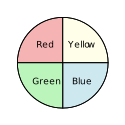
A spinner is divided into \(4\) equal sections: Red, Yellow, Blue, and Green. What is the probability of spinning Red or Green?
A jar holds \(3\) yellow, \(4\) purple, and \(8\) orange tokens. If a token is drawn at random, what is the theoretical probability it is purple?
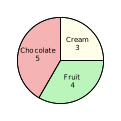
A restaurant menu has \(12\) desserts: \(5\) chocolate, \(4\) fruit, and \(3\) cream-based. If you pick one at random, what is the probability of choosing a chocolate or cream-based dessert?
A fair coin is flipped. What is the theoretical probability of getting heads?
A bag contains \(6\) white socks and \(4\) black socks. A sock is drawn at random. What is the probability of drawing a white sock?
A box contains cards numbered \(5\) through \(14\). A card is drawn at random. What is the probability of drawing a card with a number divisible by \(3\)?
Total \(=4+5+6=15\). \(P(\text{blue})=\frac{5}{15}=\frac{1}{3}\).
Favorable outcomes: \(5, 6\) (two outcomes). Total outcomes: \(6\). \(P(\text{>4})=\frac{2}{6}=\frac{1}{3}\).
Each section is \(\frac{1}{4}\). Red + Green \(= \frac{1}{4} + \frac{1}{4} = \frac{1}{2}\).
Total tokens \(= 3 + 4 + 8 = 15\). \(P(\text{purple})=\frac{4}{15}\).
Chocolate or cream-based: \(5 + 3 = 8\). \(P=\frac{8}{12}=\frac{2}{3}\).
A fair coin has two equally likely outcomes: heads and tails. \(P(\text{heads})=\frac{1}{2}\).
Total socks \(= 6 + 4 = 10\). \(P(\text{white})=\frac{6}{10}=\frac{3}{5}\).
Numbers: \(5, 6, 7, 8, 9, 10, 11, 12, 13, 14\) (10 total). Divisible by \(3\): \(6, 9, 12\) (3 outcomes). \(P=\frac{3}{10}\).
