A triangular prism has a triangular base with area \(15\) cm\(^2\) and a height of \(10\) cm. What is its volume?
- \(25\) cm\(^3\)
- \(75\) cm\(^3\)
- \(150\) cm\(^3\)
- \(300\) cm\(^3\)


Students will build Grade 7 mastery of volume of prisms using models, equations, and test-style reasoning.
A triangular prism has a triangular base with area \(15\) cm\(^2\) and a height of \(10\) cm. What is its volume?
A rectangular prism has dimensions \(5\) m, \(4\) m, and \(8\) m. What is its volume?
A rectangular prism has a base area of \(24\) square inches and a height of \(6\) inches. Find the volume.
A rectangular prism has length \(12\) cm, width \(5\) cm, and height \(3\) cm. Which expression correctly represents the volume?
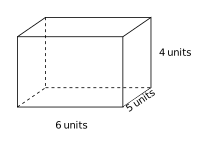
The rectangular prism shown has dimensions as labeled. What is its volume in cubic units?
A rectangular prism has volume \(240\) cm\(^3\) and base area \(30\) cm\(^2\). What is the height of the prism?
A triangular prism has volume \(126\) cubic inches. If the triangular base has area \(18\) in\(^2\), what is the height of the prism?
Convert \(2\) cubic meters to cubic centimeters. (Hint: \(1\) m \(= 100\) cm)
Volume of a prism \(=\) base area \(\times\) height \(=15\times10=150\) cm\(^3\).
Volume \(= l \times w \times h = 5 \times 4 \times 8 = 160\) m\(^3\).
\(V = B \times h = 24 \times 6 = 144\) in\(^3\).
Volume of a rectangular prism is length \(\times\) width \(\times\) height, so \(12 \times 5 \times 3 = 180\) cm\(^3\).
\(V = 6 \times 4 \times 5 = 120\) cubic units.
Rearranging \(V = B \times h\), we get \(h = \frac{V}{B} = \frac{240}{30} = 8\) cm.
\(h = \frac{V}{B} = \frac{126}{18} = 7\) inches.
\(1\) m \(= 100\) cm, so \(1\) m\(^3 = (100)^3 = 1{,}000{,}000\) cm\(^3 = 10^6\) cm\(^3\). Thus \(2\) m\(^3 = 2 \times 10^6\) cm\(^3\).
