

CH07-06 lesson

Volume of Prisms Learning Activity

A focused Grade 7 learning session for Volume of Prisms using visual models, worked examples, strategy guidance, and a short mastery check.

18
minutes
6
lesson parts
11
practice items
Learning goal

Students will build Grade 7 mastery of volume of prisms using models, equations, and test-style reasoning.

Student goal: I can solve problems involving volume of prisms.

concept

Learn the Idea

Volume of Prisms is part of Grade 7 Measurement Geometry. This activity focuses on the central idea students need before they move into independent practice.

Students will build Grade 7 mastery of volume of prisms using models, equations, and test-style reasoning.

visual model

See the Math

What to noticeHow to use it
Numbers, units, labels, diagrams, or graphsIdentify what each part represents before calculating.
The relationship in the problemConnect the model to an equation, comparison, or explanation.

Use the figures and worked questions in the practice set below as the visual model for this skill.

worked example

Follow a Worked Example

Read the first practice question slowly. Decide what the question is asking, choose a strategy, solve, and then compare your reasoning with the answer explanation.

For Volume of Prisms, a strong worked example should show the setup, the calculation or model, and a final answer that matches the context.

real world

Connect It to a Real Situation

Many Grade 7 test questions use real situations. Look for quantities, units, rates, measures, expressions, or data values that connect the math to the story.

After solving, explain what the answer means in the situation, not just the number you calculated.

strategy

Avoid Mistakes and Choose a Strategy

  • Underline the exact question before solving.
  • Label units, variables, or graph axes when they appear.
  • Estimate first so unreasonable answers are easier to catch.
  • Review missed questions and write the reason for each mistake.
summary

Remember the Key Idea

I can solve problems involving volume of prisms.

Use the warmup, guided question, practice set, and exit questions below to check whether this skill is ready or needs more practice.

Guided to independent practice

Solve before opening the answer

Use scratch paper. The explanation matters more than simply seeing whether the choice is correct.

warmup

2 questions
G7-C07-T06-Q001 About 1 min

A triangular prism has a triangular base with area \(15\) cm\(^2\) and a height of \(10\) cm. What is its volume?

  1. A \(25\) cm\(^3\)
  2. B \(75\) cm\(^3\)
  3. C \(150\) cm\(^3\)
  4. D \(300\) cm\(^3\)
Check answer and explanation

Answer C: \(150\) cm\(^3\)

Volume of a prism \(=\) base area \(\times\) height \(=15\times10=150\) cm\(^3\).
G7-C07-T06-Q002 About 1 min

A rectangular prism has dimensions \(5\) m, \(4\) m, and \(8\) m. What is its volume?

  1. A \(320\) m\(^3\)
  2. B \(160\) m\(^3\)
  3. C \(40\) m\(^3\)
  4. D \(17\) m\(^3\)
Check answer and explanation

Answer B: \(160\) m\(^3\)

Volume \(= l \times w \times h = 5 \times 4 \times 8 = 160\) m\(^3\).

guided

1 question
G7-C07-T06-Q003 About 1 min

A rectangular prism has a base area of \(24\) square inches and a height of \(6\) inches. Find the volume.

  1. A \(288\) in\(^3\)
  2. B \(144\) in\(^3\)
  3. C \(72\) in\(^3\)
  4. D \(30\) in\(^3\)
Check answer and explanation

Answer B: \(144\) in\(^3\)

\(V = B \times h = 24 \times 6 = 144\) in\(^3\).

practice

5 questions
G7-C07-T06-Q004 About 1 min

A rectangular prism has length \(12\) cm, width \(5\) cm, and height \(3\) cm. Which expression correctly represents the volume?

  1. A \((12 + 5) \times 3\)
  2. B \(12 \times 5 \times 3\)
  3. C \(2(12 + 5 + 3)\)
  4. D \(12 + 5 + 3\)
Check answer and explanation

Answer B: \(12 \times 5 \times 3\)

Volume of a rectangular prism is length \(\times\) width \(\times\) height, so \(12 \times 5 \times 3 = 180\) cm\(^3\).

G7-C07-T06-Q005 About 1 min

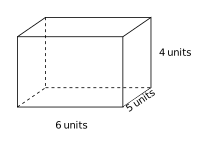
The rectangular prism shown has dimensions as labeled. What is its volume in cubic units?

Volume of Prisms visual for G7-C07-T06-Q005
  1. A \(15\) cubic units
  2. B \(60\) cubic units
  3. C \(120\) cubic units
  4. D \(240\) cubic units
Check answer and explanation

Answer C: \(120\) cubic units

\(V = 6 \times 4 \times 5 = 120\) cubic units.

G7-C07-T06-Q006 About 1 min

A rectangular prism has volume \(240\) cm\(^3\) and base area \(30\) cm\(^2\). What is the height of the prism?

  1. A \(8\) cm
  2. B \(10\) cm
  3. C \(15\) cm
  4. D \(210\) cm
Check answer and explanation

Answer A: \(8\) cm

Rearranging \(V = B \times h\), we get \(h = \frac{V}{B} = \frac{240}{30} = 8\) cm.

G7-C07-T06-Q007 About 1 min

A triangular prism has volume \(126\) cubic inches. If the triangular base has area \(18\) in\(^2\), what is the height of the prism?

  1. A \(7\) in
  2. B \(8\) in
  3. C \(9\) in
  4. D \(144\) in
Check answer and explanation

Answer A: \(7\) in

\(h = \frac{V}{B} = \frac{126}{18} = 7\) inches.

G7-C07-T06-Q008 About 1 min

A rectangular prism with a volume of \(360\) m\(^3\) has a base area of \(40\) m\(^2\). Find the height.

  1. A \(4\) m
  2. B \(7\) m
  3. C \(9\) m
  4. D \(14400\) m
Check answer and explanation

Answer C: \(9\) m

\(h = \frac{V}{B} = \frac{360}{40} = 9\) m.

exit

3 questions
G7-C07-T06-Q009 About 1 min

Convert \(2\) cubic meters to cubic centimeters. (Hint: \(1\) m \(= 100\) cm)

  1. A \(2 \times 10^6\) cm\(^3\)
  2. B \(2 \times 10^8\) cm\(^3\)
  3. C \(2 \times 10^{12}\) cm\(^3\)
  4. D \(2 \times 10^9\) cm\(^3\)
Check answer and explanation

Answer A: \(2 \times 10^6\) cm\(^3\)

\(1\) m \(= 100\) cm, so \(1\) m\(^3 = (100)^3 = 1{,}000{,}000\) cm\(^3 = 10^6\) cm\(^3\). Thus \(2\) m\(^3 = 2 \times 10^6\) cm\(^3\).

G7-C07-T06-Q010 About 1 min

Convert \(5{,}000\) cubic inches to cubic feet. (Hint: \(1\) ft \(= 12\) in, so \(1\) ft\(^3 = 1{,}728\) in\(^3\))

  1. A \(2.89\) ft\(^3\)
  2. B \(3.25\) ft\(^3\)
  3. C \(3.68\) ft\(^3\)
  4. D \(8{,}640\) ft\(^3\)
Check answer and explanation

Answer A: \(2.89\) ft\(^3\)

\(\frac{5{,}000 \text{ in}^3}{1{,}728 \text{ in}^3 / \text{ft}^3} \approx 2.89\) ft\(^3\).

G7-C07-T06-Q011 About 1 min

A rectangular prism has length \(8\) cm, width \(6\) cm, and height \(10\) cm. Convert its volume to liters if \(1\) liter \(= 1{,}000\) cm\(^3\).

  1. A \(0.48\) L
  2. B \(480\) L
  3. C \(48\) L
  4. D \(4.8\) L
Check answer and explanation

Answer A: \(0.48\) L

\(V = 8 \times 6 \times 10 = 480\) cm\(^3 = 480 / 1000 = 0.48\) L.

Page UP