




Introduction
Measurement Data and Line Plots is an important Grade 3 math skill because students are moving from simple answers toward explaining how the math works.
In this lesson, students use models, real questions, worked examples, practice problems, and two online quizzes to build confidence with measurement data and line plots.
What Is Measurement Data and Line Plots?
Measurement Data and Line Plots means reading, creating, and explaining displays so data can answer real questions.
The goal is not only to get the answer. Students should be able to show the idea, explain the strategy, and check whether the answer makes sense.
Understanding Measurement Data and Line Plots
Before solving, students should slow down and decide what each number, shape, unit, or label represents.
- Read the title, labels, and scale before answering.
- Use the scale value instead of counting marks as ones when the graph is scaled.
- Compare categories by subtracting or adding values from the display.
- Explain what the data shows in a complete sentence.
Visual Models
Visual Model 1
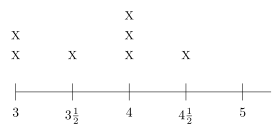
Question: This line plot shows ribbon lengths in inches. The scale goes by halves: \(3, 3\frac{1}{2}, 4, 4\frac{1}{2}, 5\). How many ribbons are \(4\) inches long?
- A. \(2\)
- B. \(3\)
- C. \(4\)
- D. \(5\)
Why it works: Count the X's directly above the \(4\)-inch mark. There are three X's stacked there.
Answer: \(3\) ribbons
Visual Model 2
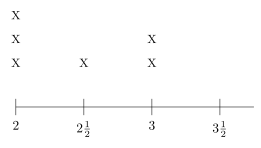
Question: Sam measured the heights of flower stems in inches. The line plot below shows halves: \(2, 2\frac{1}{2}, 3, 3\frac{1}{2}\). What is the most common stem height?
- A. \(2\) inches
- B. \(2\frac{1}{2}\) inches
- C. \(3\) inches
- D. \(3\frac{1}{2}\) inches
Why it works: The value with the most X's is the mode. At \(2\) inches, there are \(3\) X's. This is more than any other value.
Answer: \(2\) inches
Worked Examples
Example 1
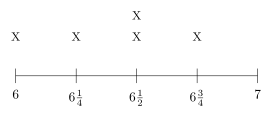
Question: A line plot shows fish tank measurements in inches using quarters: \(6, 6\frac{1}{4}, 6\frac{1}{2}, 6\frac{3}{4}, 7\). How many measurements in total?
- A. \(5\)
- B. \(6\)
- C. \(4\)
- D. \(7\)
- Count all the X's: one at \(6\), one at \(6\frac{1}{4}\), two at \(6\frac{1}{2}\), one at \(6\frac{3}{4}\).
- Total is \(5\).
Answer: \(5\) measurements
Example 2
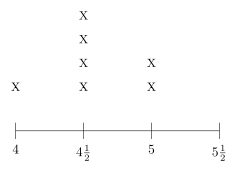
Question: Mia recorded the weights of apples in ounces. The line plot shows: \(4, 4\frac{1}{2}, 5, 5\frac{1}{2}\). Which weight has the least X's?
- A. \(4\) ounces
- B. \(4\frac{1}{2}\) ounces
- C. \(5\) ounces
- D. \(5\frac{1}{2}\) ounces
- At \(5\frac{1}{2}\), there are zero X's.
- All other values have at least one X.
Answer: \(5\frac{1}{2}\) ounces
Example 3
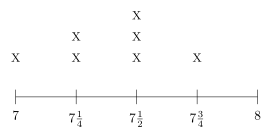
Question: A line plot shows paintbrush lengths in inches: \(7, 7\frac{1}{4}, 7\frac{1}{2}, 7\frac{3}{4}, 8\). What is the most common paintbrush length?
- A. \(7\) inches
- B. \(7\frac{1}{4}\) inches
- C. \(7\frac{1}{2}\) inches
- D. \(7\frac{3}{4}\) inches
- At \(7\frac{1}{2}\), there are \(3\) X's.
- This is more than at any other length.
Answer: \(7\frac{1}{2}\) inches
Real-World Word Problems
Problem 1
Question: A line plot shows the lengths of \(10\) pencils to the nearest \(\frac{1}{4}\) inch. There are three X's above \(4\frac{1}{2}\) inches. What does this mean?
- A. \(3\) pencils are \(4\frac{1}{2}\) inches long
- B. \(3\) is added to \(4\frac{1}{2}\)
- C. \(\frac{1}{2}\) of the pencils are \(3\) inches
- D. \(3\) pencils total
Why it works: Each X represents one measurement. Three X's above \(4\frac{1}{2}\) means three pencils have that length.
Answer: \(3\) pencils are \(4\frac{1}{2}\) inches long
Problem 2
Question: Emma measured twig lengths in inches. At the \(4\) inch mark, there are \(5\) X's. At the \(4\frac{1}{4}\) inch mark, there are \(3\) X's. How many more twigs are exactly \(4\) inches long than \(4\frac{1}{4}\) inches long?
- A. \(1\)
- B. \(2\)
- C. \(3\)
- D. \(8\)
Why it works: Subtract: \(5 - 3 = 2\) more twigs are \(4\) inches long.
Answer: \(2\) more twigs
Common Mistakes
- Ignoring the graph scale.
- Reading the wrong category or axis label.
- Answering a comparison question without subtracting.
- Writing a number without explaining what it represents.
Strategy Tips
- Circle the scale before using the graph.
- Write down the value for each category you compare.
- Use addition for totals and subtraction for differences.
- Answer in words so the data result has meaning.
Practice Questions
Question 1
A line plot shows book page counts: \(50, 50\frac{1}{2}, 51, 51\frac{1}{2}, 52\) pages. There are two X's at \(50\) pages, one X at \(50\frac{1}{2}\) pages, four X's at \(51\) pages, one X at \(51\frac{1}{2}\) pages, and one X at \(52\) pages. Which page count appears the least often?
- A. \(50\) pages
- B. \(50\frac{1}{2}\) pages
- C. \(51\) pages
- D. \(52\) pages
Question 2
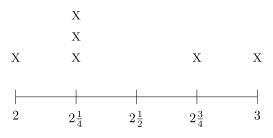
A line plot shows toy car weights in ounces with quarter marks: \(2, 2\frac{1}{4}, 2\frac{1}{2}, 2\frac{3}{4}, 3\). How many toy cars weigh at most \(2\frac{1}{2}\) ounces?
- A. \(3\)
- B. \(4\)
- C. \(5\)
- D. \(6\)
Question 3
A line plot shows eraser weights in grams: \(10, 10\frac{1}{2}, 11, 11\frac{1}{2}\). At \(10\) grams there are \(2\) X's. At \(10\frac{1}{2}\) there are \(4\) X's. At \(11\) there are \(2\) X's. How many erasers total?
- A. \(6\)
- B. \(8\)
- C. \(10\)
- D. \(12\)
Question 4
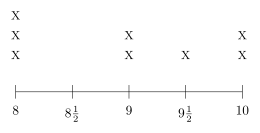
Lily made a line plot of marble diameters in millimeters using halves: \(8, 8\frac{1}{2}, 9, 9\frac{1}{2}, 10\). Which marble size appears least often?
- A. \(8\) mm
- B. \(8\frac{1}{2}\) mm
- C. \(9\frac{1}{2}\) mm
- D. \(10\) mm
Question 5
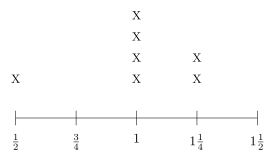
A line plot shows pencil lead thicknesses in millimeters: \(\frac{1}{2}, \frac{3}{4}, 1, 1\frac{1}{4}, 1\frac{1}{2}\). What is the most common thickness?
- A. \(\frac{1}{2}\) mm
- B. \(\frac{3}{4}\) mm
- C. \(1\) mm
- D. \(1\frac{1}{2}\) mm
Question 6
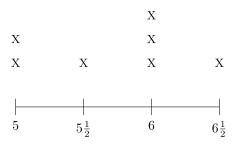
Ava measured the heights of plant stems in inches using halves: \(5, 5\frac{1}{2}, 6, 6\frac{1}{2}\). How many plant stems are 6 inches or taller?
- A. \(2\)
- B. \(3\)
- C. \(4\)
- D. \(5\)
Full Answer Explanations Click to show all answers and explanations
Question 1
Answer: \(50\frac{1}{2}\) pages
Both \(50\frac{1}{2}\) and \(52\) pages have only \(1\) X each, but \(50\frac{1}{2}\) is one of the least common. The next most common is \(50\) pages with \(2\) X's, and \(51\) pages appears most often with \(4\) X's.
Question 2
Answer: \(4\) toy cars
At most \(2\frac{1}{2}\) includes weights of \(2\), \(2\frac{1}{4}\), and \(2\frac{1}{2}\) ounces. The plot has \(1+3+0=4\) X's at those values.
Question 3
Answer: \(8\) erasers
Add: \(2 + 4 + 2 = 8\) erasers total.
Question 4
Answer: \(8\frac{1}{2}\) mm
At \(8\frac{1}{2}\) there are no X's, so it appears least often.
Question 5
Answer: \(1\) mm
At \(1\) mm there are \(4\) X's, which is the highest count.
Question 6
Answer: \(4\) stems
At \(6\) inches there are \(3\) X's and at \(6\frac{1}{2}\) inches there is \(1\) X. Total: \(3 + 1 = 4\).
Connection to Standards
This lesson supports Grade 3 math expectations for reasoning, modeling, problem solving, and explaining answers clearly. It connects classroom skills to the kind of questions students see on state math assessments.
Summary
Measurement Data and Line Plots becomes easier when students connect the question to a model, use clear steps, and explain why the answer fits.
GOLDEN RULE
Read the scale before reading the answer.