





Introduction
Adding and Subtracting Linear Expressions is an important Grade 7 math skill because students are moving from simple answers toward explaining how the math works.
In this lesson, students use models, real questions, worked examples, practice problems, and two online quizzes to build confidence with adding and subtracting linear expressions.
What Is Adding and Subtracting Linear Expressions?
Adding and Subtracting Linear Expressions means using place value, operations, and equations to reason accurately with numbers.
The goal is not only to get the answer. Students should be able to show the idea, explain the strategy, and check whether the answer makes sense.
Understanding Adding and Subtracting Linear Expressions
Before solving, students should slow down and decide what each number, shape, unit, or label represents.
- Read the question carefully and identify what is being asked.
- Choose a model, equation, table, or diagram that matches the situation.
- Solve one step at a time and keep units or labels attached.
- Use the answer explanation to check that the result makes sense.
Visual Models
Visual Model 1
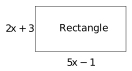
Question: A rectangle has width \((2x+3)\) cm and length \((5x-1)\) cm. What is the perimeter expression?
- A. \(14x+4\)
- B. \(7x+2\)
- C. \(10x-2\)
- D. \(14x+2\)
Why it works: Perimeter \(= 2(5x-1)+2(2x+3)=10x-2+4x+6=14x+4\).
Answer: \(14x+4\)
Visual Model 2
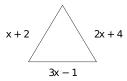
Question: A triangle has sides measuring \((x+2)\) m, \((3x-1)\) m, and \((2x+4)\) m. What is the perimeter?
- A. \(6x+5\)
- B. \(6x-5\)
- C. \(5x+5\)
- D. \(6x+3\)
Why it works: Add all sides: \((x+2)+(3x-1)+(2x+4)=(x+3x+2x)+(2-1+4)=6x+5\).
Answer: \(6x+5\)
Worked Examples
Example 1
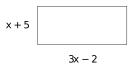
Question: A rectangle's sides are \((x+5)\) and \((3x-2)\). What is the perimeter?
- A. \(8x+6\)
- B. \(4x+3\)
- C. \(8x+3\)
- D. \(8x-6\)
- Perimeter \(= 2(x+5)+2(3x-2)=2x+10+6x-4=8x+6\).
Answer: \(8x+6\)
Example 2
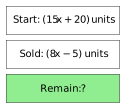
Question: A store owner tracks inventory. She started with \((15x+20)\) units. After selling \((8x-5)\) units, how many units remain?
- A. \(7x+25\)
- B. \(23x+15\)
- C. \(7x+15\)
- D. \(7x-25\)
- Subtract: \((15x+20)-(8x-5)=15x+20-8x+5=7x+25\) units.
Answer: \(7x+25\)
Example 3
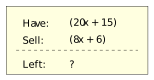
Question: At a bakery, you have \((20x+15)\) cookies. You sell \((8x+6)\) cookies to a class. How many cookies remain?
- A. \(12x+9\)
- B. \(28x+21\)
- C. \(12x+21\)
- D. \(12x+15\)
- Subtract: \((20x+15)-(8x+6)=20x+15-8x-6=12x+9\) cookies.
Answer: \(12x+9\)
Real-World Word Problems
Problem 1
Question: A student simplified \((12x-8)-(3x-5)\) and got \(9x-13\). What mistake did the student make?
- A. Did not distribute the negative to the second expression
- B. Added instead of subtracting the constants
- C. Subtracted \(8\) and \(5\) incorrectly
- D. Forgot to combine \(x\) terms
Why it works: The student forgot to distribute the negative: should be \(12x-8-3x+5=9x-3\), not \(9x-13\). The error was not distributing the negative to both terms in the second expression.
Answer: The correct answer is \(9x-3\)
Problem 2
Question: A contractor builds two walls. Wall 1 is \((10x+8)\) feet long. Wall 2 is \((6x-3)\) feet long. What is the total length?
- A. \(16x+5\)
- B. \(16x+11\)
- C. \(4x+5\)
- D. \(16x+3\)
Why it works: Add both walls: \((10x+8)+(6x-3)=(10x+6x)+(8-3)=16x+5\) feet.
Answer: \(16x+5\)
Common Mistakes
- Rushing before identifying what the numbers represent.
- Choosing an operation that does not match the situation.
- Dropping labels, units, or context from the answer.
- Skipping the estimate or reasonableness check.
Strategy Tips
- Underline the question being asked.
- Use a model before jumping to computation.
- Write an equation that matches the story or picture.
- Explain the final answer in a sentence.
Practice Questions
Question 1
Simplify: \((3x+5)+(2x-7)\)
- A. \(5x-2\)
- B. \(5x+2\)
- C. \(5x-12\)
- D. \(6x-2\)
Question 2
Simplify: \((4x-3)-(2x+5)\)
- A. \(2x-8\)
- B. \(2x+2\)
- C. \(6x-8\)
- D. \(2x+8\)
Question 3
Combine like terms: \((7a+9)-(3a-4)\)
- A. \(4a+13\)
- B. \(4a+5\)
- C. \(10a+5\)
- D. \(4a-13\)
Question 4
Simplify: \((-2b+6)+(5b-1)\)
- A. \(3b+5\)
- B. \(3b-5\)
- C. \(7b+7\)
- D. \(-7b+5\)
Question 5
Simplify: \((6m-2)-(4m-8)\)
- A. \(2m+6\)
- B. \(2m-10\)
- C. \(10m-10\)
- D. \(2m-6\)
Question 6
Which expression is equivalent to \((5p+3)+(2p-9)\)?
- A. \(7p-6\)
- B. \(3p-6\)
- C. \(7p-12\)
- D. \(7p+6\)
Full Answer Explanations Click to show all answers and explanations
Question 1
Answer: \(5x-2\)
Combine like terms: \((3x+2x)+(5-7)=5x-2\).
Question 2
Answer: \(2x-8\)
Distribute the negative: \(4x-3-2x-5=(4x-2x)+(-3-5)=2x-8\).
Question 3
Answer: \(4a+13\)
Distribute the negative: \(7a+9-3a+4=(7a-3a)+(9+4)=4a+13\).
Question 4
Answer: \(3b+5\)
Combine like terms: \((-2b+5b)+(6-1)=3b+5\).
Question 5
Answer: \(2m+6\)
Distribute the negative: \(6m-2-4m+8=(6m-4m)+(-2+8)=2m+6\).
Question 6
Answer: \(7p-6\)
Combine: \((5p+2p)+(3-9)=7p-6\).
Connection to Standards
This lesson supports Grade 7 math expectations for reasoning, modeling, problem solving, and explaining answers clearly. It connects classroom skills to the kind of questions students see on state math assessments.
Summary
Adding and Subtracting Linear Expressions becomes easier when students connect the question to a model, use clear steps, and explain why the answer fits.
GOLDEN RULE
Understand the model before choosing the operation.