




Introduction
Constructing Triangles from Three Measurements is an important Grade 7 math skill because students are moving from simple answers toward explaining how the math works.
In this lesson, students use models, real questions, worked examples, practice problems, and two online quizzes to build confidence with constructing triangles from three measurements.
What Is Constructing Triangles from Three Measurements?
Constructing Triangles from Three Measurements means choosing a model, naming what each number means, and explaining the strategy.
The goal is not only to get the answer. Students should be able to show the idea, explain the strategy, and check whether the answer makes sense.
Understanding Constructing Triangles from Three Measurements
Before solving, students should slow down and decide what each number, shape, unit, or label represents.
- Read the question carefully and identify what is being asked.
- Choose a model, equation, table, or diagram that matches the situation.
- Solve one step at a time and keep units or labels attached.
- Use the answer explanation to check that the result makes sense.
Visual Models
Visual Model 1
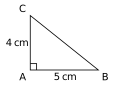
Question: Triangle \(ABC\) with \(AB=5\) cm, \(AC=4\) cm, and a right angle at \(A\) satisfies which congruence condition?
- A. SSS
- B. SAS
- C. ASA
- D. RHS
Why it works: Two sides and the included right angle are given: \(AC=4\) cm, \(AB=5\) cm, and angle \(A=90°\) is between them. This is SAS (Side\textendash{}Angle\textendash{}Side) congruence.
Answer: SAS
Visual Model 2
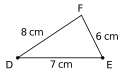
Question: Triangle \(DEF\) has sides \(DE=7\) cm, \(EF=6\) cm, and \(FD=8\) cm. Is this triangle unique?
- A. No, infinitely many triangles have these side lengths
- B. Yes, SSS guarantees uniqueness
- C. No, SAS allows variation
- D. Yes, but only if we specify one angle
Why it works: When all three side lengths are specified (7 cm, 6 cm, 8 cm), exactly one unique triangle (up to congruence) can be constructed. This is the SSS (Side\textendash{}Side\textendash{}Side) condition.
Answer: Yes, SSS guarantees uniqueness
Worked Examples
Example 1
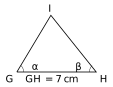
Question: If \(GH=7\) cm and angles \(\alpha\) and \(\beta\) at \(G\) and \(H\) are known, which congruence condition applies?
- A. SAS
- B. ASA
- C. AAS
- D. SSS
- We have angle \(\alpha\) at \(G\), the side \(GH=7\) cm between them, and angle \(\beta\) at \(H\).
- This is Angle\textendash{}Side\textendash{}Angle (ASA): two angles and the included side are given.
Answer: ASA
Example 2
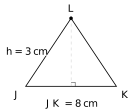
Question: Triangle \(JKL\) has base \(JK=8\) cm and perpendicular height \(h=3\) cm. How many distinct triangles satisfy these conditions?
- A. \(1\) (unique)
- B. \(2\) (two possible positions for \(L\))
- C. Infinitely many
- D. \(0\) (impossible)
- The vertex \(L\) may lie anywhere on a line parallel to \(JK\) at distance 3 cm above it.
- Each position yields a different triangle with the same base and height but different side lengths and angles.
Answer: Infinitely many
Example 3
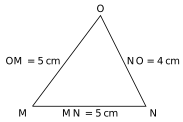
Question: Triangle \(MNO\) has sides \(MN=5\) cm, \(NO=4\) cm, and \(OM=5\) cm. What type of triangle is \(MNO\)?
- A. Scalene
- B. Isosceles
- C. Equilateral
- D. Right triangle
- Two sides have the same length: \(OM=MN=5\) cm.
- An isosceles triangle has at least two congruent sides.
- Checking: \(4^2+5^2=41\neq 25\), so it is not a right triangle.
Answer: Isosceles
Real-World Word Problems
Problem 1
Question: How many unique triangles can be constructed with sides of length \(6\) cm, \(8\) cm, and \(10\) cm?
- A. \(0\)
- B. \(1\)
- C. \(2\)
- D. More than \(2\)
Why it works: Given three specific side lengths that satisfy the Triangle Inequality, exactly one unique triangle (up to congruence) can be formed. In fact, this is a right triangle because \(6^2+8^2=10^2\).
Answer: \(1\)
Problem 2
Question: Which set of side lengths will NOT form a triangle?
- A. \(5\) cm, \(7\) cm, \(11\) cm
- B. \(4\) cm, \(6\) cm, \(9\) cm
- C. \(3\) cm, \(4\) cm, \(6\) cm
- D. \(5\) cm, \(5\) cm, \(8\) cm
Why it works: The Triangle Inequality states the sum of any two sides must exceed the third. Check: \(4+6=10\) is not greater than \(9\), so this fails.
Answer: \(4+6=10\not>9\)
Common Mistakes
- Rushing before identifying what the numbers represent.
- Choosing an operation that does not match the situation.
- Dropping labels, units, or context from the answer.
- Skipping the estimate or reasonableness check.
Strategy Tips
- Underline the question being asked.
- Use a model before jumping to computation.
- Write an equation that matches the story or picture.
- Explain the final answer in a sentence.
Practice Questions
Question 1
Two triangles each have angles measuring 50°, 60°, and 70°. Are the triangles congruent?
- A. Yes, always congruent
- B. No, never congruent
- C. Only if one side length is the same
- D. Cannot be determined without side lengths
Question 2
A triangle has sides of length \(5\) m and \(9\) m. Which length CANNOT be the third side?
- A. \(6\) m
- B. \(10\) m
- C. \(13\) m
- D. \(15\) m
Question 3
Which statement best describes the SSA (Side\textendash{}Side\textendash{}Angle) condition for constructing triangles?
- A. SSA always produces exactly one triangle
- B. SSA may produce zero, one, or two triangles
- C. SSA never produces a valid triangle
- D. SSA produces exactly two triangles
Question 4
A triangle has two sides of length \(5\) cm and \(7\) cm, with an included angle of 45°. How many distinct triangles can be constructed with these measurements?
- A. \(0\)
- B. \(1\)
- C. \(2\)
- D. Infinitely many
Question 5
If two triangles have two pairs of congruent angles, what can we conclude?
- A. The triangles are congruent
- B. The third angles must also be congruent
- C. The triangles are similar
- D. No conclusion can be drawn
Question 6
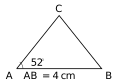
To construct triangle \(ABC\) with side \(AB=4\) cm and angle at \(A=52°\) uniquely, the minimum additional information needed is:
- A. One more side length
- B. One more angle measure
- C. Either another side or another angle
- D. Nothing; the triangle is already unique
Full Answer Explanations Click to show all answers and explanations
Question 1
Answer: Without side lengths, cannot be determined
AAA (Angle\textendash{}Angle\textendash{}Angle) guarantees similarity, not congruence. The triangles could be different sizes but the same shape. At least one side length is needed to prove congruence.
Question 2
Answer: 15 m
The Triangle Inequality requires the sum of any two sides to exceed the third. With sides 5 and 9: we need \(5+9>c\), so \(c<14\) m. Also \(5+c>9\), so \(c>4\) m. Thus \(4
Question 3
Answer: SSA may produce zero, one, or two triangles
SSA is the ambiguous case. Depending on the side lengths and angle, there may be no valid triangle (Triangle Inequality violated), exactly one triangle (right angle or obtuse), or two distinct triangles (acute angle with proper side ratio).
Question 4
Answer: \(1\)
Two sides and the included angle uniquely determine a triangle by the SAS (Side\textendash{}Angle\textendash{}Side) condition. Exactly one triangle can be constructed.
Question 5
Answer: The triangles are similar (AA Similarity)
If two angles of one triangle equal two angles of another, the third angles must also be equal (angle sum is always 180°). This AA (Angle\textendash{}Angle) criterion guarantees similarity: the triangles have the same shape but not necessarily the same size. Similarity does not imply congruence without matching side lengths.
Question 6
Answer: Either another side or another angle
With one side and one angle, we have insufficient information. Adding a second side gives SAS; adding a second angle gives ASA. Either approach uniquely determines the triangle.
Connection to Standards
This lesson supports Grade 7 math expectations for reasoning, modeling, problem solving, and explaining answers clearly. It connects classroom skills to the kind of questions students see on state math assessments.
Summary
Constructing Triangles from Three Measurements becomes easier when students connect the question to a model, use clear steps, and explain why the answer fits.
GOLDEN RULE
Understand the model before choosing the operation.