




Introduction
Integers and Their Opposites is an important Grade 7 math skill because students are moving from simple answers toward explaining how the math works.
In this lesson, students use models, real questions, worked examples, practice problems, and two online quizzes to build confidence with integers and their opposites.
What Is Integers and Their Opposites?
Integers and Their Opposites means choosing a model, naming what each number means, and explaining the strategy.
The goal is not only to get the answer. Students should be able to show the idea, explain the strategy, and check whether the answer makes sense.
Understanding Integers and Their Opposites
Before solving, students should slow down and decide what each number, shape, unit, or label represents.
- Read the question carefully and identify what is being asked.
- Choose a model, equation, table, or diagram that matches the situation.
- Solve one step at a time and keep units or labels attached.
- Use the answer explanation to check that the result makes sense.
Visual Models
Visual Model 1
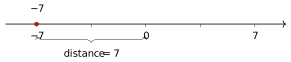
Question: What is \(|-7|\)?
- A. \(-7\) (confuses absolute value with the original number)
- B. \(-14\) (incorrectly applies a sign reversal)
- C. \(0\) (misplaces absolute value at the origin)
- D. \(7\) (correct; distance is always non-negative)
Why it works: The absolute value of any number is its distance from zero, which is always non-negative. \(|-7| = 7\).
Answer: \(7\)
Visual Model 2
Question: What is \((-9) + 9\)?

- A. \(18\) (adds absolute values)
- B. \(9\) (ignores the negative sign)
- C. \(0\) (opposites sum to zero)
- D. \(-18\) (doubles negative)
Why it works: Opposites sum to zero: \(a + (-a) = 0\).
Answer: \(0\)
Worked Examples
Example 1
Question: What is the opposite of the opposite of \(11\)?

- A. \(-11\)
- B. \(22\)
- C. \(0\)
- D. \(11\)
- The opposite of \(11\) is \(-11\).
- The opposite of \(-11\) is \(11\).
- So the opposite of the opposite returns you to the original number.
Answer: \(11\)
Example 2
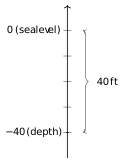
Question: A scuba diver descends \(40\) feet below sea level. Which integer represents this depth?
- A. \(40\) (ignores direction/below sea level)
- B. \(-80\) (double the depth)
- C. \(0\) (at sea level, not below)
- D. \(-40\) (correct; below is negative)
- Descending (going down) below sea level is represented by a negative number.
- A descent of \(40\) feet is \(-40\).
Answer: \(-40\)
Example 3
Question: On a number line, which point represents a number whose absolute value is \(10\)?

- A. Only \(10\)
- B. Only \(-10\)
- C. Both \(10\) and \(-10\)
- D. Only \(0\)
- Two points on a number line have absolute value \(10\): the point \(10\) (ten units right of zero) and \(-10\) (ten units left of zero).
Answer: Both \(10\) and \(-10\)
Real-World Word Problems
Problem 1
Question: A student claims that \(-14 + 14 = 28\). What is the student's error?
- A. They forgot that opposites sum to \(0\)
- B. They should have subtracted instead
- C. The answer is correct
- D. Absolute values were not used
Why it works: The correct answer is \(-14 + 14 = 0\) because \(-14\) and \(14\) are opposites. The student incorrectly added the absolute values.
Answer: They forgot that opposites sum to \(0\)
Problem 2
Question: An error analysis: A student wrote \(|-9| = -9\). What is the correct value, and why is the student wrong?
- A. Correct: \(|-9| = -9\); student is right
- B. Correct: \(|-9| = 18\); doubling the number
- C. Correct: \(|-9| = 0\); distance from zero is zero
- D. Correct: \(|-9| = 9\); absolute value is always non-negative
Why it works: Absolute value represents distance from zero, which is never negative. Since \(-9\) is \(9\) units from zero, \(|-9| = 9\). The student confused the opposite with absolute value.
Answer: Correct: \(|-9| = 9\); absolute value is always non-negative
Common Mistakes
- Rushing before identifying what the numbers represent.
- Choosing an operation that does not match the situation.
- Dropping labels, units, or context from the answer.
- Skipping the estimate or reasonableness check.
Strategy Tips
- Underline the question being asked.
- Use a model before jumping to computation.
- Write an equation that matches the story or picture.
- Explain the final answer in a sentence.
Practice Questions
Question 1
What is the opposite of \(-15\)?
- A. \(15\) (correct)
- B. \(-15\) (no sign change)
- C. \(0\) (neither opposite nor equal)
- D. \(|{-15}|\) (absolute value, not opposite)
Question 2
Marcus walks \(12\) meters east. To return to his starting point, he must walk \(12\) meters west. Which number represents his westward walk?
- A. \(-12\) (opposite direction)
- B. \(12\) (same direction as eastward walk)
- C. \(0\) (no displacement)
- D. \(-24\) (double the distance in opposite direction)
Question 3
A bank account starts with a credit of $50. After a debit of $50, what is the account balance?
- A. \($100\) (adds both amounts instead of subtracting)
- B. \($50\) (ignores the debit)
- C. \(-$50\) (records only the debit)
- D. \($0\) (correct; opposites sum to zero)
Question 4
Temperature drops \(20\) degrees from \(10\) degrees. Express the drop (change) as a signed number.
- A. \(20\) (ignores the direction of change)
- B. \(30\) (adds instead of subtracts)
- C. \(-10\) (starting temperature)
- D. \(-20\) (correct; drop is negative change)
Question 5
A stock loses \(15\) points. Express this as a signed number.
- A. \(-15\) (correct; loss is negative)
- B. \(0\) (no change)
- C. \(15\) (ignores the loss/negative direction)
- D. \(-30\) (double the loss)
Question 6
What is the opposite of \(0\)?
- A. \(-1\)
- B. \(1\)
- C. \(0\)
- D. Undefined
Full Answer Explanations Click to show all answers and explanations
Question 1
Answer: \(15\)
The opposite of a number reverses its sign. The opposite of \(-15\) is \(15\). Note: the absolute value \(|-15| = 15\) looks the same but represents distance, not the additive inverse.
Question 2
Answer: \(-12\)
If east is positive, then west is negative. Walking \(12\) meters west is represented by \(-12\).
Question 3
Answer: \(0\)
The credit of \(+50\) and debit of \(-50\) are opposites and sum to zero. This demonstrates the additive inverse property: \(50 + (-50) = 0\).
Question 4
Answer: \(-20\)
A decrease or drop is represented by a negative number. A \(20\)-degree drop is \(-20\).
Question 5
Answer: \(-15\)
A loss is represented by a negative number. A loss of \(15\) points is \(-15\).
Question 6
Answer: \(0\)
Zero is its own opposite. The opposite of \(0\) is \(0\), since \(0 = -0\).
Connection to Standards
This lesson supports Grade 7 math expectations for reasoning, modeling, problem solving, and explaining answers clearly. It connects classroom skills to the kind of questions students see on state math assessments.
Summary
Integers and Their Opposites becomes easier when students connect the question to a model, use clear steps, and explain why the answer fits.
GOLDEN RULE
Understand the model before choosing the operation.