





Introduction
Reproducing Scale Drawings at a Different Scale is an important Grade 7 math skill because students are moving from simple answers toward explaining how the math works.
In this lesson, students use models, real questions, worked examples, practice problems, and two online quizzes to build confidence with reproducing scale drawings at a different scale.
What Is Reproducing Scale Drawings at a Different Scale?
Reproducing Scale Drawings at a Different Scale means choosing a model, naming what each number means, and explaining the strategy.
The goal is not only to get the answer. Students should be able to show the idea, explain the strategy, and check whether the answer makes sense.
Understanding Reproducing Scale Drawings at a Different Scale
Before solving, students should slow down and decide what each number, shape, unit, or label represents.
- Read the question carefully and identify what is being asked.
- Choose a model, equation, table, or diagram that matches the situation.
- Solve one step at a time and keep units or labels attached.
- Use the answer explanation to check that the result makes sense.
Visual Models
Visual Model 1
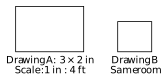
Question: Two drawings of the same rectangular room are shown. If Drawing A uses scale \(1\) in \(:4\) ft and is \(3 \times 2\) in, what is the scale of Drawing B if it shows \(1.5 \times 1\) in?
- A. \(1\) in \(:2\) ft
- B. \(1\) in \(:8\) ft
- C. \(1\) in \(:4\) ft
- D. \(2\) in \(:1\) ft
Why it works: Drawing A: actual room is \(3 \times 4 = 12\) ft by \(2 \times 4 = 8\) ft. Drawing B at \(1.5 \times 1\) in for same room: scale is \(12 \div 1.5 = 8\) ft per inch, or \(1\) in \(:8\) ft.
Answer: \(1\) in \(:8\) ft
Visual Model 2
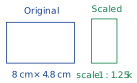
Question: A scale drawing of a rectangular room is \(8\) cm \(\times\) \(4.8\) cm. The drawing is enlarged proportionally so the new dimensions are \(10\) cm \(\times\) \(6\) cm. If the original scale was \(1\) cm \(:5\) m, what is the scale of the enlarged drawing?
- A. \(1\) cm \(:4\) m
- B. \(1\) cm \(:6.25\) m
- C. \(1\) cm \(:3.125\) m
- D. \(1\) cm \(:2.5\) m
Why it works: Zoom ratio: \(10 / 8 = 1.25\). Drawing is enlarged by 1.25 times, so the new scale is \(5 \text{ m} / 1.25 = 4\) m per cm, or \(1\) cm \(:4\) m.
Answer: \(1\) cm \(:4\) m
Worked Examples
Example 1
Question: A rectangle has dimensions \(4\) in by \(6\) in at a scale of \(1\) in \(:2\) ft. If redrawn at a new scale of \(1\) in \(:4\) ft, what are the new dimensions?
- A. \(1\) in by \(1.5\) in
- B. \(2\) in by \(3\) in
- C. \(8\) in by \(12\) in
- D. \(16\) in by \(24\) in
- At scale 1:2, the drawing is \(4 \times 6\) in representing a fixed real object.
- At scale 1:4, the same object is represented differently.
- The ratio of real-world per drawing unit goes from 2 to 4 (doubled), so the drawing must shrink by factor \(4 \div 2 = 2\).
- New dimensions: \(4 \div 2 = 2\) in and \(6 \div 2 = 3\) in.
Answer: \(2\) in by \(3\) in
Example 2
Question: A blueprint shows a room measuring \(3\) cm by \(5\) cm at a scale of \(1\) cm \(:1\) m. What are the actual room dimensions?
- A. \(3\) m by \(5\) m
- B. \(300\) cm by \(500\) cm
- C. \(1\) m by \(1.67\) m
- D. \(6\) m by \(10\) m
- Scale 1 cm : 1 m means 1 cm on the drawing represents 1 m in reality.
- Scale factor is 1 m per cm.
- Multiply each drawing dimension by the scale factor: \(3 \text{ cm} \times 1 \text{ m/cm} = 3\) m and \(5 \text{ cm} \times 1 \text{ m/cm} = 5\) m.
- This foundational skill (single scale) is the basis for comparing two scales in later problems.
Answer: \(3\) m by \(5\) m
Example 3
Question: A scale model of a car is drawn at a scale of \(1\) in \(:5\) ft. If the model is \(8\) inches long, what is the length of the actual car?
- A. \(13\) ft
- B. \(40\) ft
- C. \(45\) ft
- D. \(64\) ft
- Scale 1 in : 5 ft means 1 inch on the model represents 5 feet in reality.
- Scale factor is 5 ft per inch.
- To find actual length, multiply: \(8 \text{ in} \times 5 \text{ ft/in} = 40\) ft.
- The scale factor (5 ft/in) is the key ratio that converts drawing dimensions to real-world dimensions.
Answer: \(40\) ft
Real-World Word Problems
Problem 1
Question: A floor plan shows a rectangular office that is \(2.5\) inches by \(3.5\) inches at a scale of \(1\) in \(:10\) ft. Which pair of measurements are the actual office dimensions?
- A. \(25\) ft by \(35\) ft
- B. \(2.5\) ft by \(3.5\) ft
- C. \(12.5\) ft by \(17.5\) ft
- D. \(20\) ft by \(28\) ft
Why it works: Multiply drawing dimensions by scale factor: \(2.5 \times 10 = 25\) ft and \(3.5 \times 10 = 35\) ft.
Answer: \(25\) ft by \(35\) ft
Problem 2
Question: A scale drawing of a rectangular garden is \(6\) cm long at a scale of \(1\) cm \(:0.5\) m. If the scale is changed to \(1\) cm \(:1\) m, what will be the new length?
- A. \(3\) cm
- B. \(6\) cm
- C. \(12\) cm
- D. \(24\) cm
Why it works: Original scale 1:0.5 means 1 cm = 0.5 m. New scale 1:1 means 1 cm = 1 m. Real-world distance per cm doubled (0.5 to 1), so the drawing shrinks. Scale factor ratio: \(1 \div 0.5 = 2\), so drawing shrinks by factor \(1 \div 2 = 0.5\). New length: \(6 \times 0.5 = 3\) cm (or \(6 \div 2 = 3\) cm).
Answer: \(3\) cm
Common Mistakes
- Rushing before identifying what the numbers represent.
- Choosing an operation that does not match the situation.
- Dropping labels, units, or context from the answer.
- Skipping the estimate or reasonableness check.
Strategy Tips
- Underline the question being asked.
- Use a model before jumping to computation.
- Write an equation that matches the story or picture.
- Explain the final answer in a sentence.
Practice Questions
Question 1
A rectangle on a map has length \(7\) cm and width \(4\) cm. The map scale is \(1\) cm \(:2\) km. When the map is enlarged so that the new scale becomes \(1\) cm \(:1\) km, what are the new dimensions?
- A. \(7\) cm by \(4\) cm
- B. \(14\) cm by \(8\) cm
- C. \(3.5\) cm by \(2\) cm
- D. \(3\) cm by \(2\) cm
Question 2
A blueprint of a house wing shows a rectangular area \(5\) cm by \(7\) cm at scale \(1\) cm \(:3\) m. A new blueprint is drawn at scale \(1\) cm \(:6\) m. What are the dimensions on the new blueprint?
- A. \(2.5\) cm by \(3.5\) cm
- B. \(5\) cm by \(7\) cm
- C. \(10\) cm by \(14\) cm
- D. \(15\) cm by \(21\) cm
Question 3
A scale model of a rectangular stage is \(10\) cm wide. The scale is \(1\) cm \(:0.4\) m. How many meters wide is the actual stage?
- A. \(0.4\) m
- B. \(2.5\) m
- C. \(4\) m
- D. \(40\) m
Question 4
A landscape drawing shows a rectangular flower bed \(8\) inches by \(12\) inches at scale \(1\) in \(:2\) ft. What are the dimensions of the actual flower bed?
- A. \(2\) ft by \(3\) ft
- B. \(4\) ft by \(6\) ft
- C. \(16\) ft by \(24\) ft
- D. \(32\) ft by \(48\) ft
Question 5
A rectangular pool on a site plan is \(4\) cm by \(6\) cm at scale \(1\) cm \(:5\) m. When enlarged to scale \(1\) cm \(:2.5\) m, what will be the new dimensions?
- A. \(2\) cm by \(3\) cm
- B. \(4\) cm by \(6\) cm
- C. \(8\) cm by \(12\) cm
- D. \(20\) cm by \(30\) cm
Question 6
A school gymnasium is drawn at \(9\) cm by \(15\) cm on a blueprint with scale \(1\) cm \(:4\) m. The drawing is redone at scale \(1\) cm \(:2\) m. How many centimeters long is the gym on the new blueprint?
- A. \(7.5\) cm
- B. \(15\) cm
- C. \(30\) cm
- D. \(60\) cm
Full Answer Explanations Click to show all answers and explanations
Question 1
Answer: \(14\) cm by \(8\) cm
Original scale 1:2 means 1 cm = 2 km. New scale 1:1 means 1 cm = 1 km. The real-world distance per cm is halved, so the drawing must double in size. Scale factor ratio: \(1 \div 2 = 0.5\), reciprocal shrink \(= 2\). New dimensions: \(7 \times 2 = 14\) cm and \(4 \times 2 = 8\) cm.
Question 2
Answer: \(2.5\) cm by \(3.5\) cm
Original scale 1:3 means 1 cm = 3 m. New scale 1:6 means 1 cm = 6 m. Real-world distance per cm doubled (3 to 6), so drawing shrinks by factor \(3 \div 6 = 0.5\) (or multiply by reciprocal 6 ÷ 3 = 2, then invert: 1/2). New dimensions: \(5 \div 2 = 2.5\) cm and \(7 \div 2 = 3.5\) cm.
Question 3
Answer: \(4\) m
Multiply drawing width by scale factor: \(10 \text{ cm} \times 0.4 \text{ m/cm} = 4\) m.
Question 4
Answer: \(16\) ft by \(24\) ft
Multiply by scale factor: \(8 \text{ in} \times 2 \text{ ft/in} = 16\) ft and \(12 \times 2 = 24\) ft.
Question 5
Answer: \(8\) cm by \(12\) cm
Original scale 1:5 means 1 cm = 5 m. New scale 1:2.5 means 1 cm = 2.5 m. Real-world distance per cm halved (5 to 2.5), so drawing expands. Scale factor ratio: \(2.5 \div 5 = 0.5\), so drawing dimension ratio = \(1 \div 0.5 = 2\). New dimensions: \(4 \times 2 = 8\) cm and \(6 \times 2 = 12\) cm.
Question 6
Answer: \(30\) cm
Halving the real scale (4 m to 2 m) doubles the drawing: \(15 \times 2 = 30\) cm.
Connection to Standards
This lesson supports Grade 7 math expectations for reasoning, modeling, problem solving, and explaining answers clearly. It connects classroom skills to the kind of questions students see on state math assessments.
Summary
Reproducing Scale Drawings at a Different Scale becomes easier when students connect the question to a model, use clear steps, and explain why the answer fits.
GOLDEN RULE
Understand the model before choosing the operation.