




Introduction
Simulating Compound Events is an important Grade 7 math skill because students are moving from simple answers toward explaining how the math works.
In this lesson, students use models, real questions, worked examples, practice problems, and two online quizzes to build confidence with simulating compound events.
What Is Simulating Compound Events?
Simulating Compound Events means choosing a model, naming what each number means, and explaining the strategy.
The goal is not only to get the answer. Students should be able to show the idea, explain the strategy, and check whether the answer makes sense.
Understanding Simulating Compound Events
Before solving, students should slow down and decide what each number, shape, unit, or label represents.
- Read the question carefully and identify what is being asked.
- Choose a model, equation, table, or diagram that matches the situation.
- Solve one step at a time and keep units or labels attached.
- Use the answer explanation to check that the result makes sense.
Visual Models
Visual Model 1
Question: A die is rolled \(150\) times. The results are shown in the table below. Which outcome has the highest estimated probability based on this simulation?
| Outcome | 1 | 2 | 3 | 4 | 5 | 6 |
|---|---|---|---|---|---|---|
| Frequency | 20 | 18 | 25 | 28 | 31 | 28 |
- A. \(2\)
- B. \(4\)
- C. \(5\)
- D. \(6\)
Why it works: Outcome \(5\) has the highest frequency (\(31\) out of \(150\)), so \(P(5) \approx \frac{31}{150} \approx 0.207\).
Answer: \(5\)
Visual Model 2
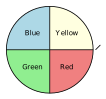
Question: The spinner above has \(4\) equal sections. If it is spun \(80\) times and the results are recorded, approximately how many times would you expect to see the blue section?
- A. \(10\) times
- B. \(15\) times
- C. \(20\) times
- D. \(25\) times
Why it works: Each section has probability \(\frac{1}{4}\). Expected frequency \(= \frac{1}{4} \times 80 = 20\).
Answer: \(20\) times
Worked Examples
Example 1
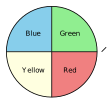
Question: The spinner above has \(4\) equal sections. In a simulation with \(160\) spins, the number of times each section appears is: Blue \(52\), Yellow \(38\), Red \(41\), Green \(29\). Which section has an estimated probability closest to its theoretical probability?
- A. Blue
- B. Yellow
- C. Red
- D. Green
- Theoretical probability for each = \(0.25\).
- Blue: \(\frac{52}{160} = 0.325\).
- Yellow: \(\frac{38}{160} = 0.238\).
- Red: \(\frac{41}{160} = 0.256\).
Answer: Red
Example 2
Question: A spinner with sections A and B is spun twice. What is the total number of outcomes in the sample space?

- A. \(2\)
- B. \(3\)
- C. \(4\)
- D. \(8\)
- First spin: \(2\) outcomes (A or B).
- Second spin: \(2\) outcomes.
- Total: \(2 \times 2 = 4\) outcomes (AA, AB, BA, BB).
Answer: \(4\)
Example 3
Question: A coin is flipped \(300\) times. Based on the simulation, what is the estimated probability of getting tails?
| Spin Result | Heads | Tails | Total |
|---|---|---|---|
| Frequency | 156 | 144 | 300 |
- A. \(0.44\)
- B. \(0.48\)
- C. \(0.50\)
- D. \(0.52\)
- Relative frequency \(= \frac{144}{300} = 0.48\).
Answer: \(0.48\)
Real-World Word Problems
Problem 1
Question: Which simulation tool best models the probability of selecting a red marble or a blue marble from a bag with equal numbers of red and blue marbles?
- A. Rolling a standard die once
- B. Flipping a coin
- C. Spinning a spinner with \(10\) equal sections
- D. Drawing two cards from a deck without replacing the first
Why it works: Two equally likely outcomes (red or blue, heads or tails) match perfectly.
Answer: Flipping a coin
Problem 2
Question: A bag contains \(3\) red marbles, \(2\) blue marbles, and \(5\) green marbles. To simulate drawing one marble, which probability does rolling a standard die best represent?
- A. Probability of drawing red
- B. Probability of drawing blue
- C. Probability of drawing green
- D. Probability of drawing blue or green
Why it works: There are \(5\) green marbles out of \(10\) total, giving probability \(\frac{5}{10} = \frac{1}{2}\). Rolling \(1\)--\(3\) on a die simulates this (or rolling odd/even).
Answer: Probability of drawing green
Common Mistakes
- Rushing before identifying what the numbers represent.
- Choosing an operation that does not match the situation.
- Dropping labels, units, or context from the answer.
- Skipping the estimate or reasonableness check.
Strategy Tips
- Underline the question being asked.
- Use a model before jumping to computation.
- Write an equation that matches the story or picture.
- Explain the final answer in a sentence.
Practice Questions
Question 1
To simulate the probability of guessing a true/false question correctly \(3\) times in a row, which tool best models this compound event?
- A. Rolling a six-sided die once
- B. Flipping a coin \(3\) times
- C. Spinning a spinner with \(3\) equal sections once
- D. Drawing a card from a deck of \(52\) once
Question 2
A spinner has \(6\) equal sections. To simulate rolling a standard die once, how many trials are needed if we spin once per trial?
- A. \(1\) trial
- B. \(2\) trials
- C. \(6\) trials
- D. \(36\) trials
Question 3
To simulate drawing a card from a standard deck and finding whether it is a heart (probability \(\frac{1}{4}\)), which spinner design is best?
- A. Spinner with \(2\) equal sections (one shaded, one not)
- B. Spinner with \(4\) equal sections (one shaded, three not)
- C. Spinner with \(6\) equal sections (two shaded, four not)
- D. Spinner with \(13\) equal sections (one shaded, twelve not)
Question 4
A spinner with \(4\) equal sections (Red, Blue, Green, Yellow) is spun twice to simulate a compound event. If "success" is defined as "the first spin is Red and the second spin is Blue," how many outcomes in the sample space represent a success?
- A. \(1\)
- B. \(2\)
- C. \(4\)
- D. \(8\)
Question 5
Two fair dice are rolled as a simulation of a compound event. If "success" is rolling a sum of \(7\), which of the following correctly identifies all successful outcomes?
- A. \((1,7), (2,7), (3,7), (4,7), (5,7), (6,7)\) — six outcomes
- B. \((1,6), (2,5), (3,4), (4,3), (5,2), (6,1)\) — six outcomes
- C. \((1,6), (2,5), (3,4)\) — three outcomes
- D. Any roll where one die shows \(7\) — multiple outcomes
Question 6
A spinner is spun \(60\) times, and section A appears \(18\) times. What is the experimental probability of landing on section A?
- A. \(0.20\)
- B. \(0.25\)
- C. \(0.30\)
- D. \(0.35\)
Full Answer Explanations Click to show all answers and explanations
Question 1
Answer: Flipping a coin \(3\) times
Each true/false question has \(2\) equally likely outcomes (like a coin). The compound event is three consecutive guesses, so three flips simulate this.
Question 2
Answer: \(1\) trial
A spinner with \(6\) equal sections directly models one roll of a die (one outcome per spin).
Question 3
Answer: Spinner with \(4\) equal sections (one shaded, three not)
Probability \(\frac{1}{4}\) means \(1\) favorable outcome out of \(4\) equally likely ones.
Question 4
Answer: \(1\)
The sample space has \(4 \times 4 = 16\) equally likely outcomes. Only one outcome satisfies the condition: "first spin Red, second spin Blue."
Question 5
Answer: \((1,6), (2,5), (3,4), (4,3), (5,2), (6,1)\) — six outcomes
Each standard die shows \(1\)--\(6\), so \((1,7)\) is impossible. To get a sum of \(7\), identify all pairs \((a, b)\) where \(a + b = 7\) and \(1 \leq a, b \leq 6\). These are the six outcomes listed. The probability is thus \(\frac{6}{36} = \frac{1}{6}\).
Question 6
Answer: \(0.30\)
Relative frequency \(= \frac{18}{60} = 0.30\).
Connection to Standards
This lesson supports Grade 7 math expectations for reasoning, modeling, problem solving, and explaining answers clearly. It connects classroom skills to the kind of questions students see on state math assessments.
Summary
Simulating Compound Events becomes easier when students connect the question to a model, use clear steps, and explain why the answer fits.
GOLDEN RULE
Understand the model before choosing the operation.