






Introduction
Solving Real-World Problems with Rational Numbers is an important Grade 7 math skill because students are moving from simple answers toward explaining how the math works.
In this lesson, students use models, real questions, worked examples, practice problems, and two online quizzes to build confidence with solving real-world problems with rational numbers.
What Is Solving Real-World Problems with Rational Numbers?
Solving Real-World Problems with Rational Numbers means using place value, operations, and equations to reason accurately with numbers.
The goal is not only to get the answer. Students should be able to show the idea, explain the strategy, and check whether the answer makes sense.
Understanding Solving Real-World Problems with Rational Numbers
Before solving, students should slow down and decide what each number, shape, unit, or label represents.
- Read the question carefully and identify what is being asked.
- Choose a model, equation, table, or diagram that matches the situation.
- Solve one step at a time and keep units or labels attached.
- Use the answer explanation to check that the result makes sense.
Visual Models
Visual Model 1
Question: Based on the pattern, what is the temperature change after 5 hours?
| Time (hours) | Temperature change (\(\degree\)F) |
|---|---|
| 1 | \(-1.5\) |
| 2 | \(-3.0\) |
| 3 | \(-4.5\) |
- A. -6.0°F
- B. -7.5°F
- C. 7.5°F
- D. -13.5°F
Why it works: Change per hour is -1.5°F. After \(5\) hours: \(-1.5 \times 5 = -7.5°\)F.
Answer: -7.5°F
Visual Model 2
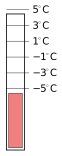
Question: The thermometer shows the current temperature. If the temperature drops 2°C, what will the new temperature be?
- A. -7°C
- B. -5°C
- C. -3°C
- D. 3°C
Why it works: Current temp (at mercury level) is -1°C. Drop of 2°C: \(-1 - 2 = -3°\)C.
Answer: -3°C
Worked Examples
Example 1
Question: A student gets all quizzes correct (\(3\) quizzes), completes all homework (\(6\) assignments), and submits \(2\) late assignments. What is the total point change?
| Activity | Point change |
|---|---|
| Quiz | \(+5\) |
| Homework | \(+2\) |
| Late work | \(-1\) |
- A. \(+25\)
- B. \(+27\)
- C. \(+29\)
- D. \(+15\)
- Quizzes: \(3\times(+5)=+15\).
- Homework: \(6\times(+2)=+12\).
- Late work: \(2\times(-1)=-2\).
- Total: \(15+12+(-2)=+25\) points.
Answer: \(+25\)
Example 2
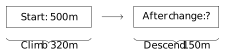
Question: A climber starts at \(500\) m elevation, climbs \(320\) m, then descends \(150\) m. What is the final elevation?
- A. \(150\) m
- B. \(320\) m
- C. \(670\) m
- D. \(970\) m
- Start \(500\) m, climb \(320\) m: \(500 + 320 = 820\) m.
- Descend \(150\) m: \(820 - 150 = 670\) meters.
Answer: \(670\) m
Example 3
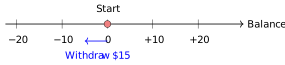
Question: A bank account has a balance of $0 (neutral). If a withdrawal of $15 is made, what is the new balance?
- A. \(-$15\)
- B. \(+$15\)
- C. \($0\)
- D. \(-$30\)
- A withdrawal decreases the balance.
- From $0, withdrawing $15 gives \(0 - 15 = -15\) dollars.
Answer: \(-$15\)
Real-World Word Problems
Problem 1
Question: The temperature dropped 2.5°F each hour for \(4\) hours. What was the total change in temperature?
- A. -10°F
- B. -6.5°F
- C. 6.5°F
- D. 10°F
Why it works: A drop of 2.5°F is \(-2.5\). Over \(4\) hours: \(4\times(-2.5)=-10°\)F.
Answer: -10°F
Problem 2
Question: A diver descends \(3.5\) meters below sea level each minute. After \(6\) minutes, what is the diver's depth relative to sea level?
- A. \(-21\) m
- B. \(-10.5\) m
- C. \(10.5\) m
- D. \(21\) m
Why it works: Each descent of \(3.5\) m is negative: \(-3.5 \times 6 = -21\) m.
Answer: \(-21\) m
Common Mistakes
- Rushing before identifying what the numbers represent.
- Choosing an operation that does not match the situation.
- Dropping labels, units, or context from the answer.
- Skipping the estimate or reasonableness check.
Strategy Tips
- Underline the question being asked.
- Use a model before jumping to computation.
- Write an equation that matches the story or picture.
- Explain the final answer in a sentence.
Practice Questions
Question 1
Maria has a bank account balance of \($145.50\). She withdraws \($28.75\), then deposits \($52.25\). What is her new balance?
- A. \($116.75\)
- B. \($118.75\)
- C. \($169.00\)
- D. \($226.50\)
Question 2
A football team loses \(7\) yards on one play and gains \(13\) yards on the next. What is the net change in yards?
- A. \(-20\) yards
- B. \(-6\) yards
- C. \(6\) yards
- D. \(20\) yards
Question 3
A recipe calls for \(\frac{3}{4}\) cup of sugar. If you are making \(\frac{1}{2}\) of the recipe, how much sugar do you need?
- A. \(\frac{3}{8}\) cup
- B. \(\frac{1}{2}\) cup
- C. \(\frac{5}{4}\) cups
- D. \(1\frac{1}{2}\) cups
Question 4
The temperature at 6 AM was -8°C. It rose by 3.5°C by 9 AM. What was the temperature at 9 AM?
- A. -11.5°C
- B. -4.5°C
- C. 4.5°C
- D. 11.5°C
Question 5
An elevator starts at the 5th floor, goes down 8 floors, then up 6 floors. On which floor does it end?
- A. Floor \(-3\)
- B. Floor \(1\)
- C. Floor \(3\)
- D. Floor \(19\)
Question 6
A store gives a discount of \(\frac{1}{5}\) off the original price of \($60\). How much does the item cost after the discount?
- A. \($12\)
- B. \($36\)
- C. \($48\)
- D. \($72\)
Full Answer Explanations Click to show all answers and explanations
Question 1
Answer: \($169.00\)
\(145.50 - 28.75 + 52.25 = 116.75 + 52.25 = 169.00\) dollars.
Question 2
Answer: \(6\) yards
Loss of \(7\) yards is \(-7\); gain of \(13\) is \(+13\): \(-7 + 13 = 6\) yards.
Question 3
Answer: \(\frac{3}{8}\) cup
Multiply: \(\frac{3}{4} \times \frac{1}{2} = \frac{3}{8}\) cup.
Question 4
Answer: -4.5°C
\(-8 + 3.5 = -4.5°\)C.
Question 5
Answer: Floor \(3\)
Start at 5, go down 8: \(5 - 8 = -3\) (basement). Then up 6: \(-3 + 6 = 3\).
Question 6
Answer: \($48\)
Discount: \(\frac{1}{5} \times 60 = 12\). Price: \(60 - 12 = 48\) dollars.
Connection to Standards
This lesson supports Grade 7 math expectations for reasoning, modeling, problem solving, and explaining answers clearly. It connects classroom skills to the kind of questions students see on state math assessments.
Summary
Solving Real-World Problems with Rational Numbers becomes easier when students connect the question to a model, use clear steps, and explain why the answer fits.
GOLDEN RULE
Understand the model before choosing the operation.