





Introduction
Transformations on the Coordinate Plane is an important Grade 7 math skill because students are moving from simple answers toward explaining how the math works.
In this lesson, students use models, real questions, worked examples, practice problems, and two online quizzes to build confidence with transformations on the coordinate plane.
What Is Transformations on the Coordinate Plane?
Transformations on the Coordinate Plane means choosing a model, naming what each number means, and explaining the strategy.
The goal is not only to get the answer. Students should be able to show the idea, explain the strategy, and check whether the answer makes sense.
Understanding Transformations on the Coordinate Plane
Before solving, students should slow down and decide what each number, shape, unit, or label represents.
- Read the question carefully and identify what is being asked.
- Choose a model, equation, table, or diagram that matches the situation.
- Solve one step at a time and keep units or labels attached.
- Use the answer explanation to check that the result makes sense.
Visual Models
Visual Model 1
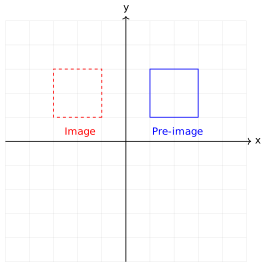
Question: Which transformation maps the blue figure (pre-image) to the red figure (image)?
- A. Translation by \((-2, 0)\)
- B. Reflection over the \(y\)-axis
- C. Rotation of 90° counterclockwise
- D. Reflection over the \(x\)-axis
Why it works: The blue square at \(x\in[1,3]\) maps to the red square at \(x\in[-3,-1]\). This is a reflection over the \(y\)-axis.
Answer: Reflection over the \(y\)-axis
Visual Model 2
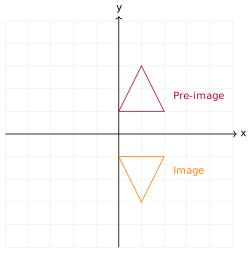
Question: Which transformation maps the purple triangle to the orange triangle?
- A. Reflection over the \(x\)-axis
- B. Reflection over the \(y\)-axis
- C. Translation by \((0, -2)\)
- D. Rotation of 90° clockwise
Why it works: The purple triangle vertices have \(y\)-values \(1, 1, 3\), which become \(-1, -1, -3\) in the orange triangle, indicating a reflection over the \(x\)-axis.
Answer: Reflection over the \(x\)-axis
Worked Examples
Example 1
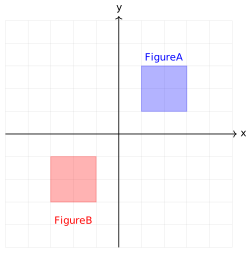
Question: What transformation maps Figure A to Figure B?
- A. Translation by \((-4, -4)\)
- B. Rotation of 180° about the origin
- C. Reflection over the line \(y=-x\)
- D. Rotation of 90° counterclockwise
- A 180° rotation about the origin uses the rule \((x, y)\to(-x, -y)\), negating both coordinates.
- The center \((2,2)\) of Figure A maps to \((-2, -2)\), the center of Figure B.
- This confirms the 180° rotation.
Answer: Rotation of 180° about the origin
Example 2
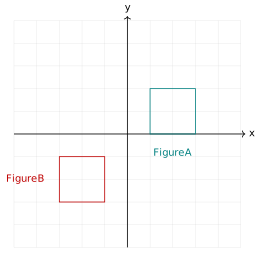
Question: Figure A is transformed to Figure B by a single transformation. What is the transformation?
- A. Translation by \((-4, -2)\)
- B. Rotation of 180° about the origin
- C. Reflection over the line \(y=-x\)
- D. Reflection over the line \(y=x\)
- A 180° rotation about the origin maps \((x, y)\to(-x, -y)\).
- The vertex \((1, 0)\) of Figure A should map to \((-1, 0)\); however, Figure B's location suggests a different structure.
- Visual inspection confirms the 180° rotation: Figure A (upper right) maps to Figure B (lower left), which is the expected behavior of a 180° rotation about the origin.
Answer: Rotation of 180° about the origin
Example 3
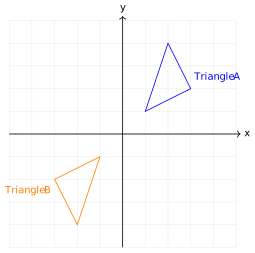
Question: Triangle A is transformed to create Triangle B. What transformation was applied?
- A. Rotation of 180°
- B. Reflection over the \(y\)-axis
- C. Translation by \((-2, -3)\)
- D. Reflection over the line \(y=x\)
- A 180° rotation maps \((1, 1)\to(-1, -1)\), \((3, 2)\to(-3, -2)\), and \((2, 4)\to(-2, -4)\), matching Triangle B.
Answer: Rotation of 180°
Real-World Word Problems
Problem 1
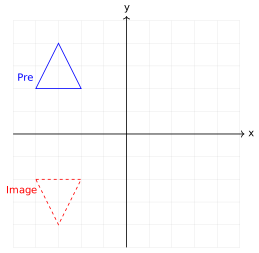
Question: The blue triangle (pre-image) is transformed to the red triangle (image). Which error was made if the student reflected over the \(y\)-axis instead of the \(x\)-axis?
- A. They negated the \(x\)-coordinate only
- B. They negated both coordinates
- C. They should negate the \(y\)-coordinate only
- D. They added instead of subtracting
Why it works: The correct reflection over the \(x\)-axis maps \((x, y)\to(x, -y)\). The image shown negates both, indicating the student confused the axis.
Answer: They should negate the \(y\)-coordinate only
Problem 2
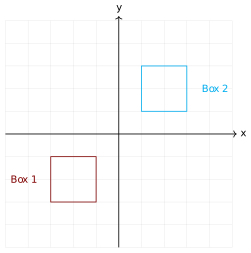
Question: Box 1 is transformed to Box 2. A student claims this is a reflection over the line \(y=x\). Is the student correct? Why or why not?
- A. Yes; the coordinates are swapped
- B. No; this is a 180° rotation plus translation
- C. Yes; dimensions are preserved
- D. No; reflection over \(y=x\) would map \((-3,-3)\) to \((-3,-3)\), not \((1,1)\)
Why it works: Reflecting \((-3, -3)\) over \(y=x\) gives \((-3, -3)\) (it's on the line). Since Box 2 is at \((1, 1)\) to \((3, 3)\), the transformation is a 180° rotation, not a reflection over \(y=x\).
Answer: No; reflection over \(y=x\) would map \((-3,-3)\) to \((-3,-3)\), not \((1,1)\)
Common Mistakes
- Rushing before identifying what the numbers represent.
- Choosing an operation that does not match the situation.
- Dropping labels, units, or context from the answer.
- Skipping the estimate or reasonableness check.
Strategy Tips
- Underline the question being asked.
- Use a model before jumping to computation.
- Write an equation that matches the story or picture.
- Explain the final answer in a sentence.
Practice Questions
Question 1
Point \(P(4,-3)\) is reflected over the \(x\)-axis. What are the coordinates of the image \(P'\)?
- A. \((-4,-3)\)
- B. \((-4,3)\)
- C. \((4,3)\)
- D. \((4,-3)\)
Question 2
Which transformation moves the point \(Q(-5, 2)\) to \(Q'(5, 2)\)?
- A. Translation by \((5, 0)\)
- B. Reflection over the \(y\)-axis
- C. Reflection over the \(x\)-axis
- D. Rotation of 180° about the origin
Question 3
A triangle with vertices at \(A(1,1)\), \(B(3,1)\), and \(C(2,3)\) is translated by the vector \((2, -4)\). What is the image of vertex \(B\) after this translation?
- A. \((5,-3)\)
- B. \((3,-4)\)
- C. \((1,3)\)
- D. \((6,0)\)
Question 4
Point \(R(2, 5)\) is reflected over the line \(y=x\). What are the new coordinates?
- A. \((5, 2)\)
- B. \((-2, -5)\)
- C. \((2, -5)\)
- D. \((-5, -2)\)
Question 5
Which of the following is an example of a rigid transformation (one that preserves distance and angles)?
- A. Reflection over the \(x\)-axis
- B. Dilation by a factor of 2
- C. Rotation of 45°
- D. Shearing the figure
Question 6
A quadrilateral \(ABCD\) has vertices \(A(0,0)\), \(B(4,0)\), \(C(4,3)\), and \(D(0,3)\). If the quadrilateral is translated by \((-2, 1)\), which of the following is the new location of vertex \(C\)?
- A. \((2, 4)\)
- B. \((2, 2)\)
- C. \((6, 2)\)
- D. \((4, 3)\)
Full Answer Explanations Click to show all answers and explanations
Question 1
Answer: \((4,3)\)
A reflection over the \(x\)-axis flips the sign of the \(y\)-coordinate: \((4,-3)\to(4,3)\).
Question 2
Answer: Reflection over the \(y\)-axis
Reflection over the \(y\)-axis uses the rule \((x, y)\to(-x, y)\). The \(x\)-coordinate changes sign; the \(y\)-coordinate stays the same. So \((-5, 2)\to(5, 2)\). Check: (A) Translation by \((5, 0)\) gives \((-5+5, 2)=(0, 2)\), not \((5, 2)\). (C) Reflection over \(x\)-axis gives \((-5, -2)\). (D) 180° rotation gives \((5, -2)\).
Question 3
Answer: \((5,-3)\)
A translation by \((2, -4)\) adds the vector to each point: \((3, 1)+(2, -4)=(5, -3)\).
Question 4
Answer: \((5, 2)\)
Reflection over \(y=x\) uses the rule \((x, y)\to(y, x)\), swapping the coordinates: \((2, 5)\to(5, 2)\).
Question 5
Answer: Reflection over the \(x\)-axis
A rigid transformation preserves all distances and angles. Reflection, rotation, and translation are rigid. Dilation (option B) and shearing (option D) change size or shape, so they are not rigid.
Question 6
Answer: \((2, 4)\)
Applying the translation vector to \(C(4, 3)\): \((4, 3)+(-2, 1)=(2, 4)\).
Connection to Standards
This lesson supports Grade 7 math expectations for reasoning, modeling, problem solving, and explaining answers clearly. It connects classroom skills to the kind of questions students see on state math assessments.
Summary
Transformations on the Coordinate Plane becomes easier when students connect the question to a model, use clear steps, and explain why the answer fits.
GOLDEN RULE
Understand the model before choosing the operation.